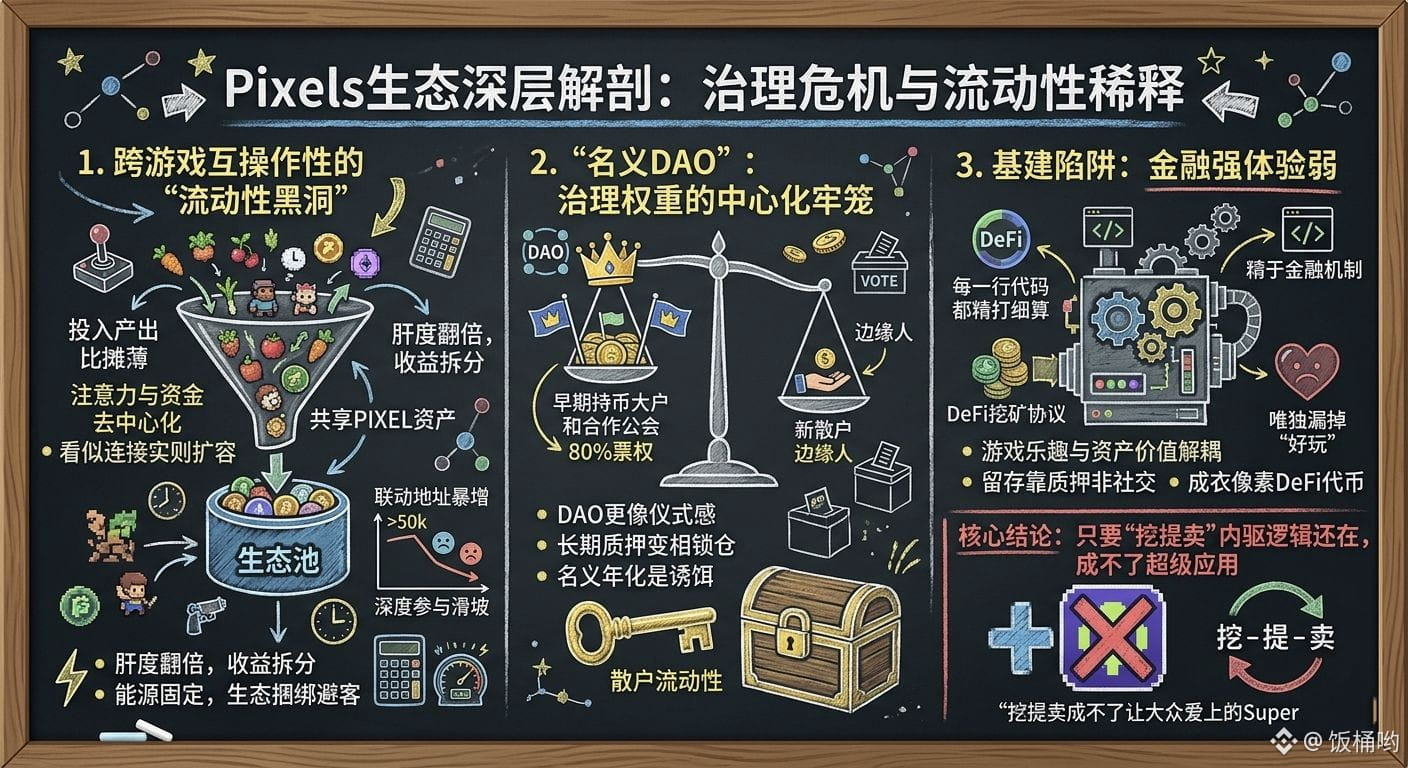
There's a phenomenon I've been watching for a while before I dared to define it: the cross-game interoperability of @Pixels is actually evolving into a liquidity dilution disaster. The official narrative keeps pushing that multiple games can share PIXEL assets, but in reality, this cross-game asset hopping is causing serious decentralization of attention and funds. The assets you stake in Pixels might just be a numeric scoreboard in another game, lacking any substantial value-adding capabilities. It’s like putting your funds into an ever-expanding pool where returns are diluted; it looks like it’s connecting the ecosystem, but in reality, it’s just diluting the individual player’s ROI.
The basis for this judgment comes from the multi-game interaction data after February 2026. Although the officials claim that cross-game interaction addresses have surpassed 50,000, the user activity of those deeply engaged in more than two games is consistently declining. The reason is simple: the grind doubles, but the rewards are split. If you want to juggle multiple games within the ecosystem, your energy cost skyrockets, while the total reward pool remains fixed. This kind of ecosystem bundling is driving away core players who want to focus on experiencing a single product.
Now let's look at governance weight. The governance voting from early 2026 with $PIXEL showed that despite a large number of participants, 80% of the voting power is still held by early large holders and partner guilds. The community's so-called DAO governance feels more like a ritual. New players, even if holding hundreds or thousands of PIXEL, are still absolute outsiders when it comes to decisions involving ecosystem reward adjustments. When the project team starts emphasizing long-term staking, it’s essentially locking in retail liquidity, using nominal annual yields as bait, turning players into liquidity providers who maintain the price floor. #pixel
My conclusion is straightforward: Pixels is stepping into a typical infrastructure trap. It's too strong in financial mechanism design but too weak in user entertainment experience. It has turned gaming into a financial engineering playground, where every line of code is meticulously calculated, yet it completely misses the fun factor. When asset value is fully decoupled from the core enjoyment of the game, and retention relies solely on staking rewards instead of social achievements, it’s no longer a game; it’s a DeFi mining protocol dressed in pixel clothing. As long as the intrinsic logic of mining and selling is in play, it will never become that Web3 super application that people truly love.
The basis for this judgment comes from the multi-game interaction data after February 2026. Although the officials claim that cross-game interaction addresses have surpassed 50,000, the user activity of those deeply engaged in more than two games is consistently declining. The reason is simple: the grind doubles, but the rewards are split. If you want to juggle multiple games within the ecosystem, your energy cost skyrockets, while the total reward pool remains fixed. This kind of ecosystem bundling is driving away core players who want to focus on experiencing a single product.
Now let's look at governance weight. The governance voting from early 2026 with $PIXEL showed that despite a large number of participants, 80% of the voting power is still held by early large holders and partner guilds. The community's so-called DAO governance feels more like a ritual. New players, even if holding hundreds or thousands of PIXEL, are still absolute outsiders when it comes to decisions involving ecosystem reward adjustments. When the project team starts emphasizing long-term staking, it’s essentially locking in retail liquidity, using nominal annual yields as bait, turning players into liquidity providers who maintain the price floor. #pixel
My conclusion is straightforward: Pixels is stepping into a typical infrastructure trap. It's too strong in financial mechanism design but too weak in user entertainment experience. It has turned gaming into a financial engineering playground, where every line of code is meticulously calculated, yet it completely misses the fun factor. When asset value is fully decoupled from the core enjoyment of the game, and retention relies solely on staking rewards instead of social achievements, it’s no longer a game; it’s a DeFi mining protocol dressed in pixel clothing. As long as the intrinsic logic of mining and selling is in play, it will never become that Web3 super application that people truly love.