

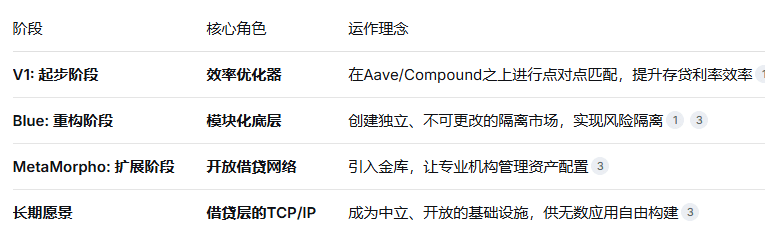
Morpho's story in the DeFi world is a remarkable tale of 'rebellious growth.' It chose not to compete head-on with giants Aave and Compound but cleverly followed a unique path of 'optimize-reconstruct-open.' The table below can help you quickly grasp its evolutionary context and core characteristics.
🔥 Rising with the trend: Highlighting value from market fluctuations
In recent market fluctuations, Morpho's unique design philosophy has been put to the test. Its modular market and risk isolation mechanism are like the watertight compartments of an aircraft carrier; even if a particular market (such as a specific algorithmic stablecoin lending pool) suffers from severe price fluctuations, the losses will be strictly contained within that market and will not trigger a systemic collapse.
This robustness has also won the favor of large institutions. Recently, the Stable blockchain, supported by Bitfinex, deposited up to $775 million into the Morpho protocol, which is being managed by the professional risk management firm Gauntlet through a treasury. This is not only a vote of confidence in the Morpho technical model but also signifies a solid step forward in building institutional-grade financial infrastructure.
🧩 Core Puzzle: A Distinctive Design Philosophy
The long-term potential of Morpho is rooted in its several disruptive design philosophies:
Risk-Isolated 'LEGO Blocks': The core of Morpho Blue is 'modular.' Each lending market, when created, has its parameters such as collateral and liquidation thresholds locked by code, making them unchangeable. This is like giving each market a robust shell, with risks encapsulated within. Historically, even when a market lost $230,000 due to oracle misconfiguration, it did not affect other markets at all.
From 'Using Liquidity' to 'Becoming Liquidity': Morpho is no longer just another lending application; it aims to become a foundational layer like the internet's TCP/IP protocol. It does not compete with the application layer for users but provides a neutral platform for institutions like Coinbase and Gauntlet to build their own financial products. This positioning gives it powerful network effects—the more integrated protocols it has, the greater its value as infrastructure.
Declare Your 'Intent': In Morpho V2, users are no longer passively accepting a unified interest rate curve but can 'declare' their lending intentions like in an order book exchange. This directly returns the power of interest rate discovery to the market, greatly enhancing the efficiency of capital pricing, which is particularly attractive to professional institutions.
🗺️ Future Landscape: Becoming an Invisible Financial Foundation
Looking ahead, the path of Morpho is already clear:
Unlocking Real-World Assets (RWA): Morpho is becoming a hub for tokenizing real-world assets (such as government bonds and private credit) into DeFi. Users can use these income-generating assets as collateral to borrow stablecoins, thereby revitalizing existing assets and creating new yield strategies.
Cross-Chain Lending Layer: As it expands into multiple chains, Morpho is expected to become a unified lending layer that connects liquidity across different blockchains, allowing users to seamlessly conduct lending operations across multiple chains.
The Popularization of 'Intent': Intent-based architecture could reshape the way users interact with DeFi, shifting from complex active operations to a simpler 'declare goals, execute automatically.'
The story of Morpho teaches us that true innovation is not always a loud revolution. It starts with a seemingly simple question: 'How can we make existing systems more efficient?' and then, through solid engineering thinking, gradually builds a more robust, open, and vibrant new financial foundation. It may not always be in the spotlight, but like the TCP/IP protocol that supports the operation of the internet, it hopes to become a powerful heart that is ubiquitous yet 'invisible' in the future on-chain financial world.