




Last night, the Federal Reserve finally cut interest rates by 25 basis points as expected. More importantly, it announced that it will end the balance sheet reduction on December 1.
Once the news broke, the crypto market did not rise as expected; instead, it experienced a slight decline. (Supplementary reading (BTC drops below 11 million: Where did the market's confidence go?))
In contrast, the U.S. stock market experienced a sharp rise, with Nvidia's market value, which had just boosted investor confidence at the GTC Autumn Conference, surpassing $5 trillion, setting a global historical record. Given the previous news that 'the Shanghai Composite Index has returned to 4000 points after 10 years', it's no wonder some people exclaimed, 'Brothers, we can't hold on anymore. Let's go play in the U.S. stock market, Hong Kong stocks, and A-shares.'
From the current market situation, our most direct feeling is: if this continues, there will hardly be anyone left to trade cryptocurrencies. It is no exaggeration to say that the crypto market is facing a new round of 'industry crisis,' and the biggest difference this time compared to previous crises is that it is caught between internal troubles and external threats—industry innovation is lacking, sector bubbles are accelerating, large funds are taking over the pricing power of mainstream coins, ordinary people's past accumulated strategies are becoming ineffective, and the experienced 'veterans' are weakening, leading to a world where 'only insiders make a fortune'; compared to the almost all-time highs in external markets (gold, Japanese and Korean stock markets, Nasdaq, etc.), the crypto market, which used to rely on wealth effects to attract newcomers, is now 'ignored,' and data-wise, institutional net inflows have stagnated, and DAT and ETFs are no longer in the spotlight.
To truly 'cross the waves with brothers,' what the crypto market really needs is: massive funds, broader attention, and liquidity.
The external crises facing the crypto market: better-performing assets can speak.
The first disappointment in the crypto market may be most intuitively reflected in the asset growth lagging behind gold.
BTC's annual growth slightly outperformed the Dow, but far from gold's performance.
From the comparison chart below, we can clearly see that compared to BTC's current increase of about 17%, gold's increase of over 50% is more significant; conversely, although the Dow's increase is not as much as BTC's, last night, the Dow Jones index touched 48,000 points, setting a new record high; compared to BTC's drop from over 125,000 USD to around 111,000 USD now, its performance is undoubtedly better.
Compared to the more recognized gold, BTC's safe-haven attributes and high risk, as well as volatility, have also faced more scrutiny. After all, whenever macro-level or global regional crises break out, BTC has not experienced a buying frenzy; more people regard it as an asset in the US stock market, 'only falling alongside.'
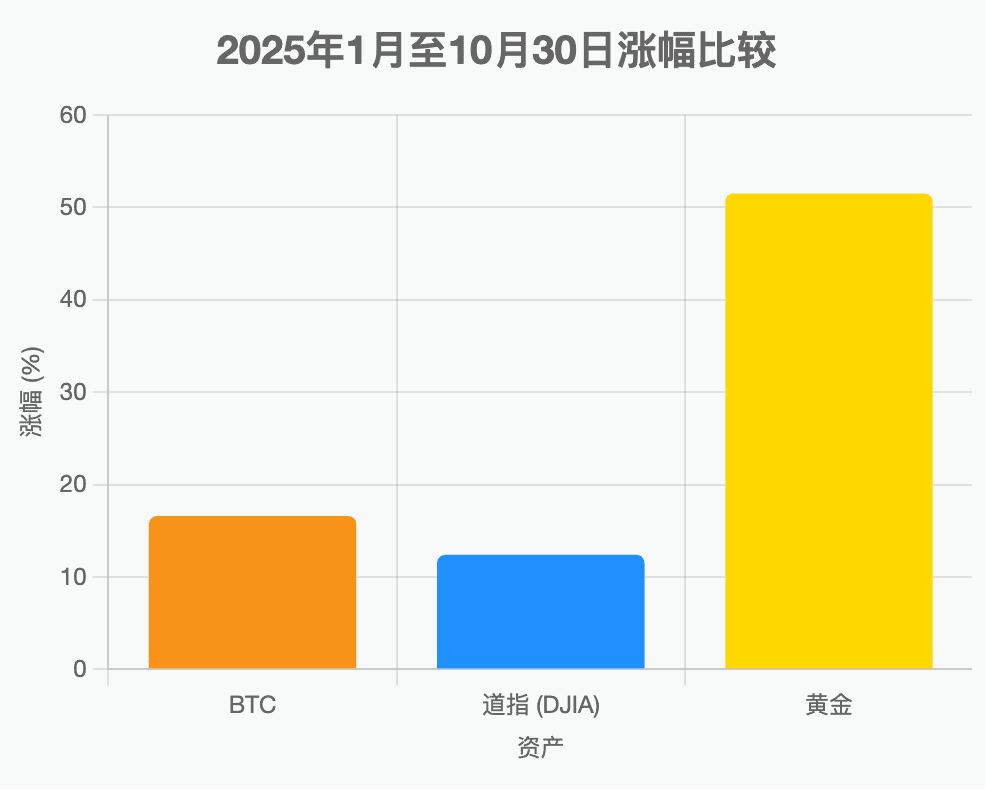
Annual growth rate chart of BTC, the Dow, and gold (as of October 30).
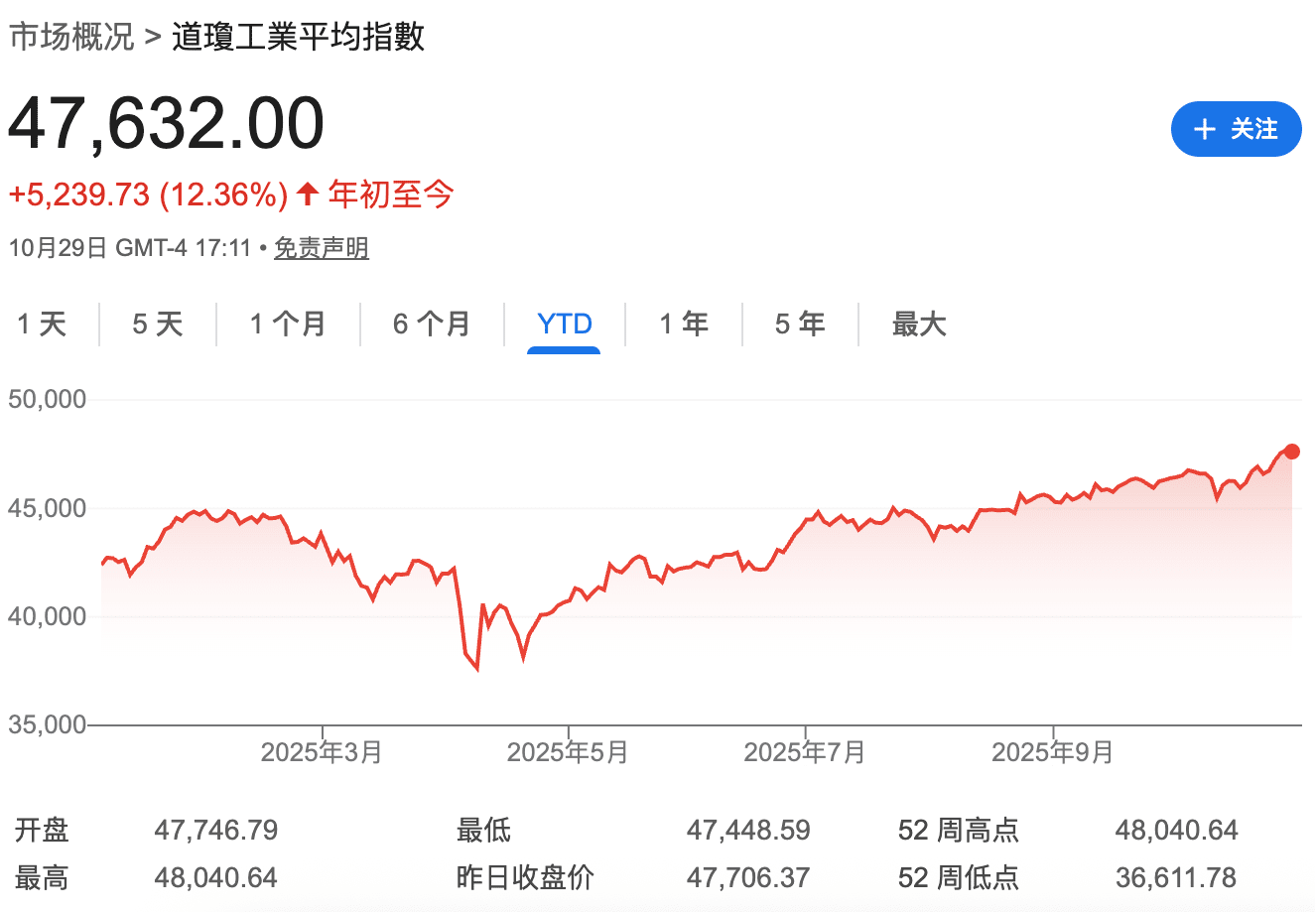
Overview of the annual growth rates of the Dow Jones index.
Market scale limitations, liquidity shortages.
In addition, compared to the overall market value of nearly 70 trillion USD in the US stock market, the overall market value of the crypto market, which remains at a scale of 3-4 trillion, has become a somewhat insignificant 'small cake'—after nearly 17 years of development, the overall market value of cryptocurrencies is still less than 10% of the US stock market; its share in the global economic system is even more pathetic.
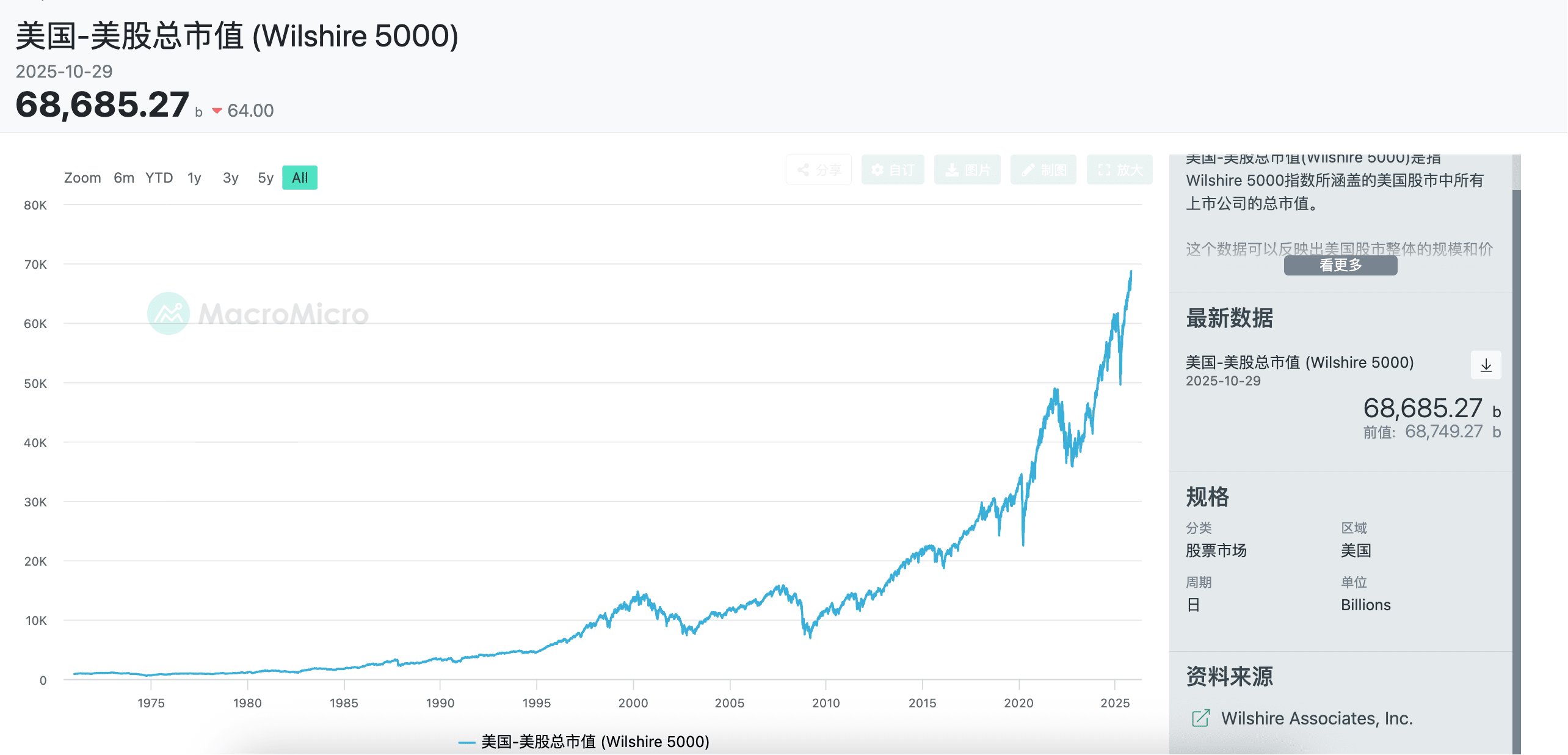
The total market value of the US stock market is nearly 70 trillion USD.
If the above numbers seem too macro, let's use a more easily understandable analogy: regarding Nvidia's receivable performance, just at the recently concluded Nvidia GTC conference, Jensen Huang stated that the Blackwell and Rubin chips expected to be launched next year will collectively bring in 500 billion USD in GPU sales over five quarters; just this one item has already exceeded Ethereum's current market value. Simply put, Nvidia's annual revenue from a single business exceeds the market value accumulated by Ethereum over 10 years, and even surpasses it.
Looking solely at retail investor data, in the first half of 2025, the trading volume of individual investors in Nasdaq reached 6.6 trillion USD; compared to this, the liquidity of the cryptocurrency market is like a puddle in front of the ocean.
The main market narrative drives the crypto circle to a standstill.
In addition to the above data and market factors, narrative fatigue is another challenge facing the crypto market at present.
Compared to the rapidly developing frontier technology, especially in the AI field, many projects and narratives in the crypto industry are still lagging behind.
Compared to AI companies that have already launched many AI models this year, such as Claude Code, GPT5, Deepseek V3.1, Qwen3 MAX, the 'crypto x AI projects' that remain at the paper or token stage are far less active than they were at this time last year; meanwhile, market attention and investors have been split into fragments by DAT treasury, exchange mechanisms, and meme coins, making it increasingly difficult to achieve strong industry-wide consensus.
The internal concerns of the crypto market: time has become the only touchstone for projects.
Continuing the narrative, the various internal troubles of the crypto market are also laid bare.
The 'October 11 crash' has taken away the last bit of liquidity from the crypto market.
The current cooling of trading and project development in the crypto market is directly caused by the industry-wide crash on October 11.
According to multiple sources, the scale of funds liquidated in this industry-wide crash is at least in the range of 30-40 billion USD, equivalent to a decrease of about 1% in the overall scale of the cryptocurrency market in just one day; on the Coinglass platform alone, over 1.6 million people faced liquidation; countless people watched their accounts go to zero and said goodbye to this rapidly declining, high-risk area of the crypto market forever.
It can be said that the 'October 11th crash' has further worsened the already limited liquidity in the crypto market.
Incremental funds are affected by this and will find it difficult to enter the crypto market in the short term.
The hotspots in the crypto market rotate but often last no more than a week.
The fragmentation of market hotspots is also another major manifestation of internal troubles.
A few days ago, the market was still speculating on the 'two saints' intentions', playing with Chinese memes; these days, x402 has already begun to recycle old materials, attracting widespread attention online; and as the market fluctuates, saving and investing seems to have become the only choice for many.
Market hotspots are dazzling, but they also tear attention apart like scraps of paper, making it impossible to piece together a complete picture of the market.
Trump's series of TACO performances have messed up the crypto market.
Another internal trouble in the crypto market is the various TACO (Trump-style capitulation) dramas that emerged after Trump's rise to power.
From the tariff trade war that started in April to the subsequent delays in high tariff policies by various countries; from the previously tense US-China situation to the current meeting between the leaders of the two countries, Trump always releases 'harsh words' first, causing the market to tremble and fall; then, a plot twist occurs, pulling the financial market and the crypto market out of the downward trend, unexpectedly ushering in a wave of inexplicable yet real increases.
The ongoing fluctuations in the crypto market since BTC broke its new high are closely related to the highly active and super influential figures in the crypto market, such as Trump and the Trump family, and insiders from Trump’s faction.
In simple terms, if you are not in the 'insider' circle, you are the 'ATM' of the insiders.

Image source: Odaily Planet Daily Reader Group - A10 Supercar Club
Financial management projects are flourishing, and the crypto circle has become a 'piggy bank.'
On the one hand, the depletion of industry narratives has led many crypto projects into a state of inward competition with serious homogenization; on the other hand, more and more projects have begun to operate under the model of 'financial management projects,' backed by major well-known investment institutions or possessing glamorous backgrounds and ecosystem support, becoming one of the few focal points sought after by the market.
Previously, Circle's listing surged nearly 10 times, the wave of stablecoin issuance, and the generous airdrops of Plasma (XPL) events have led more people to reluctantly believe that they can only use liquid funds to exchange for economic returns.
The cryptocurrency market is no longer a testing ground for technology and innovation as it once was; instead, it resembles a giant 'piggy bank.' This morning, it was reported that the public sale of the Ethereum ecosystem's top project MegaETH has raised 1 billion USD (with a real cap of 50 million USD), oversubscribed by 20 times.
In such a market situation, it's not surprising that the initial deposit limit for a top-tier project like Stable was even filled by 'mouse warehouses' (Additional reading: (Stable's first round of 825 million USD pre-deposits was snapped up instantly, releasing 700 million USD first, then tweeting?)), as many people lament, 'There's just not enough money,' while painfully shouting, 'This market is truly hellishly difficult.'
Conclusion: cherish the leeks still left in the market, they might be the 'engine for the next bull market.'
Finally, from the perspective of a 'crypto leek', I want to say to many crypto projects and trading platforms, cherish the leeks still left in the market, as we may become the few liquidity providers who have survived multiple industry tests as the penetration rate of cryptocurrencies increases.
Of course, I hope that the next bull market will be supported by project parties that have been established for many years and possess real value. Can I still count on you?