


Listen! The foolproof strategies for trading cryptocurrencies, I will only say it once!
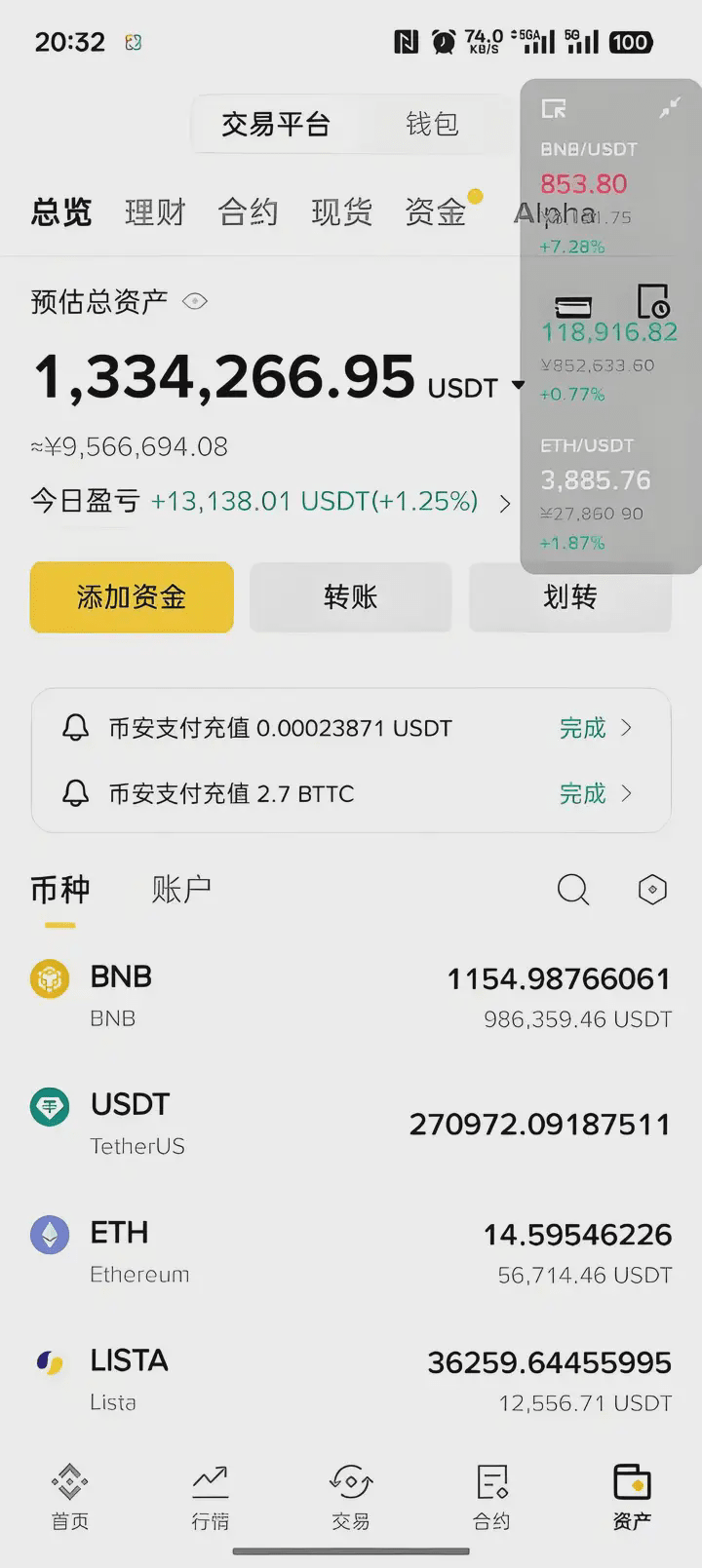
Don't guess the ups and downs like a fool; I'm playing a sure-win game. From a few thousand U to millions of dollars in 10 years, I've never been liquidated.
Just three moves:
1. Lock in profits with compound interest: Take half the profits and play with the rest, without touching the principal.
2. Misaligned position building: Focus on three cycles, layout on both sides, while others get liquidated, I profit.
3. Stop-loss means huge profits: Small stop-loss for big market movements, waiting for odds, not gambling with life.
Look at the trend in large cycles and the entry point in small cycles (with illustrations attached)
Large cycles suppress small cycles, small cycles guide large cycles
How do you use these two sentences? Many people misuse them and claim they are useless, but in fact, they have not found the right method.
The large cycle suppresses the small cycle, which means you should not trade against the trend. If the large cycle is bullish, do not short; if the large cycle is bearish, do not go long.
The small cycle guides the large cycle, indicating that a trend may reverse.
Let’s look at this through the chart.
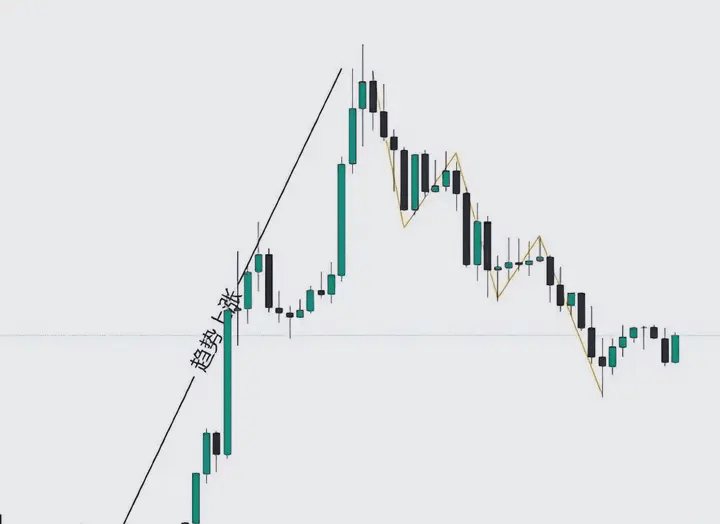
The black segment has direction and is on the rise, while the yellow segment is now starting to pull back. At this time, we need to use the first sentence: the large cycle suppresses the small cycle; at this moment, the small cycle may develop into a bearish trend, and it is normal to see this.
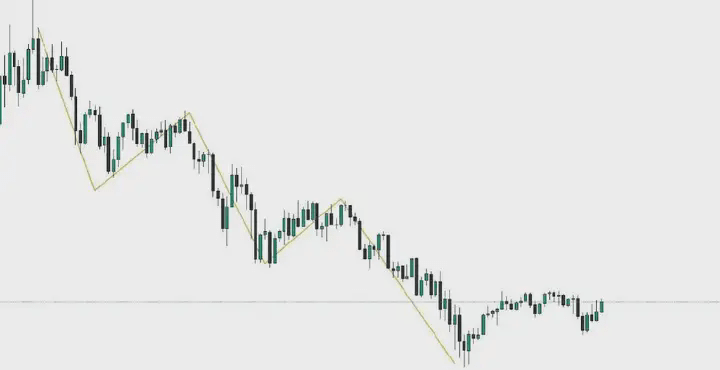
When the market rises particularly sharply.
Only healthy pullbacks will travel further, so this pullback will not go too far. If you want to short, it must be during the current yellow segment of this cycle for quick entry and exit.
Do not think about shorting very far; after all, this is just a pullback of the black segment. If you hold onto the idea of shorting very far, you will easily get stopped out if you are not careful.
So when should you go long? You can observe when the small cycle pullback ends and begins to reverse, which also indicates the large cycle pullback has ended.
For example, when the price breaks the high of the small cycle in the chart, it is a warning that the small cycle price may start to reverse, transitioning from bearish to bullish.
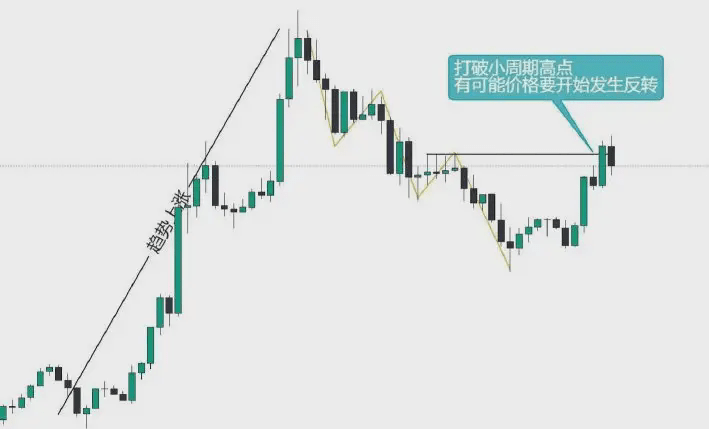
Then the prices of the small cycle began to shift from bearish to bullish, breaking through the highs of the larger cycle.
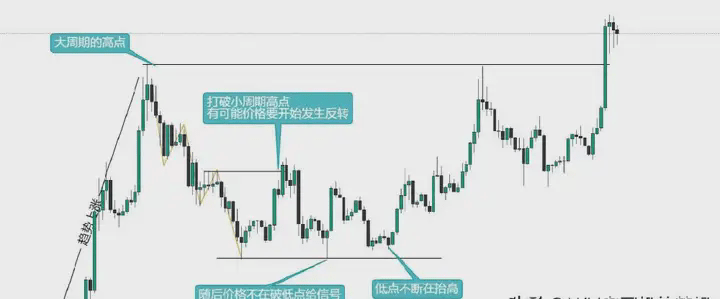
So in the small cycle, the long position you took.
What you find is the reversal point of the small cycle, following the reversal point of the small cycle also aligns with the bullish trend of the large cycle's black segment.
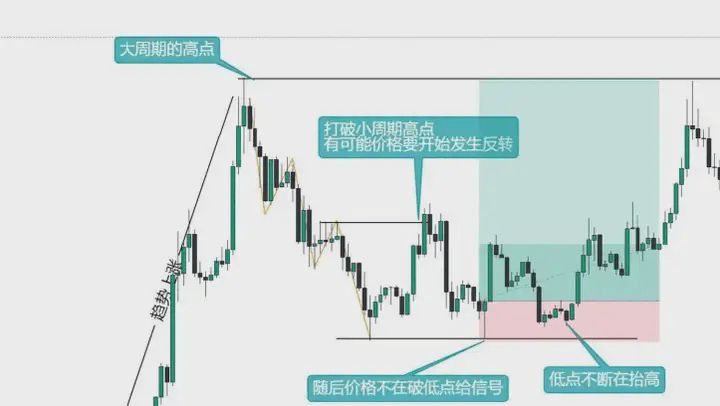
This also reflects how the small cycle guides the large cycle. Look big to act small, and follow both big and small trends.
This is also why you should not take counter-trend positions; many times, a small counter-trend position can cause you to miss out on more profits. What traders fear most is trying to eat everything and always being in the market, which is also why many traders frequently hit stop losses.
In trading, you must make some trade-offs; do not avoid trades that you are skilled at, and try to limit counter-trend positions to just one cycle.
Stick with it for a while, and your funds will definitely grow, but the prerequisite is to have a set of your own trading methods.
The order of key levels (with illustrations) suggests that trading is also a continuous process of introspection.
Today, the main focus is on the order of key levels.
Divided into three types: horizontal resistance and support pressure, channel line, trendline.
So the order of these three key levels is as follows:
1. Horizontal resistance and support pressure.
2. Channel line.
3. Trendline.
Next, we will use chart examples to sequentially understand them.
1. Horizontal resistance and support pressure.
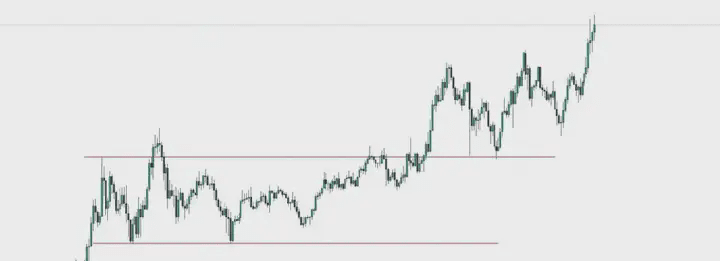
Horizontal pressure and support are lateral supports and pressures.
As shown in the image, the relative effect of this type of pressure and support is the greatest.
Sorted first.
2. Channel line.
Regarding trendlines, are you really using them correctly?
When the market is rising, the lower line is the trendline and the upper line is the channel line.
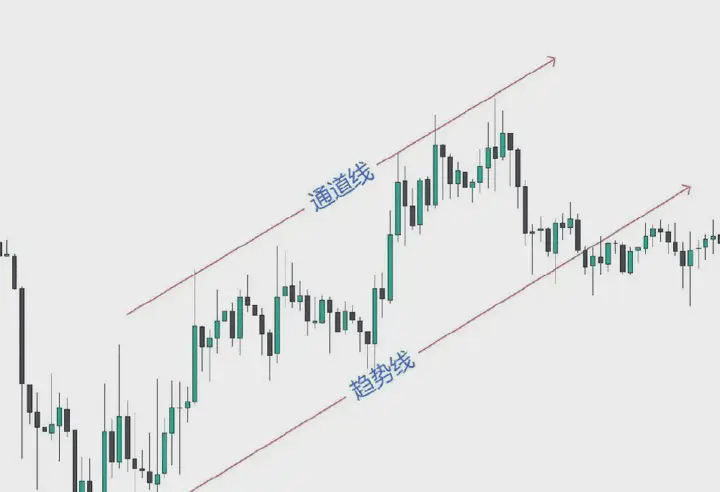
When the market is declining, the lower line is the trendline, and the upper line is the channel line.
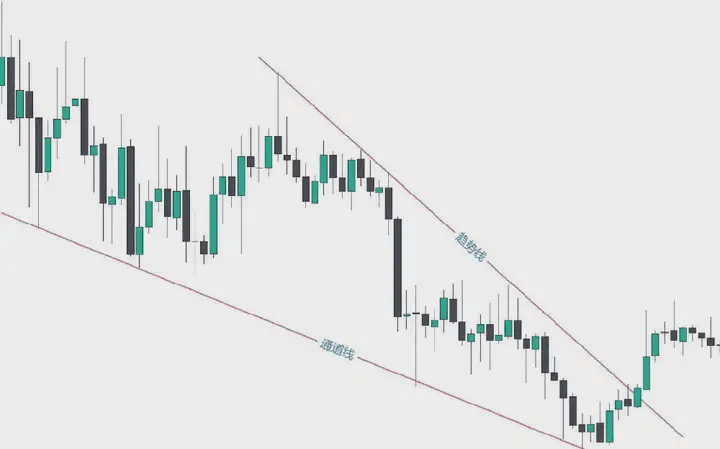
In the trading process, we will use channel lines for overshooting. It is second only to horizontal support and resistance.
Next, let's get to know the last trendline.
3. Trendline.
Regarding trendlines, there are many controversies, and each person draws differently.
When drawing trendlines, several points need attention: 1. Two points only validate; they do not constitute a proper trendline. Three points in a line conform to the correct drawing method for a trendline.
What does this mean? Looking at the chart, when the price reaches the marked position 2, this trend is drawn well, and it needs position 3 for verification.
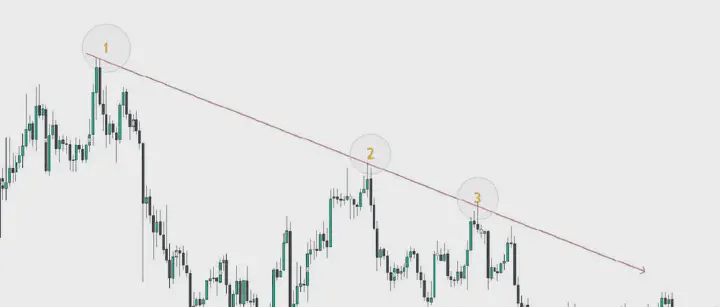
After verifying point 3, this trendline is the valid trendline.
2. Points to note.
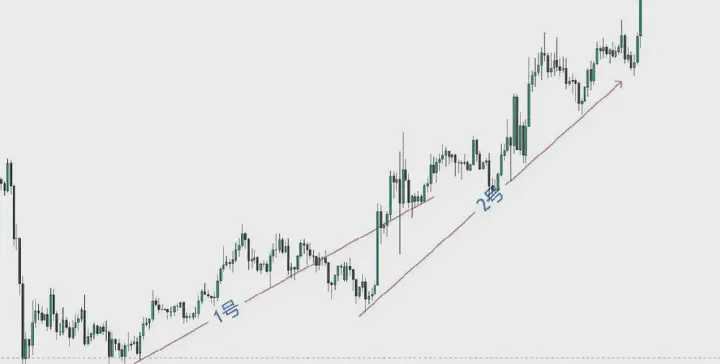
In the chart, the two trendlines are actually both valid trendlines. Which one will you use as your main reference in trading?
Whether it is number 1 or number 2, fundamentally, there is no right or wrong, but remember one thing: trendlines also have timeliness; you cannot just draw a trendline and treat it as the main reference. What matters more is the current price trend.
The key analysis of trading involves identifying and evaluating the main and secondary factors affecting a trade. Many factors can influence the success of a trade. By conducting a primary-secondary analysis of these factors, we can better understand the key points of trading, enabling us to make wiser decisions.
And be able to grasp and respond to various potential risks and opportunities more accurately in the decision-making process. Through scientific and comprehensive analysis, you can improve the success rate and efficiency of trading, thereby achieving sustainable development.
Trading is a continuous process of introspection.
Need to practice trading skills.
Need to learn to manage positions.
Need to learn to make trade-offs and give up trades that you are not skilled at.
Need to learn to be patient and wait for trades that you are good at.
Need to learn to control greed; leave when you should, and never be stubborn.
Need to bow to the market.
Need to continuously admit mistakes and correct them.
Need to understand that money is more important than a single order.
Need to comfort oneself and self-heal.
Need to simplify complexities.
Need to have self-confidence.
Need to practice self-restraint.
Need to block external noise; trading requires independent thinking.
Need to understand to extend the timeline and give up the idea of making a lot of money immediately.
In the puzzle of trading, answers may not be found in a short time, but as you grow, you will definitely find the answers.
Trading is a self-game, and in this process of the game.
You are not just improving in trading, but your inner self and personal growth will make you better, and your life will become better.
Two types of profitable strategies for rolling positions in the crypto world! Learn to follow the trend to earn long-term.
In the crypto world, it is difficult to make big money relying on small daily trades; the real top play is to leverage trends to roll over positions for huge profits. The two core strategies of rolling positions commonly used by experts are:
① Confirm the trend before rolling positions: use the market's money to earn safe profits.
Wait until the market breaks key support or resistance levels and the trend is clear, then start with light positions to test the waters. If the direction is correct and profits start to come in, gradually increase the position with the profits earned. This approach carries minimal risk—the funds for subsequent increases essentially come from 'market money'; even if the market reverses and you get washed out, you only lose floating profits, and the initial base will not be affected, equating to a 'zero-cost gamble for greater returns.'
② Opening a position means going heavy on rolling positions: high risk for high rewards.
Entering the market directly with heavy positions and using leverage to amplify positions is a high-risk strategy. However, as long as the market meets expectations, profits will grow exponentially. But it is only suitable for experienced players—who dare to bet on the big direction, can withstand short-term fluctuations, and understand when to cut losses. New traders blindly attempting this can easily face liquidation.
I personally recommend the first approach of 'using profits to increase positions.' Players like Feizhai Bitcoin and Li Fashi Tonv, who are veterans in the circle, repeatedly emphasize: in trending markets, rolling positions with floating profits + strict stop losses can capture big trends while protecting profits. This is the key to making big money in the long run.
Three pieces of advice for new traders on rolling positions, be sure to remember:
Lower expectations for risk-reward ratios; first maintain your mentality, then seek profits.
Don't always fantasize about 'making 10 times or 20 times in one go'; such high returns have extremely low win rates, and ordinary people simply cannot hold on. New traders should first set the risk-reward ratio at 2-3 times, and when the market is good, push to 4-5 times. This way, your win rate can stabilize around 50%, allowing you to earn steadily and avoid imbalances caused by a mentality of immediate profit.
Accept missing out; do not be greedy for 'all opportunities'.
Over a year, there are at least 10 waves of decent market trends in the crypto world; capturing 2-3 waves is sufficient for profit. If you always think 'I must catch every wave,' and trade frequently, you are more likely to be cut by the market back and forth, ultimately not only making no profit but also losing on fees and capital.
Understand the overall situation before taking action; rest during unfavorable market conditions.
If you want to survive on trading and do well, you must remember some 'iron rules.' If you cannot achieve these, do not easily start full-time trading.
Iron rule 1: Risk control is always the top priority.
The first thing in trading is not to think about how to make money, but to clarify: how much can I afford to lose at most?
Many people, when they first start trading, always think about doubling overnight but never set stop losses. As a result, one trade can lead to a 30% or 50% loss, ultimately resulting in liquidation.
True professional traders first focus on how not to die.
The most basic risk control principle is: using contracts as an example, the risk per trade should not exceed 1%-2% of the account funds. For instance, if you have 100,000 capital, you should bear a maximum risk of 1,000-2,000 yuan per trade. If you keep failing, you can still survive and continue to adjust.
Stop losses are not about being timid but are tactical retreats. The market can always move in ways you never thought of, and once the direction is wrong, you must decisively leave the market. Do not fantasize that 'it will rebound' or 'it will come back after a bit of holding.'
The significance of risk control is to ensure you qualify for the next opportunity. Those who can truly make money are not those who win every time but those who can afford to lose every time.
Only by controlling risks can you truly begin to consider profit matters.
Iron rule 2: Do not take action without a signal; staying out is also a strategy.
Many people, as soon as they open the market, feel itchy and think, 'Isn't it a mistake to not operate now? Am I missing a big opportunity?' In fact, true professional traders excel not in frequent trades but in enduring loneliness.
Trading is not about clocking in; it is not considered 'effort' just because you take action every day. On the contrary, more mature traders are more like patient hunters, who do not actively pursue prey but wait for it to walk into the trap.
The market does not provide good opportunities every day. If you forcefully enter the market, it is likely that you are chasing highs and cutting losses, frequently stopping out, and ultimately disrupting your rhythm and breaking your mindset. Rather than making a wrong trade, it is better not to trade at all. Missing out can wait for the next opportunity, but making a wrong trade may come at a cost.
Learning to stay out of the market is an important sign of trading maturity. Not acting without a signal is a respect for the market and also a protection of your own capital. True experts do not take many trades; they only fight 'fights worth winning.' When they act, there must be basis, logic, and win rates. At other times, just wait quietly.
Iron rule 3: Follow the system; do not follow emotions.
Many people think that trading experts rely on intuition and gut feeling, but in fact, it is quite the opposite. Those who truly make stable profits rely on systems and execution.
You need to have a standardized trading system of your own, including entry conditions, stop loss mechanisms, position adjustment logic, exit rules, and capital management. Each operation should follow a 'process-based production' approach rather than improvisation. Emotional trading is the fastest way to ruin an account.
Many people's mistakes are not in technique but in 'knowing what not to do yet still doing it.' For example, entering the market prematurely when the system has not given a signal; being lucky when it’s time to stop loss; failing to exit due to greed despite having set a target price. Ultimately, it is being defeated by emotions, not the market.
Trading is a game of probabilities, and it is impossible to win every time.
Therefore, you need to learn to accept 'planned losses' rather than pursuing lucky profits in the moment. The significance of the system is to help you maintain rationality amidst chaos; the significance of execution is to truly unleash long-term advantages.
A single loss is not scary; operating outside the system is the real danger.
Iron rule 4: Reviewing is the only shortcut to growth.
Many people have been trading for a long time but still keep spinning in circles; the reason is simple: they never review.
After completing a trade, regardless of profit or loss, have you seriously asked yourself: Was the reason for entering the market in line with the system? Was the stop loss delayed? Did you make decisions based on emotional fluctuations? If you never review, you will never know the answers to these questions.
Reviewing is the mirror for traders. It can reveal the vulnerabilities in your system, habitual mistakes in operations, and emotional weaknesses. Every trade should be recorded clearly: entry logic, psychological state during holding, and exit reasons.
Only by writing these down and summarizing them can you truly see your problems.
Reviewing is not just a formality; it is the core action of self-cultivation. Every trade you make today is material for your improvement tomorrow. True professional traders are not afraid of making mistakes; they are afraid of making the same mistake repeatedly without realizing it.
Those who do not review are destined to keep going around in circles. To break out of the 'mysteriously continuous losses' cycle, you must rely on the mirror of review to continuously correct and evolve. There is no shortcut to growth; reviewing is the only path.
Iron rule 5: Stability is more important than getting rich quickly.
Many people enter the trading market with thoughts of doubling, getting rich, or making a comeback overnight. But those who have truly traded full-time know that to survive longer, it is not about explosiveness but stability.
Professional trading is not about 'making a fortune daily', but rather 'having surplus year after year'. You do not make big money from one or two miraculous trades but from long-term stable strategies that accumulate profits steadily. The rapid rise often comes with high risks, high drawdowns, and accounts can easily crash due to emotional fluctuations.
To go far, you must learn to treat trading as a 'serious business.' Treat the account as a company, controlling costs (losses), improving efficiency (win rates), and maintaining rhythm (trade frequency). Only then can your trading form a virtuous cycle.
Stable profits may not sound that exciting, but only this model allows you to truly 'survive' in the market. Opportunities are always present, but only those who are not greedy, not crazy, and grounded can truly laugh until the end.
If you want to make a living from trading, it is not about one or two miraculous trades or some mysterious technical indicators. Those who can truly survive and make money are those who consistently do every trade well over the long term, preferring to earn less rather than act randomly.
We do not need to win every day, but we must be on the right path every day.
Finally, I would like to share a saying with everyone, a reminder to yourself:
Trading is not about defeating the market but about defeating the self that always wants to overstep its bounds.
Freedom is not doing whatever you want but is the peace of mind that comes after discipline.
Even the most diligent fisherman will not go out to sea during a stormy season, but will carefully protect his boat. This season will pass, and sunny days will come! Follow me to learn about fishing and fishing methods; the doors of the crypto world are always open. Acting in accordance with the trend is the way to have a smooth life. Save this and keep it in mind!
Welcome to follow Rongrong, where you can observe real-time trading for learning and exchange, and clearly understand the market direction and strategy. No matter what style the market is, knowing in advance allows you to better master it!
The team still has positions available; hop on board and become a big player, and also a winner.
\u003cc-36/\u003e

\u003cc-201/\u003e
