


Continue executing trading like this! Earning one million is achievable.
I have experienced the darkest moments of life, liquidation, debt, and being entangled in online loans, unable to eat well or sleep well, even standing on the rooftop contemplating ending it all. Once, a principal of 60,000 turned to zero in one day, while 1,000 U grew to 1 million.
Today, I share my valuable experiences without reservation, hoping to help everyone take fewer detours in the contract circle and achieve financial freedom as soon as possible.
Step one: Select targets — only engage with core assets in a bull market.
100,000 U cannot be scattered and randomly invested; it can only focus on the strongest trend coins:
Sector leaders (RWA, AI, Depin, Layer2)
Weekly volume breakout (for example, after TAO breaks $300, it goes straight to $700).
Small market capitalization + strong control (1-500 million U circulating).
These coins are not just following the trend; they are the ones that initiated first, focused by the main forces, and which retail traders are afraid to chase.
Step two: Rolling positions - compound profits, keeping the principal unchanged.
Divide the principal into three segments and make three key additions.
The first warehouse has 30,000 U for testing.
➤ Enter when the coin price breaks the key level with volume.
➤ Set a 10% stop loss to protect the principal's safety.
Increase position by 50,000 U (including profit).
➤ Add positions after a profit of 20%-30%.
➤ Only use profits + a small portion of the principal to roll over, magnify profit zones.
Double again and roll another round.
➤ Withdraw principal, continue with profits.
➤ The further back, the steadier the mindset; that's the critical phase.
The entire process emphasizes: increase position on the rise, stop loss on the fall, do not operate against the trend.
Step three: Position control + risk control.
Making money isn't hard; the real strong ones are those who can retain it.
No single currency should exceed 50% of the total position.
Set a stop loss of 10% for each order, never hold onto a losing position.
Every time it doubles, take half the principal, let profits fly freely.
This method has a practical win rate of over 60%, with a risk-reward ratio of 1:3, truly relying on a system to make a living, not on fantasizing about getting rich.
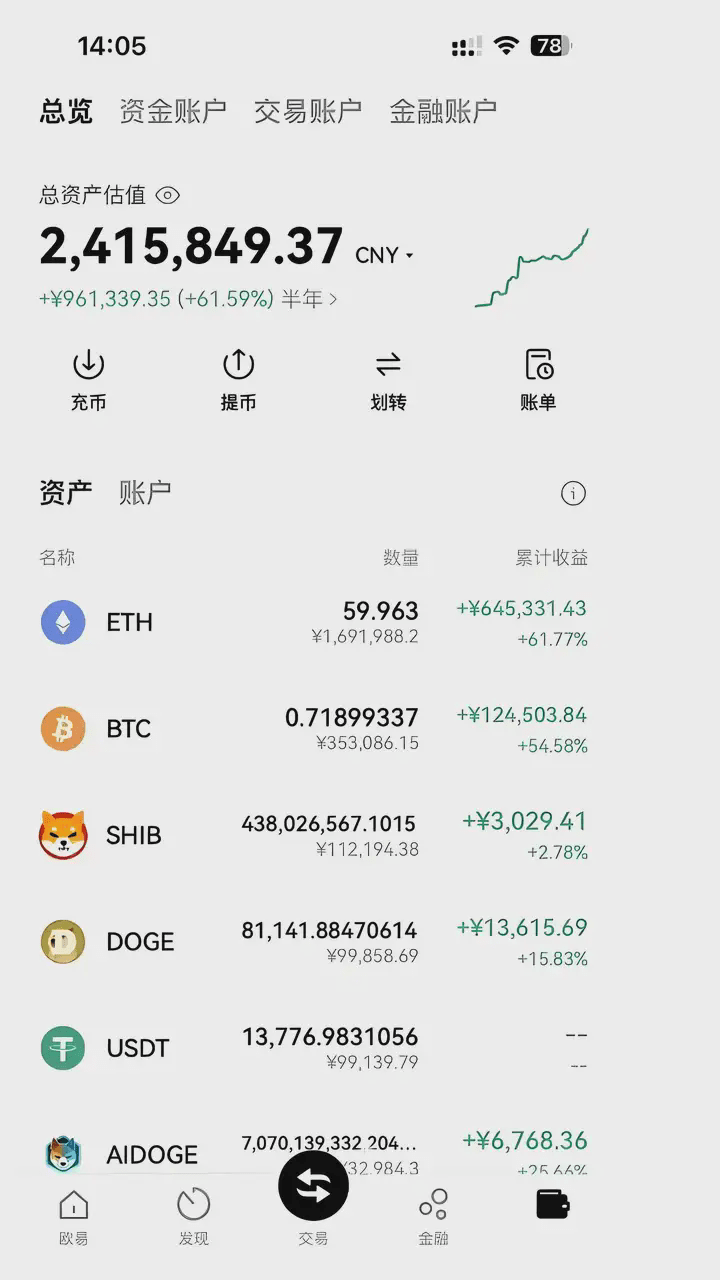
In the crypto world for ten years: from staring at the 1-minute line with a racing heart to relying on multi-cycle trading for stable profits. These three steps of mindset have helped me break free from the anxiety of gains and losses.
After ten years of grappling in the crypto world, I still can't help but laugh at my earlier 'awkwardness'—every day, my eyes were fixated on the 1-minute K-line, every fluctuation on the screen felt like my heart was racing. A two-point rise would make me panic, fearing profit loss and hastily selling, only to watch the price soar high after selling, slapping my thigh in regret for 'selling too soon'; a slight drop would make me even more anxious, constantly worried about being trapped, hastily cutting losses, but shortly after, the price rebounded, leaving me helplessly watching the opportunity slip away.
During that time, 'buying the ups' and 'selling the downs' became a common occurrence, and account funds fluctuated, causing my mindset to become chaotic. Until later, at an industry exchange meeting, I met a technical expert who had been deeply involved in the crypto space for over ten years. After a few drinks, I poured out my difficulties, and he just smiled and said, 'You see, you’ve trapped yourself in a cycle. Looking too closely prevents you from seeing the direction clearly.'
It was this insight that felt like it opened up my 'meridians' on the trading path. Later, I repeatedly studied and verified it with him, slowly summarizing a multi-cycle K-line trading method that I've used for over six years. Since then, trading has truly transformed from 'betting on luck for ups and downs' to 'grabbing opportunities based on logic,' and my account finally achieved stable profits. Today, I share this method with everyone without reservation: three simple steps to help you accurately grasp direction, find the right points, and determine timing. I suggest liking + saving this, so you don't have trouble finding it later.
Step one: Use the 4-hour K-line to determine direction; only by following the trend can you win.
Trading is like driving; if you can't even tell the direction of forward or backward, no matter how hard you press the gas pedal, you'll only get further from your destination. The 4-hour K-line is the best tool to help us 'distinguish direction' - this cycle is long enough to filter out the noise brought by short-term market sentiment, allowing us to see the real trend of the market clearly.
I usually look at the 4-hour line, focusing on two core points:
Upward trend: As long as the K-line highs continue to rise, and the lows are also moving up simultaneously, for example, rising from 30,000 USD to 32,000 USD, retracing to 31,000 USD and continuing to surge, breaking through 32,000 USD to 34,000 USD, this is a clear upward trend. What to do at this time is to 'buy on dips', waiting for the price to fall back to the previous low or hit a key moving average (like MA60, MA120) before entering, following the trend, which naturally increases the winning rate.
Downward trend: Conversely, if the highs continue to decrease and the lows are also consistently moving down, for example, dropping from 40,000 USD to 38,000 USD, rebounding to 39,000 USD and continuing to fall, breaking below 38,000 USD to 36,000 USD, then that’s a typical downward trend. At such times, don’t think about 'catching the bottom'; a more prudent approach is to 'short on rebounds', waiting for the price to rebound near the previous high or hit a resistance level before entering, following the trend downwards, which minimizes risk.
Sideways fluctuations: There is also a situation where the price fluctuates back and forth in a fixed range, for example, repeatedly jumping between 35,000 USD and 38,000 USD, neither breaking the upper edge nor falling below the lower edge. This kind of market is most likely to 'hit back and forth', buying today only for it to drop a bit, and selling tomorrow for it to rise again, frequent operations will only incur transaction fees and lose on price differences, so I generally choose to wait and see until the market shows a clear direction before taking action.
It's essential to remember a saying: Only by following the trend can there be a winning rate; going against the trend will only lead to losses. In the crypto world, there are always people who think 'catching the bottom and fleeing the top' is great, but in reality, understanding the trend is enough to beat 80% of traders.
Step two: Use the 1-hour K-line to find points; only key levels are reliable.
Having determined the big direction of the 4-hour line, the next step is to find specific entry and exit points - for this step, the 1-hour K-line is the best 'navigator'. The 1-hour line's cycle is shorter than the 4-hour line, allowing it to align with the major trend while clearly seeing the mid-term support and resistance, helping us narrow the entry range to a 'precise zone'.
For example, after confirming that the 4-hour chart is an upward trend, I would open the 1-hour chart to find support.
Entry points: Focus on three key areas - first, the previous lows, for example, when the hourly chart fell to 31,000 USD and then rebounded, that position is strong support; second, the trend line, connecting several lows on the hourly chart to form an upward trend line, the price often finds support when it retraces to this line; third, key moving averages, like MA30, MA60, in an upward trend, these moving averages often become 'boosters', making it easy for the price to continue rising after it retraces. As long as the price approaches these positions, they are potential entry opportunities.
If it’s a downward trend, then use the 1-hour line to find resistance levels to set take profit or reduce position points:
Take profit / Reduce position levels: Similarly, focus on three key areas - the previous highs, for example, when the hourly chart rose to 39,000 USD before falling, that level is strong resistance; second, the downward trend line, connecting several highs on the hourly chart, when the price rebounds to this line, it is likely to encounter resistance and fall back; third, the top formations, such as a 'double top' or 'head and shoulders' on the hourly chart, combined with shrinking trading volume, are likely signals that the rebound has reached its peak, at this point you should decisively take profit or reduce your position to lower risk.
Step three: Use the 15-minute K-line to determine timing; don't make mistakes on the 'final kick'.
Having found the big direction and circled the entry range, the final step is to grab the 'precise entry timing'—at this point, the 15-minute K-line is our 'timer'. But be sure to note that the 15-minute line is only for finding entry actions; it absolutely cannot be used to gauge trends, otherwise, it’s easy to revert back to the old path of 'focusing on small cycles and chaotic operations'.
I enter using the 15-minute line, focusing on just two signals:
Short-term reversal signals: Wait for the price to fall to a good support level on the 1-hour line (or rise to a resistance level), then observe if the 15-minute line shows reversal patterns. For example, at support, if a 'bullish engulfing' or 'hammer' appears, or if MACD shows 'bottom divergence' (price makes a new low, MACD does not), or if KDJ forms a 'golden cross', these are all signals for a short-term rebound. Entering after seeing these signals can greatly reduce the risk of 'buying at the mid-level'.
Volume confirmation: Having just reversal patterns is not enough; there must be accompanying volume. For example, if the 15-minute chart shows a bullish engulfing pattern, and the volume is significantly larger than the previous few candles, it indicates that funds are entering at this position, making the breakout more reliable; if the pattern looks good but the volume remains sluggish, it could very well be a 'false move', making it easy to get trapped after entering.
Let me give you a practical example from last year: at that time, the 4-hour chart showed that Bitcoin was in an upward trend, and the 1-hour chart found support around 42,000 USD. When the price fell back to 42,200 USD, I opened the 15-minute chart to observe and saw a 'bullish engulfing' pattern, and the volume suddenly increased by 30%. I immediately entered a long position, and the price indeed rose all the way to 45,000 USD, successfully taking profit and exiting. The whole process was neither rushed nor slow, and I didn’t have to anxiously stare at the screen.
The core logic of multi-cycle coordination: first look at the big picture, then the medium, and finally the small.
Many people still make mistakes after learning the multi-cycle trading method; the key is not understanding 'coordinated logic'. The core is actually three sentences:
First determine the direction: Before the market opens each day, take 5 minutes to look at the 4-hour K-line to determine whether to go long, short, or wait. If the direction is wrong, everything else is in vain.
Find the range again: Once the direction is determined, open the 1-hour line, circle out support (for going long) or resistance (for going short) areas, and narrow the entry range, avoiding blind chasing of highs and lows.
Final entry: Wait for the price to enter a good range on the 1-hour line, then monitor the reversal signals and volume on the 15-minute line, entering only when the conditions are met to achieve 'precise strikes'.
Here are three additional points I've summarized from my pitfalls:
Cycle conflict means staying out of the market: If the 4-hour line shows an upward trend but the 1-hour line has a clear downward pattern, or if the signals on the 15-minute line contradict the major direction, at this time it's better to stay out and observe rather than force an entry. The crypto world is not short of opportunities; it lacks patience. Making trades without certainty is not as good as waiting for consistent signals before taking action.
Short-term cycles must include stop losses: The 15-minute line fluctuates quickly, and false breakouts can easily occur, so after entering, it's essential to have a good stop loss, for example, setting the stop loss below the support level (when going long) or above the resistance level (when going short), typically controlling the stop loss range at 3%-5% to prevent being 'stopped out' by short-term fluctuations and then reversing, which can also avoid excessive losses from a single trade.
Effective when combined: Don't just look at one cycle to enter, for example, blindly going long just because the 4-hour chart shows an upward trend, without checking the support on the 1-hour chart or the timing on the 15-minute chart, it's easy to buy at a short-term high; likewise, entering just based on the 15-minute reversal signal while ignoring the downward trend on the 4-hour chart is likely 'against the trend operation', losing more than gaining.
This multi-cycle K-line trading method, I have used since 2018, has experienced the dramatic falls of the bear market and the craziness of the bull market. No matter how the market changes, as long as I strictly follow these three steps, I can always seize my opportunities. In fact, trading isn't that full of 'mysticism', nor are there any 'winning indicators'; truly reliable methods are those summarized from practice and can withstand market verification.
Finally, I want to tell everyone: no matter how good the method is, it still requires practice and summarization. At the beginning, you can use small funds to make mistakes, look at charts more, record more, for instance, before each entry, note down the signals from the 4-hour, 1-hour, and 15-minute lines, and after the trade ends, review to see what was done right and what was wrong, gradually finding your own rhythm.
In the crypto world, no one can have a smooth journey, but as long as you find the right methods and persist, there will come a day when you can transform from a 'retail trader' to a 'stable profit trader.'

Why do 99% of people blow up in the contract market but still have a bunch of people rushing in without hesitation?
In simple terms, many people haven't understood: You're not losing to the market, but to yourself.
The '3x, 5x, 10x leverage' shown by exchanges is merely surface parameters. What truly determines how long you can survive is 'real leverage'.
How to calculate real leverage?
Very simple: position ÷ stop loss space.
If you have 10,000 U in your hands and open 10x leverage, it looks stable, but if you only leave 100 U as a stop-loss buffer, you're actually playing with 100x! Once the market gives you a spike, your account will be wiped out.
Why do most people die in contracts? Simply three points:
Stubborn: Knowing it’s wrong but still holding on.
Going all in: betting everything at once, resulting in returning to square one overnight.
Emotional scaling: Getting anxious as soon as the market shakes, adding more and more leads to cooler responses.
Remember this: You blew your account because you removed the 'brake'.
What’s the essence of the contract market? It’s essentially a 'harvesting game.'
The ones making money are always the calm few, while the money lost comes from the accounts of liquidated retail traders.
Bull market? Bear market? No difference! How the market moves is not important; what's important is whether you can wait for others to make mistakes.
Bull market: Some FOMO and chase high, while you quietly short it.
Bear market: Some panic and cut losses, while you quietly take over.
Retail traders come in two types:
Dreamers: Fantasizing about 100x miracles every day, one shot down, achieving dreams or blowing up all depends on luck.
Risk managers: Use only 10%-20% of the position, with clear stop losses and reasonable risk-reward ratios, can survive and gradually eat profits.
Professional players have seen through it long ago:
80% of the time is waiting; only 20% is the time to take action.
Making money is never about operating every day, but about waiting for others to make mistakes.
Final reminder:
If you don't manage risk, don't touch contracts. Because in others' eyes, you are a 'free ATM'.
Even if the market is chaotic, one must maintain a stable mindset.
Don't know how to operate? Then follow the thoughts of experienced people; it's definitely better than messing around on your own.
In short: Don't think about getting rich overnight; first learn to survive.
Welcome to follow Rongrong, where you can watch real-time trading, learn and communicate, and clearly understand the market direction and strategies. No matter what the market style is, knowing in advance allows for better mastery!!!
The team still has positions available, get in fast, and become both the dealer and the winner.

