


Today, I want to share how I successfully transitioned from a beginner; this article is divided into three parts:
1. Essential Cognitive Framework for Cryptocurrency Beginners
2. Complete Beginner's Basic Knowledge in Cryptocurrency
3. How Beginners Can Earn Their First Bucket of Gold. Every beginner wanting to enter the cryptocurrency world is completely confused.
Wealthy big shots go in first to test the waters with real money; they spend money to stay updated, self-comforting with the first egg.
However, the vast majority actually started from scratch in the cryptocurrency world.
No knowledge, no English, no capital; the only thing I had was hard work.
Therefore, starting from scratch is the norm for anyone entering the cryptocurrency world.
I suggest starting with petting.
You can't just pet anyone. While time isn't worth that much, it's not entirely worthless either. Spending time on valuable things is always better than wasting it.
Following well-known bloggers requires time and discernment.
Learning industry knowledge also takes time and is complex and multifaceted.
How can I get started smoothly?
I also bought a Bitcoin once, which cost 8,000 RMB at the time, but my understanding was not up to par. I felt that making money was useless and meaningless.
So in the end, time was given to the dog. Everyone has to go through a detour in life, whether they go early or late.
Through more than 10 years of experience in the cryptocurrency industry:
I found some of the things I summarized to be very valuable, and they are a good starting point and suitable for beginners to understand.
That's all for now. Hope you can learn something from it.

In short, for beginners, it's all about getting started by exploring and experimenting with major public blockchain projects. The key is quality, not quantity.
Since you lack the ability to discern, it's best not to try to discern. Instead, follow the experts and look at a few major projects and sectors that might be eligible for investment opportunities.
If you have little money, you have to use it wisely; you can't afford to lose money.
Casting a wide net isn't for you; it's only for rich tycoons.
Never believe in proportions, traditional concepts, etc. You are an independent individual. You must believe in yourself, believe in your ability to succeed, and then persevere.
Don't give up. Take the first step.
Take it one step at a time.
As for multiple accounts, witches, magic, and such things, we'll deal with those later. First, we need to understand the rules of the game, the main chain and side chains, and the single account for the main projects. These will mature later.
Then proceed step by step.
You can never earn all the money in the world, but you can lose it all.
II. A Complete Set of Basic Knowledge for Cryptocurrency Beginners
The cryptocurrency world has gained increasing attention in recent years. For beginners, understanding the basics is crucial. This article will introduce the fundamentals of the cryptocurrency world to help you quickly get started.
I. What is the crypto world? The crypto world refers to the cryptocurrency field, also known as the digital currency circle or virtual currency circle. It refers to the collective name of people, projects, and communities related to cryptocurrencies.
II. The History of the Cryptocurrency Industry The origins of the cryptocurrency industry can be traced back to 2009, when Bitcoin was created as the first application of blockchain technology. Since then, more and more cryptocurrencies have been developed, and the cryptocurrency industry has gradually taken shape.
III. Key Concepts in the Cryptocurrency Industry
1. Blockchain Technology: Blockchain is a decentralized distributed ledger technology characterized by security, transparency, and immutability. Blockchain technology is the foundation of the cryptocurrency world and the core of cryptocurrencies.
2. Cryptocurrencies: Cryptocurrencies are digital currencies issued based on blockchain technology. They use cryptography to achieve secure transactions and control the issuance of currency. Bitcoin, Ethereum, and Litecoin are the most well-known cryptocurrencies in the cryptocurrency world.
3. ICO (Initial Coin Offering): ICO refers to the initial public offering of tokens, similar to an IPO (Initial Public Offering) in traditional finance. ICO is a common fundraising method in the cryptocurrency world.
IV. Investment Strategies in the Cryptocurrency Market
1. Project Research: Before investing in the cryptocurrency market, thorough research on projects is essential. Understanding factors such as the project's team background, technical capabilities, and market demand can help you make informed investment decisions.
2. Diversify your investments: Investing in cryptocurrency carries certain risks, so it is recommended to diversify your investments across multiple projects to reduce those risks.
3. Long-term holding: Investing in the cryptocurrency market is a long-term endeavor; short-term fluctuations do not reflect the intrinsic value of a project. Therefore, investors are advised to adopt a long-term holding strategy.
V. Risks and Precautions in the Cryptocurrency Market
1. Volatility Risk: Prices in the cryptocurrency market fluctuate significantly, and investors need to be prepared and take precautions to manage risk.
2. Project Risks: Many projects exist in the cryptocurrency market, some of which may be scams or fraudulent schemes. Investors need to carefully select projects and pay attention to risk warnings.
3. Security Risks: Digital assets in the cryptocurrency market need to be stored in a wallet. Investors need to choose a secure and reliable wallet and protect their private keys. VI. Future Outlook of the Cryptocurrency Market
As an emerging industry, the cryptocurrency sector has enormous development potential. With the continuous maturation of blockchain technology and the expansion of its application scenarios, the cryptocurrency sector is expected to become an important part of the future financial system.
This article introduces the basics of the cryptocurrency world, including its definition, history, key concepts, investment strategies, risks and precautions, and future outlook. Hopefully, this information will help newcomers to the cryptocurrency world better understand it and achieve success.
Remember, investing in cryptocurrencies requires caution. Don't blindly follow the crowd; proper risk management is essential for achieving better investment returns.
I. Essential Knowledge for Cryptocurrency Beginners
More and more people are paying attention to cryptocurrency trading, but very few truly understand it. Beginners often don't know where to start. Today, I'll share some basic knowledge about the cryptocurrency world with newcomers.

1. What is Cryptocurrency Trading? This article will begin by discussing cryptocurrency trading. Cryptocurrency trading is similar to stock trading, real estate trading, and forex trading; it involves buying low and selling high to profit from the price difference. For example, if you believe property prices will rise, you buy a house immediately, and then sell it when the price has increased significantly, making a large profit. The difference is that cryptocurrency trading involves digital currencies, which offer a more flexible trading mechanism (24/7 trading) and greater profit potential (no price limits), making digital currencies an investment with returns far exceeding those of traditional stocks, futures markets, funds, and real estate.
2. What is an exchange? An exchange is a platform for trading cryptocurrencies. Currently, the most commonly used exchanges are Huobi, Binance, and OKEx. There are also many other smaller exchanges. Just like there are the Big Four banks and various other banks, using top-ranked exchanges generally offers a high level of security, allowing for worry-free trading. Some cryptocurrencies can only be purchased from specific, specialized exchanges.
3. What is USDT? Exchanges are places where cryptocurrencies like Bitcoin are traded. Trading cryptocurrencies requires an intermediary coin, also called a stablecoin, which is USDT. This is also the most commonly used fiat currency.
USDT, or Tether, is a cryptocurrency pegged to the US dollar. It's a virtual currency held in foreign exchange reserves and backed by fiat currency. You can simply think of it as US dollars.
Tether (USDT) is a token issued by Tether Inc. that is based on the stable value currency, the US dollar (USD). 1 USDT = 1 US dollar.
Exchanges themselves cannot directly sell or buy cryptocurrencies, nor can they sell you USDT; you and the exchange cannot buy it together. If you want to buy cryptocurrency, you first need to buy USDT with RMB, then exchange the USDT for the cryptocurrency you want to buy. If you want to sell cryptocurrency, you need to exchange your cryptocurrency back into USDT and then sell it for RMB. Once you have USDT, you can exchange it for any cryptocurrency on an exchange; this is called cryptocurrency-to-cryptocurrency trading.
4. Basic terminology for cryptocurrency trading: Position: refers to the ratio of an investor's actual investment to the total amount of capital invested.
Full position: Use all available funds to buy cryptocurrency.
Reduce holdings: Sell some of the cryptocurrency, but not all of it.
Heavy investment: Compared to funds, cryptocurrency accounts for a larger share.
Light position: Compared to virtual currency, funds account for a larger proportion.
Empty position: Sell all the virtual currency you hold and convert it all into cash.
Profit-taking: After gaining a certain profit, sell the virtual currency you hold to secure the profit.
Stop loss: Once the losses reach a certain level, sell the virtual currency you hold to prevent further losses.
Bull market: Prices continue to rise, and the outlook is optimistic.
Bear market: Prices continue to fall, and the outlook is bleak.
Bullish (going long): Buyers who believe the price of a coin will rise in the future, buy the coin, and then sell it at a higher price to realize profits.
Short sellers (shorting): Sellers who believe that the price of a coin will fall in the future. They sell a portion of the coins they hold (or borrow coins from the trading platform), lock in their positions, and then realize their profits when the price falls to a certain level. This also helps them avoid risks.
Establishing a position: Buying virtual currency.
Averaging down: Buying cryptocurrency in batches, such as buying 1 BTC first, and then buying another 1 BTC.
Rebound: When the price of a coin falls, it rebounds and adjusts due to the rapid decline.
Consolidation (sideways movement): Price fluctuations are small, and the price of the coin is stable.
Slow and steady decline: The price of the coin is declining slowly.
A rapid, dramatic drop in the price of a coin (like a waterfall).
Cutting losses: This refers to selling cryptocurrency at a loss after the price drops to avoid further losses. Alternatively, it could mean borrowing cryptocurrency to short sell, then buying it back at a loss after the price rises.
Being trapped: You expect the price of a coin to rise, but the price falls after you buy it; or you expect the price to fall, but the price rises after you sell it.
Recovery from a loss: After buying cryptocurrency, the price of the coin drops, causing a temporary paper loss, but the price of the coin recovers afterwards, turning the loss into a profit.
Missing out: Selling cryptocurrency due to a bearish outlook, only to see the price rise continuously, preventing timely repurchase and thus missing out on profits.
Overbought: The price of the coin has continued to rise to a certain level, the buying power has been basically exhausted, and the price is about to fall.
Oversold: The price of the coin has continued to fall to a certain low point, the selling pressure has been largely exhausted, and the price is about to rebound.
Bull trap: The price of the coin has been consolidating for a long time, and the possibility of a decline is relatively high. Most of the short sellers have already sold their virtual coins. Suddenly, the short sellers push up the price, inducing the long sellers to think that the price will rise and buy in. As a result, the short sellers suppress the price, trapping the long sellers.
Short-selling trap: After bulls buy cryptocurrency, they deliberately suppress the price, making short sellers think the price will fall and sell off their holdings, thus falling into the bulls' trap.
5. What are mainstream cryptocurrencies? Mainstream cryptocurrencies are value cryptocurrencies. Bitcoin is the number one, and Ethereum is the number two. Some people think that only these two are mainstream cryptocurrencies, some people think that only the top ten cryptocurrencies by market capitalization on exchanges are mainstream cryptocurrencies, and some people think that only cryptocurrencies listed on mainstream exchanges are mainstream cryptocurrencies.
Taking Feixiaohao as an example, we can see the market capitalization rankings of relevant cryptocurrencies. Major cryptocurrencies rank highly, with Bitcoin firmly holding the top spot in market capitalization.
Generally speaking, cryptocurrencies with higher market capitalization rankings have higher market recognition, better liquidity, and higher investment value; conversely, cryptocurrencies with lower market capitalization rankings have lower recognition, poorer liquidity, and correspondingly higher investment risks, so users are advised to buy with caution.
6. Risks of Cryptocurrency Trading Perhaps the most candid advice regarding cryptocurrency investment comes from Ethereum founder Vitalik Buterin: Don't invest any money you can't afford to lose. Again, a reminder to all beginners: invest within your means. It's advisable to avoid borrowing, taking out loans, using collateral, or mortgaging credit cards for these investments, especially futures trading.
7. How to trade contracts: Cryptocurrency-to-crypto trading is a type of spot trading. To profit from rising or falling market conditions, you need to trade contracts. Contract trading, in contrast to cryptocurrency-to-crypto trading, is a type of futures trading. This means that the underlying assets of these transactions are standardized contracts.
You can deposit a certain percentage of margin to borrow cryptocurrency. If the market outlook is bullish, you can choose to go long; if the market outlook is bearish, you can go short. You can also trade in both directions, opening both long and short positions to hedge risks. Therefore, you can profit from both rising and falling markets through contract trading, greatly improving capital utilization.
The margin ratio here corresponds to different leverage levels. For example, if you predict a decline in BTC's future price and want to open a short position of 100 BTC, you only need to pay a minimum margin of 1%, which is 1 BTC, to borrow 100 BTC. This is equivalent to using 1 BTC to leverage the profits of 100 BTC. After borrowing, you immediately sell and wait for the price to fall. If BTC falls from $35,000 to $34,000, you immediately buy back 100 BTC and return it to the platform. You will then receive a profit of (35,000 - 34,000) * 100 = $100,000. Without contract trading, you cannot profit from this price drop, and without 100x leverage, you cannot obtain 100x returns. This is the nature of contracts.
Newbies, don't trade contracts! Newbies, don't trade contracts! Newbies, don't trade contracts! I'm saying it three times because it's important! Contracts may seem like the fastest way to get rich, but it's definitely not the shortest path. The "fast" here usually means getting closer to liquidation and bankruptcy, not closer to financial freedom.
8. Three essential elements for cryptocurrency trading
1. An Android phone. (Android is more convenient; Apple is prone to certificate loss.) An Android phone is also essential for running the project.
Second, spare money. Money that you don't need in the near future, money that won't affect your quality of life even if you lose it.
Third, mindset. Cryptocurrency trading is risky; those who are overly concerned with gains and losses should not participate.
The cryptocurrency world isn't just about trading cryptocurrencies; there are countless other avenues to explore. Returns are always proportional to investment, and I hope we can all achieve something in the cryptocurrency world.
II. Cryptocurrency Basics Explained in Illustrated Guide The cryptocurrency world refers to the trading market and community within the digital currency sector, most notably Bitcoin. For newcomers to the cryptocurrency world, understanding some basic knowledge is crucial. This article will introduce the fundamentals of the cryptocurrency world through illustrated explanations.
1. What is Bitcoin?
Bitcoin is a decentralized digital currency backed by the Bitcoin blockchain network. It is designed to be independent of any financial institution, offering high security and anonymity.
2. What is blockchain?
Blockchain, the underlying technology of Bitcoin and other cryptocurrencies, is a decentralized distributed ledger. It records information about all transactions and ensures the security and accuracy of the data through encryption and consensus mechanisms.
3. What is an exchange?
Exchanges are platforms for buying and selling cryptocurrencies, allowing users to trade different digital currencies. Users can buy or sell Bitcoin and other cryptocurrencies through exchanges.
4. What is a wallet?
A wallet is a tool used to store and manage digital currencies. It can be a software wallet, a hardware wallet, or an online wallet. Users can use wallets to send and receive digital currencies and view their balance and transaction history.
5. What is mining?
Mining is the process of verifying and processing Bitcoin transactions by solving complex mathematical problems. Miners maintain the Bitcoin network by providing computing power and receive a certain number of Bitcoins as a reward.
6. What is an ICO?
An ICO (Initial Coin Offering) is a crowdfunding model where a company or project issues new digital currency to raise funds. Investors can then purchase these newly issued digital currencies and expect their value to increase in the future.
7. What is a white paper?
A white paper is a detailed project introduction and planning document, typically released by the cryptocurrency project team. It contains information such as the project's goals, technical architecture, and business model, helping investors understand the project's potential and feasibility.
8. What is market capitalization?
Market capitalization refers to the total market value of a cryptocurrency, which is the current price of the cryptocurrency multiplied by its total supply. Market capitalization reflects a cryptocurrency's position and influence in the market.
Hopefully, the simple diagrams above will help you quickly understand the basics of the cryptocurrency world. Before entering the cryptocurrency market, please be sure to do thorough preparation and risk assessment, and invest cautiously. The cryptocurrency market is a field full of opportunities and risks; only by continuously learning and accumulating knowledge can you better participate in it.
I'm Rongrong, and I've weathered multiple bull and bear market cycles, accumulating rich market experience across various financial sectors. Here, I cut through the fog of information to uncover the true nature of the market. Seize more opportunities to unlock wealth and discover truly valuable opportunities—don't miss out and regret it!
III. How a novice can earn their first pot of gold
In 2024, I traded cryptocurrency full-time for 11 months, growing my initial 2000 USDT to over 2 million USDT, a 1000-fold profit.
In the cryptocurrency world, if you want to truly achieve financial freedom and realize compound interest, the right methods, techniques, and the development of your own profitable system are crucial!
Once you learn and master it, the cryptocurrency market will be like your "ATM," making money will be as easy as breathing!
After more than 10 years of cryptocurrency trading, my path to wealth can be summarized as follows:
The first ten million took the longest and was the most painful, with the trading system constantly being reshaped and refined, taking a year and a half.
The second ten million took three months
The third ten million was achieved in just 40 days.
The fourth ten million was achieved in just 5 days.
75% of the funds were earned within six months.
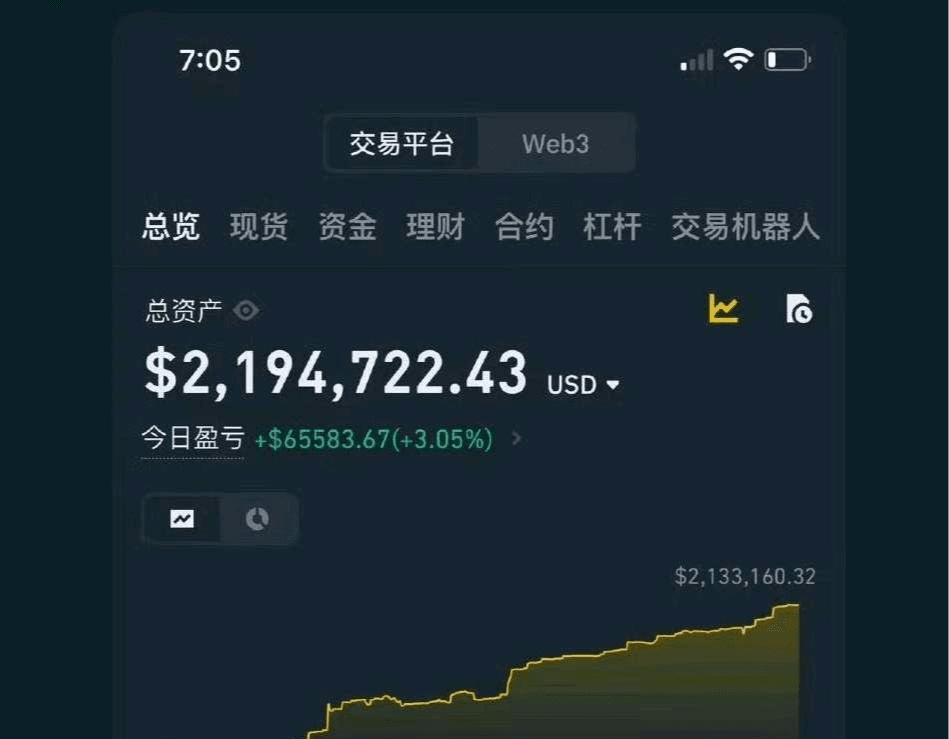
If your account has less than 1 million and you want to make a profit in the short term, there is indeed a timeless trading strategy in the crypto world*, which is also a tried-and-true "foolproof technique" that retail investors can easily apply at a glance. It's pure, practical information!
Don't worry about whether you can learn it. If I can seize this opportunity, you can too. I'm not a god, just an ordinary person. The difference between others and me is that others overlook this method. If you can learn this method, you will be able to apply it in your later trading.
It seems that it can help you earn at least 3 to 10 percent more per day.
1️⃣ Invest in batches: Suppose you have 10,000 yuan, divide it into five parts, and use only 2,000 yuan of it for each transaction.
2️⃣ Test Investment: First, use 2000 yuan to buy a cryptocurrency to test the waters.
3️⃣ Add to your position if the price drops: If the price drops by 10%, add another 2000 yuan to your position.
4️⃣ Take profits when the price rises: If the price of the coin rises by 10%, sell a portion to lock in profits.
5️⃣ Repeated Cycle: Continuously buy and sell until funds are exhausted or all coins are sold.
Strategic Advantages: The advantage of this strategy is that you can remain calm even if the price of the coin falls. By buying in batches, you avoid the risk of a one-time investment. Even if the price drops by half, you only gradually increase your position. And each time you sell, you lock in a 10% profit. For example, if you have 100,000 yuan, investing 20,000 yuan each time will earn you 2,000 yuan each time.
Key techniques include:
Technical analysis: using charts and indicators to identify trends;
Fundamental analysis: Focus on news and macroeconomic factors;
Risk management: Setting stop-loss orders and diversifying investments;
Trading strategies: Determining entry and exit points and using different strategies;
Psychological factors: Maintaining discipline and patience;
Practice and learning: simulated trading and continuous learning;
Choose a reliable trading platform.
Cryptocurrency trading carries significant short-term risks; thorough research and risk assessment are essential before engaging in any trade.

Having traded cryptocurrencies for over 10 years, I've climbed my way up from a complete novice to achieving financial freedom and upward social mobility. Here, I'd like to share some common mistakes beginners make when trading cryptocurrencies and how to avoid them.
Amid the cryptocurrency boom, more and more newcomers are attracted by its potential high returns and are entering the cryptocurrency market. However, cryptocurrency trading is not a smooth road, and beginners often fall into various pitfalls, resulting in heavy losses.
This paper provides an in-depth analysis of common misconceptions among novice cryptocurrency traders and proposes corresponding strategies to avoid them.
I. Common Misconceptions for Cryptocurrency Trading Beginners
1. Blindly following trends
Novice investors often lack independent thinking and are prone to blindly following trends. Seeing a cryptocurrency's price rise or hearing someone recommend it, they buy without hesitation, ignoring the underlying fundamentals and technicals. This kind of blind following is extremely dangerous. Market sentiment changes rapidly, and by the time novices buy in, the price may already be high, leading to significant losses if the market reverses.
For example, during the hype surrounding certain popular cryptocurrencies, newcomers rush in as prices soar. However, these cryptocurrencies may lack real value and are merely bubbles created by market speculation. When the bubble bursts, prices plummet, and these newcomers often become the last ones left holding the bag.
2. Buying high and selling low
Buying high and selling low is another common mistake for novice cryptocurrency traders. When the price of a coin rises, beginners, driven by greed, buy at the peak, hoping the price will continue to rise and they can make more profit. Conversely, when the price falls, they panic and sell, fearing further losses.
This behavior not only increases transaction costs but also causes investors to miss out on genuine investment opportunities. The cryptocurrency market is highly volatile, with price fluctuations being the norm. Chasing highs and selling lows often leads investors astray amidst market volatility, resulting in frequent trading and ultimately, losses.
3. Lack of risk awareness
Novice investors often lack awareness of risk, focusing only on the high returns of cryptocurrencies while ignoring their high risks. They may invest large sums of money in the cryptocurrency market, even resorting to borrowing to trade, without properly managing their funds and managing their risks.
The cryptocurrency market is highly uncertain and risky. Price fluctuations can cause investors' assets to shrink significantly, or even result in total loss. Newcomers should fully understand the risks, manage their positions reasonably, and avoid putting all their eggs in one basket.
4. Over-reliance on technical analysis
While technical analysis has some value in cryptocurrency trading, beginners often over-rely on it, neglecting fundamental analysis and market sentiment. They may make buy and sell decisions based on technical indicators without considering the actual value of the cryptocurrency and market trends.
Technical analysis is merely a tool and should not be the sole basis for decision-making. The cryptocurrency market is influenced by a variety of factors, including policies and regulations, market sentiment, and project fundamentals. Newcomers should consider all factors comprehensively to make more accurate investment decisions.
5. Unstable mindset
An unstable mindset is also a major misconception for novice cryptocurrency traders. In market fluctuations, beginners are easily influenced by emotions, experiencing greed, fear, and anxiety. When prices rise, greed can lead to excessive optimism and an oversight of risks; when prices fall, fear can cause panic and lead to poor decision-making.
A good mindset is key to successful cryptocurrency trading. Investors should remain calm and rational, and not let emotions control them. During market fluctuations, it's essential to learn to manage your emotions and make informed decisions.
II. How to avoid common mistakes for cryptocurrency trading beginners
1. Cultivate independent thinking ability
Novice investors should strive to cultivate their independent thinking skills and avoid blindly following trends. Before making investment decisions, they should conduct in-depth research and analysis of the cryptocurrency, understanding the underlying technology, team, application scenarios, and other factors.
At the same time, it's essential to learn to analyze market trends and sentiment, and avoid being swayed by short-term price fluctuations. Through continuous learning and practice, improve your analytical and judgment skills to make more informed investment decisions.
2. Develop reasonable trading strategies
Novice investors should develop reasonable trading strategies to avoid chasing highs and selling lows. They can determine appropriate buying and selling times based on their risk tolerance and investment goals. For example, a strategy of buying and selling in batches can reduce transaction costs and mitigate risk.
Furthermore, it is crucial to strictly adhere to your trading strategy and avoid being swayed by emotions. When market fluctuations occur, operate according to your established strategy and do not arbitrarily change your trading plan.
3. Enhance risk awareness
New investors should fully understand the risks of the cryptocurrency market and rationally plan their funds and risks. Do not invest all your funds in cryptocurrencies; determine an appropriate investment ratio based on your risk tolerance.
At the same time, it's essential to diversify your investments to reduce risk. Consider investing in different types of cryptocurrencies to avoid concentrating your investments in a single coin. Furthermore, set reasonable stop-loss and take-profit levels to lock in profits and control losses in a timely manner.
4. Utilize a variety of analytical methods
Novice investors should utilize a variety of analytical methods and avoid over-reliance on technical analysis. In addition to technical analysis, they should also pay attention to the fundamentals of the cryptocurrency and market sentiment. Understanding the project's technical capabilities, team background, application scenarios, and other fundamental aspects, as well as market trends and hot topics, will allow for more comprehensive investment decisions.
Adjust and optimize based on your own specific circumstances. At the same time, continuously learn and master new analytical methods and tools to improve your analytical abilities and skills.
5. Maintain a positive attitude
Novice investors should maintain a good mindset and not be swayed by emotions. During market fluctuations, remain calm and rational, and avoid panicking. Taking appropriate breaks and relaxing can help relieve stress and adjust your mindset.
At the same time, it's crucial to establish sound investment principles and avoid viewing cryptocurrency trading as a path to overnight riches. The cryptocurrency market is highly uncertain and risky; investors should view the market with a long-term perspective and avoid being tempted by short-term gains.
In short, novice cryptocurrency traders need to avoid common pitfalls such as blindly following trends, chasing highs and selling lows, lacking risk awareness, over-reliance on technical analysis, and unstable mindset. By cultivating independent thinking, developing sound trading strategies, enhancing risk awareness, utilizing multiple analytical methods, and maintaining a good mindset, novice investors can improve their investment skills and profitability, achieving better returns in the cryptocurrency market. At the same time, novice investors should continuously learn and accumulate experience, improving their overall capabilities to prepare for long-term investment.
These are the trading experiences Rongrong shared with you today. Many times, you miss out on numerous money-making opportunities because of your doubts. If you don't dare to try, explore, and understand, how will you know the pros and cons? Only by taking the first step will you know what to do next. A cup of warm tea, a word of advice—I am both a teacher and a friendly friend.
Meeting is fate, understanding is destiny. The instructor firmly believes that those destined to meet will eventually meet, even from afar; those not destined will simply brush past each other. The road to investment is long, and temporary gains or losses are merely the tip of the iceberg. Remember, even the wisest can make a mistake, and even the most foolish can sometimes succeed. No matter your emotions, time will not stand still for you. Pick yourself up from your troubles, stand up again, and move forward.
I'm Rongrong, and I've weathered multiple bull and bear market cycles, accumulating rich market experience across various financial sectors. Here, I cut through the fog of information to uncover the true nature of the market. Seize more opportunities to unlock wealth and discover truly valuable opportunities—don't miss out and regret it!
Giving a man a fish is not as good as teaching him how to fish. Whether you're a novice or an expert in the cryptocurrency world, with Rongrong, you'll gain more than just financial returns; you'll also grow in investment knowledge and experience. Following the instructor's guidance, Rongrong will not only provide investors with market analysis strategies, basic chart reading knowledge, and how to use various investment tools, but also offer insightful fundamental analysis, a clear understanding of the complex international situation, and the identification of various investment forces. This will help you become both a winner and an expert in investing!
To navigate the cryptocurrency market effectively, mastering the seven key trading principles is essential for understanding the art of investment—entering and retreating, offense and defense. This allows one to remain steadfast amidst opportunities and turn danger into safety when facing pitfalls. Having navigated the market for many years, Rongrong is well-versed in its opportunities and pitfalls. If you're experiencing investment setbacks and are unwilling to accept your losses, contact Rongrong, and I will correct your past mistakes. If you are already profitable, I will teach you how to protect your profits. If you are still feeling lost and confused in the market, Rongrong is willing to guide you. The true tragedy of trading lies not in how much suffering you endure, but in how many opportunities you miss! Seize the present and let's move forward together. I am Rongrong, someone who will leave a mark on the cryptocurrency world in the future.
Welcome to follow Rongrong! You can watch live trading sessions, learn and exchange ideas, and gain a clear understanding of market direction and strategies. Knowing the market's style in advance allows you to better manage it!
There are still spots available in the team, hop on board quickly, and we'll help you become the house and the winner.

