


For beginners trading cryptocurrencies, in addition to understanding basic crypto knowledge, you must clearly define your purpose in entering the crypto world: are you investing or speculating? If you're just hoping to get rich overnight by luck, I'd advise you to quit early. The crypto world today is no longer what it was ten years ago. Without awareness and learning ability, you'll only end up being a victim.
The so-called basic knowledge is usually divided into the following points
First: Basic knowledge of exchanges
The first lesson for people in the crypto world is how to choose an exchange. If you fail at this step, even with extensive investment skills, your efforts will ultimately be in vain.
Because there are numerous scam exchanges on the market, many novices download fake platforms at the first step, while others may be introduced to unknown platforms with little reputation, ultimately leading to significant financial losses.
Second: Understand the basic underlying logic.
What are the reasons for price fluctuations? Which coins can be bought, and which coins should not be touched?
There are many reasons for the rise and fall of cryptocurrency prices, including policy factors, manipulation by big players, market demand, the identity of the issuer, and other comprehensive considerations. It is necessary to pay attention to real-time data.
Third: Build your own trading system.
How much should you invest, and at what point should you enter the market? Once you enter the market, you must consider what might happen next, how to handle profits, whether to increase your position, fully take profits and exit, or continue holding.
What if the profits expand again? What if you incur losses? Should you stop-loss, hold the position, or partially exit? How much loss will trigger a full exit?
This stage is the most difficult to learn and is the core key of the entire trading process, so do not rush; you must be skilled and confident before you start trading.
Fourth: Control and manage trading psychology.
To stabilize your mindset, you must first see through the essence of trading coins, distinguish between primary and secondary, and understand that trading coins is just a side job. You must invest spare money; in the days to come, you will not lose control of your emotions.
Beginners should not play contracts, as contracts have the greatest impact on psychology and can easily lead to collapse.
There is no need to stare at the market constantly when trading spot; view price fluctuations calmly. All coins in the crypto market will rise and fall. Don't calculate how much you earned or lost every day.
Do not be greedy, do not chase highs and lows, do not fantasize about getting rich overnight, and do not easily believe those who promise to help you make money; their essence is to profit from you. There is no free lunch in the world; everything has already been secretly priced.
Finally, if you have made a profit and want to withdraw funds, be sure to pay attention to the possibility of receiving illicit funds. Regardless of whether it is from exchanges or over-the-counter trades, there is a risk of your bank card being frozen. Be cautious when choosing a coin dealer; do not let your hard work be destroyed in this last step.
You should know that locking in profits is not just receiving money; it means receiving money without getting your account frozen.
Finally, here are 16 iron rules to pay attention to: especially the last one, every word is golden advice!
1. Choose altcoins in a bull market; buy BTC in a bear market. This is my secret!
2. Altcoins with volume at the bottom must be given special attention; this could be a signal to start. Don't miss it!
3. For coins in an uptrend, when they pull back to important moving averages, it is the best time to buy. Remember to seize the opportunity!
4. Do not trade frequently; making a few large trends correctly in a year is enough. Greed can lead to significant losses!
5. You must control your position well; never go all in. Leave yourself some room to cope with market changes!
6. For losing junk coins, do not average down; timely stop-loss is the wise choice. Don't let yourself fall deeper!
7. News can only serve as a reference; do not blindly follow the crowd to gamble, or you will bear the consequences!
8. Do not touch unfamiliar coins; focus on the fields you are familiar with to ensure a higher success rate!
9. Don't let market emotions control you; stay calm and rational so that you can make the right decisions!
10. When altcoins rise too much, they will definitely fall; when they fall too much, they may not rise. Choice is very important; keep your eyes wide open!
11. When most people are optimistic, it is often when risks arise. Remember this; don't let yourself become the one left holding the bag!
12. Learn to stay in cash and wait for the market to provide clear signals before entering; this can help avoid unnecessary losses!
13. Do not follow the hype; trends often come quickly and leave quickly, so don't get trapped!
14. When trading, you must have your own trading system and strictly follow it to maintain stable profits!
15. Investment is a long-distance race; maintaining a good mindset is the key to smiling in the end. Don't let yourself give up halfway!
16. Investment does not guarantee profit; the probability of losing money is high. Therefore, try to use spare money for investment, which will keep your mindset good and increase your chances of winning. Remember this and don't let yourself fall into difficulties because of investing!
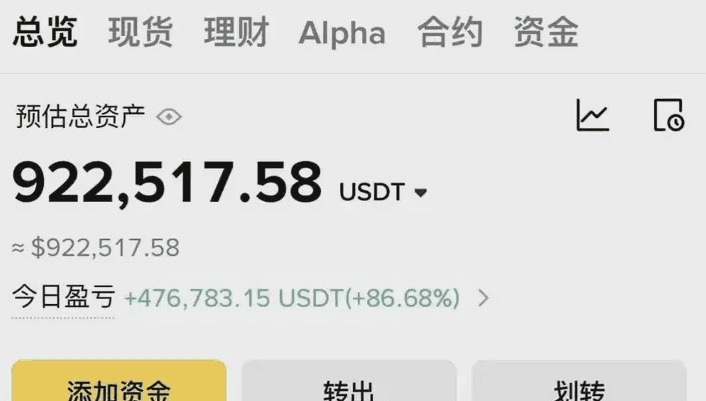
This article shares a set of (swing trading) (how to determine trading cycles).
First: The candlestick range principle. I primarily focus on 200 to 300 candlesticks and try to keep the number of candlesticks within this range; there is no limit to the cycle.
I believe that candlesticks that are relatively far apart have little impact on future market trends, and there is no need to refer to such distant price ranges to formulate your trading strategy. If you refer to too many things, it will place a significant burden on your trading system, except for key levels and resistance levels.
Second: During the training phase, it is best to control the trading cycle between 15 to 60 minutes. The goal of practice is to capture as much trading experience as possible, accumulate more trades, rather than focus on profits. The purpose of the training phase is to feel the market, hone our skills, improve our abilities, and then gradually build and improve the trading system. Therefore, during this phase, you need to do as many trades as possible in the market, so I believe smaller cycles are better.
Why is a small cycle 15 minutes? Because some beginners have already reached their upper limit of reading charts at the 15-minute level. If after a period of training, your chart reading ability and skills have improved, you can shorten this cycle; a 5-minute cycle is the best.
With a 5-minute cycle, you can complete over 100 short-term trades in three to six months. If these 100 to 150 short-term trades are conducted within your specified trading framework, it will provide you with a very rich experience in trading learning, which is very important.
Third: The main bandwidth (main volatility) is generally within the cycle of 1 hour to 8 hours, and different varieties have different volatility.
I believe the main bandwidth for Bitcoin is within the range of 4 hours to 8 hours. Currently, Bitcoin has very low volatility, with daily fluctuations of only one or two hundred dollars, which can be ignored; you cannot trade in small cycles. In small cycles, the candlesticks you see are more about continuous fluctuations and entanglements. When making candlestick judgments, you will find that there are many upper and lower shadows, and candlesticks overlap significantly, making it nearly impossible to read the chart, so it is very difficult to trade.
When you switch to four hours, you can discover some candlestick patterns that give you hints.
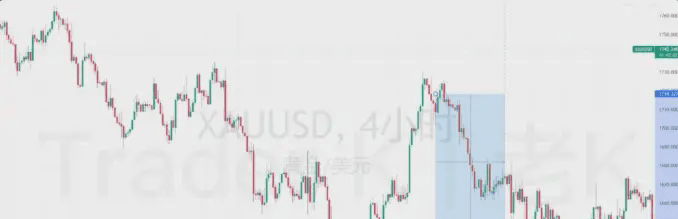
I believe the main bandwidth for gold is within one hour. Because if you exceed one hour, such as four hours, it will span a longer time period. Assuming we trade this segment, it also spans seven days, during which important news or announcements may be released. If such events occur, they can have a significant impact on your position. Therefore, when trading gold or forex, use smaller time frames, such as one or two hours.
Fourth: During periods of stagnation, it is advisable to be cautious with large cycle operations to prevent shocks from significant news or information. In a sluggish market, it is easy to be affected by large volatility, whether the shock is upward or downward, it will easily hit your stop-loss; it may even cause significant instantaneous fluctuations, leading to your liquidation due to insufficient depth.
Fifth: Try to trade during the main trading volume time zones. Some 24-hour trading products have relatively low trading volumes during the Asian time zone, but are relatively better during the European time zone. The best time is during the US trading hours.
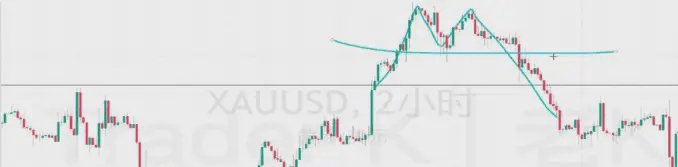
Sixth: It is not recommended to engage in cross-cycle trading. For example, in a two-hour level chart, when the momentum weakens at the top, reversal patterns, and double tops are present, after breaking the neckline, if you discover a trading signal and want to enter at a smaller cycle, such as at this position for a 15-minute entry, this can lead to a higher risk-reward ratio.
This is possible, but it can be very difficult for beginners to execute this trade because of the impossible triangle of trading: risk-reward ratio, win rate, and trading opportunities cannot be achieved simultaneously. When you see a great opportunity and enter the market with an extremely short time frame, using very tight stop-losses to achieve a high risk-reward ratio, but it is tough for beginners to withstand the entire process's volatility when trying to go from the bottom to the top; furthermore, high risk-reward ratios lead to low win rates, resulting in frequent consecutive stop-losses, which can be a significant blow to your confidence.
As a beginner, start with some simple trades, and first understand the basic current cycle trading signals, trading logic, and trading system.
Seventh: The issue of individual differences. Although trading cycles vary from person to person and differ significantly from one's own trading habits, most traders overlook a crucial problem, which is that when you have not yet achieved stable profits, you should do everything possible to accumulate more trading experience.
Only when you have enough trading frequency and rich experience do you have the initiative to choose your trading cycle. Otherwise, lacking experience and having too large a trading cycle can make it difficult to grow in a short time. Therefore, the prerequisite for determining the trading cycle is to participate in market trading as much as possible, allowing yourself to undergo rapid training, accumulate sufficient practical experience, and then consider the advantages and disadvantages of different cycles in relation to yourself.
(Swing Trading) 3 | (Trading strategies and ideas for potential breakthroughs)
A potential breakthrough refers to a very strong trend in the candlestick, which may soon break through a key level or a key resistance level. When handling potential breakthroughs, the first step is to identify the key positions, which are usually key horizontal levels; do not look for diagonal lines, as they are more ambiguous.
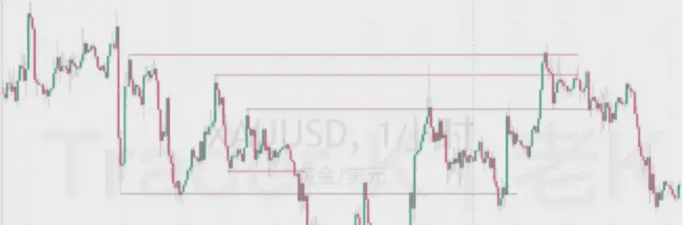
A very critical level has a characteristic: it is obvious, and most people can discover its existence through graphical means. Usually, it is the intersection of several price extremes, and when the price approaches these positions, there will be a certain degree of performance. For example, before breaking through this key position, a bearish candle may appear first, which is the first failed breakout pullback; thereafter, the second upward breakout succeeds.
It will still have a pullback before breaking out, and before the breakout is completed, we can only consider it a failed breakout, not a successful one. Only when the subsequent candlesticks emerge can we determine that it is a successful breakout, which is very critical.
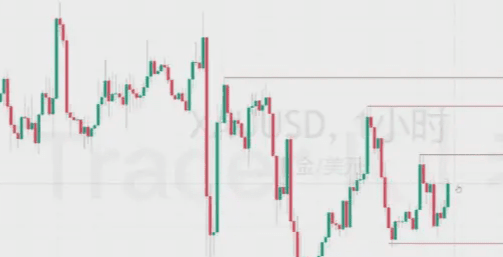
Before the price has broken out, we do not know that it will make some crosses at certain future prices. How to handle this issue?
When the price fluctuates midway, we need to pre-mark the relevant levels of the previous high and low points. When the price reaches these positions, we should pay attention to how the price performs.
However, whether upward or downward, there will always be many resistance and support levels interfering with your price movement and disrupting your trading thought process. At the same time, most people in the market will also have this thought, so the divergence in market direction becomes significant, leading to chaotic fluctuations in specific price performances.
The difficulty of trading in a fluctuating trend is due to these reasons.
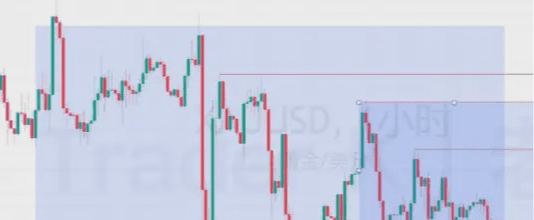
The second is when a key level is expected not to break through, handle it conservatively according to the potential range. The market has reached its current position, where it can be expected to be a larger trading range, nested with some smaller trading ranges that may fluctuate back and forth within these larger and smaller trading ranges. Therefore, when making breakthroughs on some key positions, first expect that this position is likely to be a false breakout; we should handle it conservatively according to the false breakout or non-breakthrough to avoid continuous stop-loss.
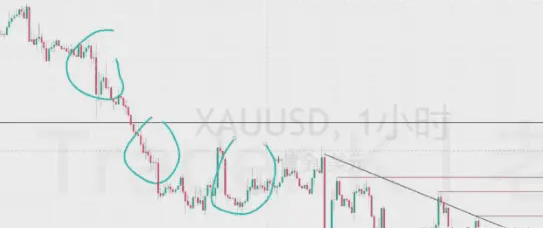
However, as our trading experience gradually enriches, we can diversify the handling of potential trading ranges. Diversified handling means interpreting its more possibilities and which direction it is more likely to develop.
For example, if its highs are gradually lowering while the lows do not, it may be a converging triangle. After the converging triangle forms, we can expect it to continue the previous bearish trend and break down. Within this converging triangle, we can also see that the bearish trend candlesticks are very strong.
As we gradually enrich our trading experience, these patterns can also be used for trading.
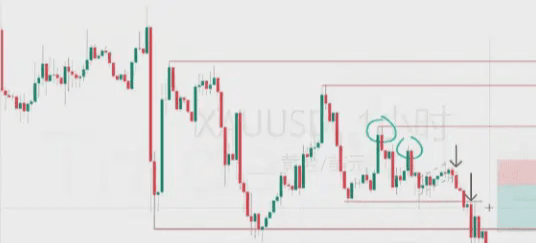
In addition to potential trading ranges, we can also notice the last three rebounds, where the bullish momentum gradually weakens. In the last rebound, the bulls form a bear flag, and there is a signal candlestick that breaks down through the bear flag, with previous double doji and triple doji, enabling entry at these points for trading.
Set your take profit at the bottom position. When engaging in potential range trading, do not expect too much take profit space. If you are focused on the market and have a strong grasp of the candlestick momentum, you may not need to set a take profit. When the candlestick runs to the lower position, observe whether the momentum has exhausted; if it hasn't, and it breaks down directly, you can hold on.
However, many times, after breaking through the range, the rebound is also very strong, and during the trading day, it will pull back to the breakout position. Therefore, when you take this trade, your mindset will be tortured. Because approaching a risk-reward ratio of two with floating profits, due to greed, you do not take profits, and the risk-reward ratio immediately retracts to less than one, and you may soon hit your entry point. At this time, you will panic. If you have this mindset, it is recommended that you do not engage in expected breakouts; just manually take profits at the bottom.
If you miss the drop behind, there is really nothing you can do. After extensive targeted training, you will understand that there is a high probability of a failed breakout before a breakout occurs. You can accept those places where the breakout pullback action is relatively healthy, and then you can take the trade. However, it cannot avoid a failed breakout, significant reverse movement, or even hitting your stop-loss. These situations are unavoidable.
Therefore, my trading principle is that in most cases, I will choose to close positions at the bottom and conservative positions, without being greedy. Only when the entry position is very good, and the previous entry structure is also very good, will I not set a take profit. For example, if there is a very strong bearish trend ahead, followed by a double top, breaking the neckline and pulling back, and then breaking down, if you enter at these positions, your entry point is quite good, but it is not something you can always meet.
Third: If a breakthrough is expected, there must be good structural support. Whether the breakout succeeds or fails cannot be predicted in advance by any means.
I can only say that after trading for a long time, you will gain some experiential knowledge.
Fourth: The main problem with breakout trading. Low win rate, high risk-reward ratio, and difficulty in identifying breakouts. It is essential to deeply understand failed breakouts, breakout pullbacks, and breakout tests.
I often engage in breakouts, but I will choose situations where the entry positions are particularly good. First, even if the breakout fails, I can retreat safely; second, I may also choose to close positions early, resulting in very small stop-losses. The aim is to use a single stop-loss to test multiple breakouts, thus maximizing the risk-reward ratio.
I have achieved a risk-reward ratio of one to ten in some trades, but before that trade, I had already made multiple attempts; this is just the final result.
Failed breakouts, trend reversals after failed breakouts, successful breakouts, and trend continuations after breakouts are the most common and ordinary logic in price movements. I believe all price movements follow this basic process. Therefore, a failed breakout is the basis for all trend reversals, but a failed breakout does not necessarily mean a reversal.
At the critical point about to break through, both bulls and bears will assess the strength of the breakout. If the building formation and entry candlestick are very good, most traders in the market will expect the breakout to succeed, which is very important.
The issue of whether a breakout is successful or not lies in the accumulation process before the breakout; this transition process is very subtle. When the price is in the process of breaking out, after the first failed breakout, like the current candlestick, when it fails and pulls back to the breakout area, those who have already shorted and those who are waiting to enter after missing the breakout will choose to enter at the pullback breakout position. At the same time, those who are long may also choose to close their positions at these points or the next candlestick.
At this point, in this extreme region, both sides' views will change and lean in the same direction, and the price will break through in a certain direction. When we judge the trend of candlestick movements and handle potential breakthroughs, we need to have a complete and coherent logical thought process, including how most people in the market think about candlesticks, how they think about patterns, and how they think about the process of price changes. If you do not have this mindset, it is not recommended to engage in potential breakthroughs.
After undergoing some training and acquiring a certain level of knowledge, you can establish your own breakout thinking based on this logic.
This is the trading experience shared by Rong Rong today. Many times, you lose many opportunities to make money due to your doubts. If you do not dare to try boldly, touch, and understand, how do you know the pros and cons? You can only know how to proceed after taking the first step. A cup of warm tea, a piece of advice, I am both a teacher and a friendly conversationalist.
Meeting is fate, knowing each other is a division. I firmly believe that if fate allows, we will meet regardless of distance; if there is no division, it is destiny. The path of investment is very long, and momentary gains and losses are just the tip of the iceberg. Remember, even the wisest can make mistakes, and the least wise may find success. Regardless of your emotions, time will not pause for you. Pick up the worries in your heart and stand up again to move forward.
The martial arts secret manual has been given to you; whether you can become famous in the world depends on yourself.
Welcome to follow Rong Rong, where you can learn and communicate with real-time trading, and clearly understand the direction and strategy of the market. No matter what style the market is, knowing in advance can give you time to better grasp it!
The team still has spots available, hop on quickly to become a big player and a winner.

