
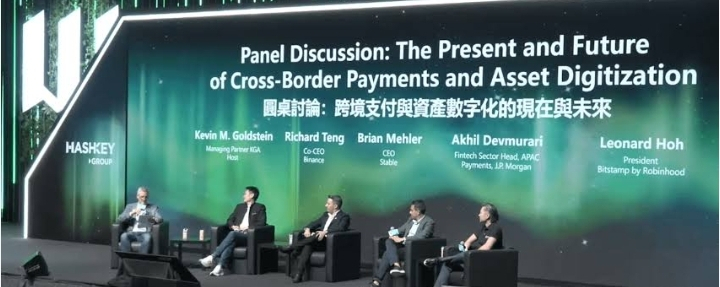

The global financial system is undergoing one of its most profound transformations in decades. In today’s panel discussion, industry leaders, fintech innovators, and policymakers explored how cross-border payments and digital asset tokenization are converging to reshape global finance.
From stablecoins to CBDCs, and from real-time rails to tokenized assets, the message was clear:
👉 The future of money is faster, programmable, and borderless.
🔹 The Present: A System Still Facing Friction
Despite technological progress, today’s cross-border payments ecosystem remains inefficient:
High transaction costs
Slow settlement times (often days)
Complex intermediary chains
Regulatory fragmentation
These inefficiencies stem largely from legacy correspondent banking systems and fragmented infrastructure. �
thepaymentsassociation.org
💡 Panel consensus:
The current system is functional—but far from optimal.
🚀 The Rise of Real-Time & Interoperable Payment Systems
A major theme of the discussion was the shift toward real-time global payments.
Instant domestic payment systems are now being linked across borders
ISO 20022 is becoming the global messaging standard
Account-to-account (A2A) payment corridors are expanding
This transformation is pushing the industry toward 24/7, near-instant global transactions. �
Thunes.com
📊 Insight from panelists:
“Speed is no longer a competitive advantage—it’s an expectation.”
💰 Stablecoins: The Backbone of Next-Gen Cross-Border Payments
Stablecoins dominated the discussion as a practical solution already in use today.
Key advantages:
Near-instant settlement
Lower costs
Reduced need for pre-funded accounts
Programmability
By 2026, stablecoins are moving from experimentation to core financial infrastructure. �
FXC Intelligence
Recent developments reinforce this trend:
Growing demand for USD-backed and emerging regional stablecoins �
Reuters
Traditional giants like Mastercard investing heavily in stablecoin infrastructure �
Reuters
💡 Panel takeaway:
Stablecoins are not replacing banks—they’re upgrading them.
🌐 CBDCs & Geopolitics: The New Financial Power Play
Central Bank Digital Currencies (CBDCs) are becoming strategic tools for global influence.
China’s cross-border digital currency platform is expanding rapidly �
Reuters
BRICS nations are exploring CBDC-based payment integration �
The Economic Times
Europe is pushing for euro-based digital alternatives �
Reuters
🌍 Panel insight:
Digital currencies are not just financial tools—they are geopolitical instruments.
🧩 Asset Digitization: Unlocking Trillions in Value
Another key focus was the tokenization of real-world assets (RWAs):
Real estate
Bonds and equities
Commodities
Infrastructure assets
Tokenization enables:
Fractional ownership
Increased liquidity
Global accessibility
Faster settlement
According to global projections, entire asset classes may soon be traded on-chain, transforming capital markets. �
World Economic Forum
💡 Panel takeaway:
“Everything that can be tokenized—will be tokenized.”
🔗 The Convergence: Finance Becomes One Unified System
A powerful theme emerged during the discussion:
👉 The fusion of traditional finance (TradFi) and decentralized finance (DeFi)
This includes:
Banks integrating blockchain rails
Wallets becoming global financial hubs
Platforms offering all-in-one financial services
By 2026, the industry is shifting from competition to integration. �
Conduit Pay
⚖️ Regulation: From Barrier to Enabler
Regulation was once seen as a bottleneck—but that narrative is changing.
Clear frameworks for digital assets are emerging globally
Compliance is becoming real-time and technology-driven
Governments are integrating crypto into formal systems
For example:
Pakistan recently moved to integrate virtual asset providers into its banking system, signaling growing regulatory acceptance. �
Reuters
💡 Panel consensus:
Regulation is becoming the foundation for mass adoption—not an obstacle.
🔮 The Future: What Comes Next?
Panelists highlighted several defining trends for the next phase:
1. 🌍 Borderless Financial Infrastructure
Payments will move seamlessly across banks, wallets, and blockchains.
2. ⚡ Instant Global Settlement
Days → seconds
3. 🧠 AI-Driven Payments & Compliance
Smarter fraud detection, routing, and automation
4. 🪙 Multi-Currency Digital Economy
Stablecoins + CBDCs + tokenized assets coexisting
5. 🔗 Interoperability as the Key Differentiator
The winners will be those who can connect everything
🧠 Final Thoughts
Today’s panel made one thing clear:
The transformation of cross-border payments and asset digitization is no longer theoretical—it’s happening now.
The financial system is evolving into:
Faster
More transparent
More inclusive
Programmable by design
For investors, institutions, and everyday users, this shift represents a once-in-a-generation opportunity