


Key points:
Different visions for the development of blockchain can lead to disagreements even among successful teams.
Gavin Wood played a key technical role in the creation of Ethereum and its smart contracts.
Wood's departure from Ethereum was driven by a desire for scalability and multi-chain architecture.
His work on Polkadot and Web3 Foundation developed new approaches to blockchain interoperability and the evolution of Web3.
The contrast between Ethereum and Polkadot demonstrates different philosophies of blockchain development and stimulates innovations in the crypto industry.
The history of Ethereum shows how innovative ideas can unite strong developers, but over time lead to their paths diverging. Among Ethereum co-founders, Gavin Wood played an important role, being responsible for the project's technical vision. As the ecosystem evolved, various approaches to decentralization, scaling, and the future of blockchain emerged. It was these differences in vision for the development of Web3 that led some founders, including Wood, to decide to pursue their own paths.
Short biography of Gavin
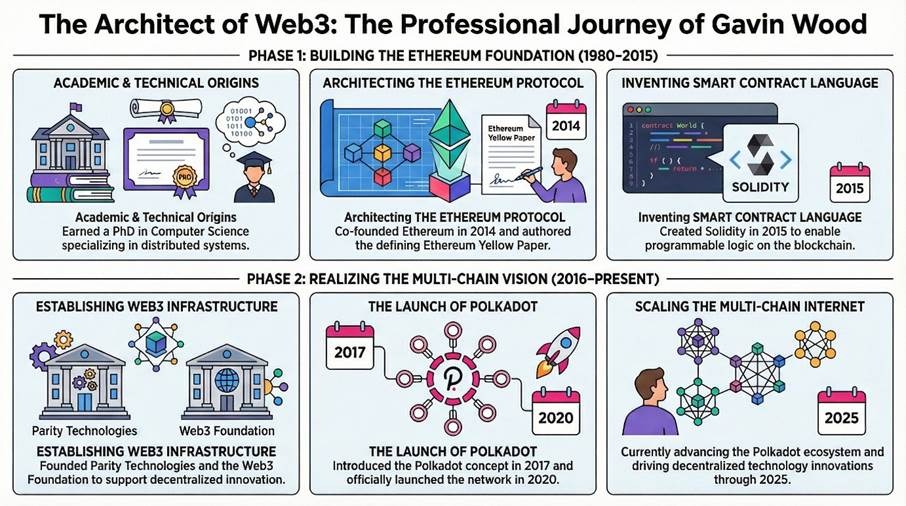
Gavin Wood is a British programmer and scientist who has significantly influenced the formation of the modern blockchain industry. He obtained a PhD in computer science and focused on researching distributed systems, which later became the basis for his work in the crypto sphere. His experience in creating complex software architectures helped lay the groundwork for further crypto innovations in Web3.
Wood co-founded Ethereum in 2014 and played a key role in its technical development. He is the author of the Ethereum Yellow Paper, created Solidity, and also founded Parity Technologies and Web3 Foundation, which continue to develop ideas of decentralization.
Wood is considered one of the leading technical experts in crypto. His contributions go beyond individual products and encompass the formation of the very concept of Web3. Thus, his career is an example of influential technical leadership in the field of crypto innovation.
What exactly did Gavin contribute to Ethereum
Gavin Wood's role in the history of Ethereum was decisive from a technical standpoint. He did not just join the team; he effectively created the architectural basis of the network and its operational principles, defining the logic of smart contracts and the Ethereum Virtual Machine. This approach laid the groundwork for further crypto innovations and the development of decentralized applications. His key contributions can be summarized as follows:
writing the formal specification of Ethereum (Ethereum Yellow Paper)
creating Solidity as a tool for developers
developing the concept of Ethereum Virtual Machine (EVM)
implementation of universal computations in blockchain
formation of standards for decentralized applications
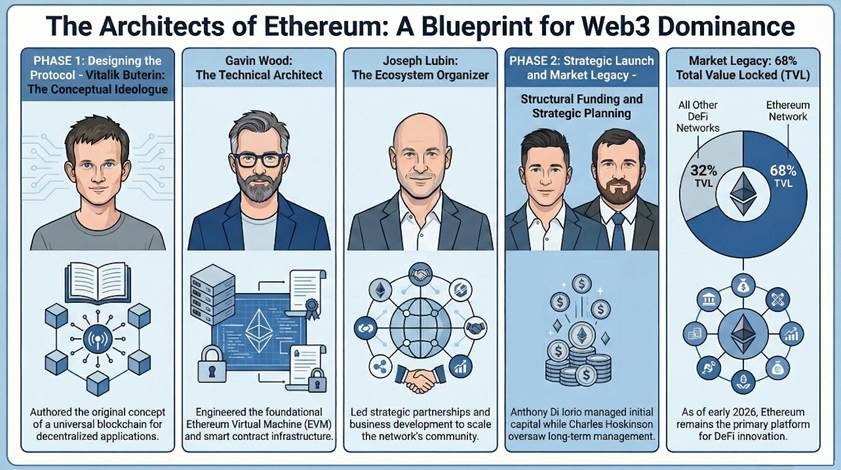
Modern statistics confirm the scale of this impact: by 2025, the total value locked in DeFi on Ethereum exceeded $99 billion, and the platform held approximately 60–70% TVL among all blockchains. This demonstrates that even more than ten years after the creation of Ethereum, Wood's architectural solutions remain decisive for the development of the blockchain ecosystem. Thus, his contribution became the foundation for the entire subsequent evolution of DeFi and Web3.
Ethereum as a collective project, not a story of one person
Ethereum has never been a project of a single individual — it emerged as a result of collaboration among talented developers with diverse ideas, skills, and ambitions. This combination of different approaches became the driving force for the rapid development of the protocol but also gave rise to conflicts over the future direction. Ultimately, differing visions for the future of Web3 led some co-founders to pursue their own paths. Among the key participants who played an important role in the formation of Ethereum are:
Vitalik Buterin — the ideologist of the platform, author of the concept of a universal blockchain for decentralized applications
Joseph Lubin — business leader and community organizer, fostered strategic partnerships and ecosystem development
Anthony Di Iorio — responsible for initial funding and structural support of the project
Charles Hoskinson — engaged in long-term strategic planning and management
Gavin Wood — technical architect who laid the foundation for smart contracts and EVM
Why Wood left Ethereum
Over time, discrepancies began to emerge among the founders regarding the development of the blockchain. Wood sought a more structured and scalable architecture than early versions of Ethereum could offer, emphasizing the need for a more flexible system capable of working with multiple blockchains simultaneously. This was one of the reasons for his departure in 2016 and the search for ways to realize his vision of a multi-chain ecosystem.
Among the main reasons for this decision are:
the scalability limitations of Ethereum, which hindered the speed and efficiency of the network
different visions of decentralization, where Wood prioritized technical autonomy and security
the desire to create a multi-chain ecosystem capable of integrating different blockchains and applications
technical disputes regarding the future of the protocol, including approaches to smart contracts and governance
the desire for greater independence in development to implement innovative ideas without compromises
Wood began to focus on projects that preceded the creation of Polkadot and Web3 Foundation, aiming to address scalability and interoperability issues between blockchains. Scalability remains one of the key problems of Ethereum, confirming Wood's concerns. As a result, his departure was a logical step in the development of the crypto industry and initiated a new stage in the evolution of the multi-chain ecosystem.
What happened next in Wood's career
After leaving Ethereum, Wood did not disappear from the crypto scene; on the contrary, he expanded his influence and began working on an alternative architecture for blockchains aimed at creating a more flexible multi-chain ecosystem. He founded Polkadot and Web3 Foundation, as well as developed tools for cross-network interaction, actively promoting the idea of Web3 as an open network for developers and users.
Let’s enumerate his subsequent steps:
launch of Polkadot
development of Web3 Foundation
creation of tools for cross-network interaction
promotion of the Web3 idea
support for new startups
This demonstrates that his new direction received practical recognition in the crypto industry and allowed for the development of a multi-chain ecosystem that attracts the attention of developers and users. Wood's career after Ethereum only strengthened his influence on the development of blockchain technologies and the crypto industry as a whole.
Ethereum vs Polkadot as a reflection of two approaches
Ethereum and Polkadot represent different philosophies of blockchain development. The former focuses on a single network with scaling through L2 solutions, while the latter is oriented towards a multi-chain ecosystem with parallel blockchains. This opposition illustrates the broader divide in the crypto industry and the different approaches to decentralization and blockchain development. The main differences between them can be presented in the form of a table:
Characteristics | Ethereum | Polkadot |
Architecture | Monolithic network | Network of parachains |
Scaling | Through L2 solutions | Parallel blockchains (multi-chain) |
Governance model | Community + Ethereum Foundation | Nominated Proof-of-Stake, decentralized governance of parachains |
Focus | dApps and DeFi | Infrastructure for blockchain interaction and multi-chain ecosystem |
Speed of innovation | Depends on on-chain developments | More flexible due to parachains and modular architecture |
This shows that both approaches have their advantages and limitations. Ethereum is more focused on the widespread use of dApps and financial services, while Polkadot aims to provide a flexible multi-chain ecosystem for faster development of blockchain infrastructure. Ultimately, the competition between these models stimulates the development of crypto innovations and shapes the diversity of approaches in the modern blockchain industry.
Conclusions
The history of Gavin Wood shows that different visions of development can diverge even successful technological alliances. His journey from Ethereum to Polkadot illustrates the evolution of blockchain, the formation of a multi-chain ecosystem, and the development of Web3, where Wood's contribution remained fundamental for DeFi, decentralized applications, and crypto innovations.
Follow us on social media Binance Ukraine:
Telegram channel | Telegram group | TikTok | X (Twitter) | Facebook | Instagram | YouTube | Twitch | Threads