



When ordinary users are still anxious about the error page of 'too many users claiming', some 'scientists' using automation tools may have already rolled away some airdrop profits. Following the frequent appearance of large airdrops worth hundreds of dollars on the Binance Alpha platform in September, some studios rushed to enter the scene, using automated scripts for bulk operations, illegally participating in point brushing and airdrop snatching, infringing on the rights and interests of the platform and real trading users.
On October 19, Binance launched a combined crackdown, announcing the ban of over 600违规 accounts, and considering recovering the activity profits of these accounts. It also introduced a community reporting reward mechanism, launching a comprehensive counterattack against studios and 'scientists' from technical risk control to community governance.
Over the past few months, the platform has repeatedly identified and banned related violating accounts through optimizing airdrop claiming rules, increasing cheating costs, and iterating risk control mechanisms. With the further upgrade of Alpha's risk control level and punitive measures, the platform will maintain fairness to a greater extent, directing benefits toward real individual users.
Binance's strong measures against violating accounts
On October 18, a user shared a recording on social media where they frequently encountered errors while claiming the Binance Alpha airdrop. The video showed that after clicking the 'Claim' button, the user repeatedly faced the error page stating 'Too many users claiming at the moment, please try again later', ultimately causing them to miss the airdrop.
The user reflected that this is the current situation of real users on Binance Alpha, 'I don't know if there are too many people, or if it's really the scientists taking over? Does the rule need to be re-established?'. Shortly after, a familiar figure appeared in the comment section of the post, the Binance co-founder He Yi, jokingly referred to by the community as 'Chief Customer Service', showed up. She succinctly and powerfully stated, 'Okay, we will solve it.'
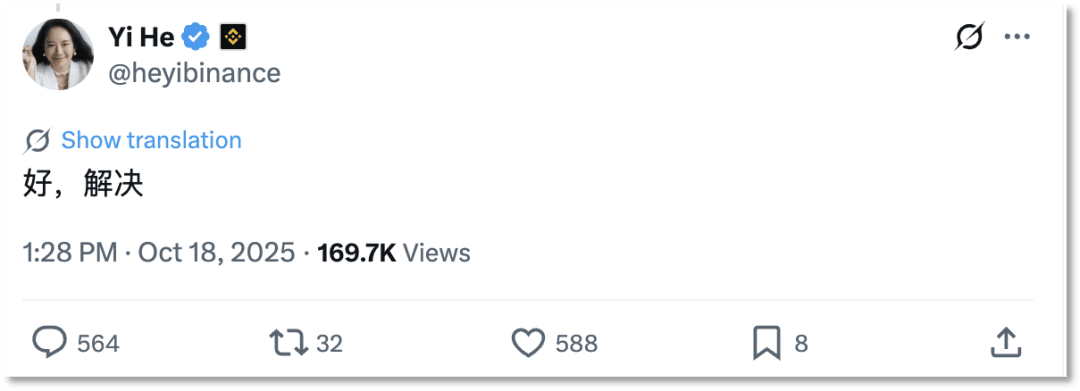
He Yi responds to users in the comment section
He Yi's commitment was fulfilled within 24 hours. On the 19th, Binance announced the ban of over 600 accounts using violating third-party tools, stating that Binance is committed to safeguarding the rights and interests of real users and providing a fair and just Alpha platform. Effective immediately, if any violations of using third-party tools or other behaviors that violate Binance's trading platform, Binance wallet, and Binance Alpha related terms are verified, the platform reserves the right to permanently cancel their eligibility to participate in any Binance activities.

Binance announces the cleanup of violating accounts
Since the launch of Binance Alpha, it has been a 'Selection Pool' project prior to logging into the main Binance site, providing generous project token airdrop rewards to users who meet the point requirements through the distribution of airdrops. This intention was originally to reward the benefits of real trading users on the platform, which inevitably attracted many 'scientists' and 'script parties' to participate. Their common characteristic is that they do not engage in real trading and use scripts and other automated tools to inflate their volume to earn Alpha points, often operating in bulk, and when claiming airdrops, they use automated scripts, severely infringing upon the interests of 'speed-hand' real users.
In fact, prior to this large-scale ban of violating accounts by Binance, the platform had already conducted multiple rounds of rectification actions against violations. In early June, certain teams were detected using bots to participate in Alpha activities, and the company made it clear that any behavior using bots (including but not limited to scripts, automated tools, or other non-manual methods) would be considered 'violations'. The risk control system has been upgraded to enhance the detection and handling capabilities of violating behaviors, and accounts triggering risk control will have their eligibility to participate in Alpha points revoked.
This time, Binance's punitive measures have significantly intensified. According to the announcement, it not only prohibits violating accounts from participating in Alpha activities but is also likely to permanently revoke their eligibility to participate in any Binance activities. Furthermore, the platform will also reclaim all earnings from violating accounts in the Alpha activities.
In addition to intensifying punitive measures, Binance has also launched the 'Bounty Hunter' program, mobilizing community power to combat 'scientists' and 'script parties'. The announcement encourages users to jointly supervise and report suspected fraudulent and violating behaviors. The first user to successfully report and verified by the platform can receive part of the earnings recovered from that account (up to 50%) as a reward.
This crackdown action has received widespread support from the community. Binance user 'Xiao Gan' stated on social media that the reporting mechanism 'is very reasonable', as script authors hold a bunch of studio account UIDs, and a moment's hesitation to report could lead to 'getting rich quickly', 'studio juniors' could also become potential reporters. He stated that Binance's strict crackdown on violations will restore Alpha to a healthy state, 'The original intention of Alpha is to benefit a wide range of retail investors, and it must not be destroyed by script studios.'
The dynamic game between the platform and 'scientists'
Whether in the Web3 or traditional internet space, wherever there is profit, there are 'scientists' and 'script parties'. Especially in September, Binance Alpha distributed several large airdrops, for instance, STBL provided over 500 U in airdrop rewards, and projects like BLESS, OPEN, and XPL also had single accounts exceeding 200 U in earnings. The frequent large profits attracted more studios and 'scientists' to join.
At that time, on social media, some studios claimed to 'add accounts', and on a second-hand trading website, multiple merchants brazenly sold scripts and tools for automated volume inflation and airdrop claiming. Indeed, after entering October, Alpha users felt unprecedented competition.
User 'Zhu Feng' stated that compared to the hundreds of U gains provided by multiple Alpha airdrops in September, the airdrop projects in October generally saw a decrease in rewards to around 50 U. Moreover, the difficulty in claiming has clearly increased, 'often encountering errors, and then it shows that the airdrop has ended'. Another significant change is that the threshold for claiming Alpha airdrops has been raised from around 200-220 points in September to the range of 220-240 points, with many projects in late October requiring over 240 Alpha points to claim, reflecting a situation of 'more monks than rice porridge', indicating a surge in the number of participants in Alpha and severe point competition.
The large-scale entry of 'scientists' and 'script parties' has infringed upon the rights and interests of real users, and as the platform party, Binance has also faced public criticism regarding fairness, which evidently has prompted Binance to intensify its determination to rectify.
This time, Binance banned over 600 violating accounts at once, which reflects its firm crackdown on violating accounts. The higher punitive measures and reporting mechanisms also signify that Binance's cleansing actions against 'script parties' and 'scientists' have entered a new phase.
In fact, over the past months, Binance has used various means to limit violations in order to maximize the protection of the rights and interests of real users.
In terms of rule design, Binance has added a 'staged claiming' mechanism based on the initial 'first come, first served' airdrop claiming mechanism, allowing high-point users to claim first, distinguishing user loyalty and activity, and prioritizing rewards for core users. On October 22, Binance also updated the Alpha points rules. When an account's balance points are 0 for the day, both trading volume points and task points will also be counted as 0, and this rule takes effect immediately. This seemingly simple change is actually a precise and powerful upgrade of risk control aimed at script studios that generate accounts in bulk.
Before the rule update, the strategy of script studios was often 'minimizing costs'. They would only transfer a minimal amount of funds on the day they needed to inflate trading volume and complete tasks to earn points, and once the tasks were completed, they would immediately withdraw the funds. This kept their accounts at a balance of 0 most of the time, yet they could still accumulate points to participate in airdrops. The new regulations mean that cheaters must keep their funds deposited in the platform for a long time, significantly increasing their capital and opportunity costs. They can no longer 'get something for nothing' and must, like real users, make real asset commitments to the platform. Accurately identifying and eliminating 'shell accounts' has greatly compressed the survival space of cheaters.
In terms of technical means, Binance continuously upgrades its risk control system to identify accounts participating in activities using bots, scripts, automated tools, etc., combating automated volume inflation and airdrop grabbing behaviors.
In the key process of claiming airdrops, its verification mechanism for identifying 'real humans' has also been continuously iterated. From initially being able to directly apply for airdrops to introducing facial recognition and a pre-check five minutes in advance, we aim to ensure that real users claim airdrops, increasing the cost of cheating for studios. In the final verification stage, it has also upgraded from relatively simple slider verification to tap verification, maximizing the blockage of automated batch operations.
A technician familiar with 'anti-scripting' revealed that the dynamic game between the platform and 'script parties' is a protracted battle. This technical and rule-based confrontation often presents an evolutionary trend of 'the higher the way, the higher the demon'. On one hand, cheating technologies of script studios are continually evolving, using methods such as virtual environments, proxy IPs, and human-computer interaction simulations, making their behaviors increasingly indistinguishable from normal users, thus extremely difficult to identify; on the other hand, script parties often possess a large account pool and highly decentralized operational nodes, making it difficult to eradicate them all at once. They also deliberately avoid triggering risk control thresholds, making their behaviors very covert.
For any platform, thoroughly cleaning up 'scientists' and script studios is a daunting task. 'The key lies in the continuous upgrading of the platform's technical monitoring means, gradual optimization of reward rules, and the determination and continuity to combat violations,' the technician stated.
From Binance's actions, it is evident that it is defending the fairness of the platform by continuously upgrading risk control mechanisms and intensifying punitive measures. The direct involvement of 'Chief Customer Service' He Yi has undoubtedly raised the priority of the cleanup actions against 'scientists' and 'script parties' to a higher level. It can be anticipated that under the strict rectification of the platform and the gradual optimization of the reward mechanism, the Alpha sector will more often direct benefits toward real individual users, thus ensuring the long-term healthy development of the Alpha platform as a 'Selection Pool' project and its empowering role for the entire Binance ecosystem.
(Disclaimer: Readers are advised to strictly comply with local laws and regulations; this article does not constitute any investment advice.)