


Original | Odaily Planet Daily (@OdailyChina)
Author | Azuma (@azuma_eth)
Reuters reported exclusively on April 18 that three knowledgeable sources revealed to them that Zuckerberg's Meta plans to launch the first round of large-scale layoffs this year on May 20, with further layoffs to follow.
A knowledgeable source said that Meta will cut about 10% of its global workforce (approximately 79,000 employees), which is about 8,000 people, in the first round of layoffs. Another knowledgeable source indicated that Meta also plans to conduct further layoffs in the second half of this year, but the specific timing and scale have yet to be finalized. As the observation of AI capabilities continues, Meta's executive team may adjust the plan.
In another report from Reuters last month, insiders revealed that Meta was considering layoffs of 20% or more.
As of the time of publication, Meta declined to comment on the timing and scale of layoffs.
10 days ago, Meta just caught up with the AI big league
Just 10 days ago, the AI development team 'Meta Superintelligence Labs' (MSL), led by the high-priced recruited Chinese genius Alexandr Wang, released its first self-developed AI model, Muse Spark.
Alexandr Wang revealed that over the past nine months, MSL has rebuilt the entire AI technology stack from scratch. Muse Spark is a native multimodal reasoning model that supports tool invocation, visual chain of thought, and multi-agent orchestration. It is the most powerful model Meta has released to date. During training, MSL observed predictable scalable improvements during pre-training, reinforcement learning, and testing reasoning phases.
Muse Spark also supports 'Contemplating Mode,' which is designed to handle complex scientific problems and reasoning tasks by orchestrating multiple parallel reasoning agents. In testing, MSL found its performance competitive with extreme reasoning models like Gemini Deep Think and GPT Pro.
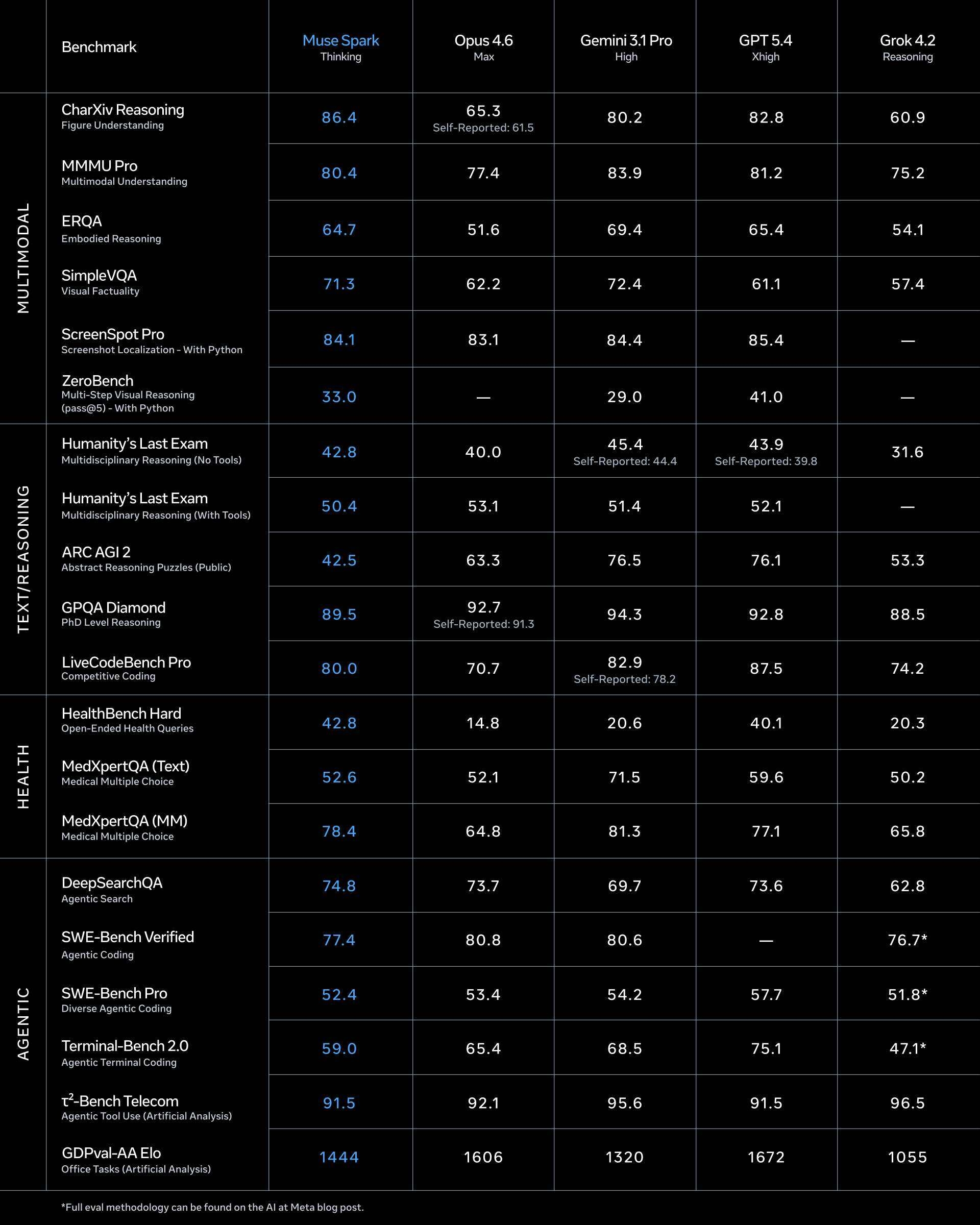
As the first substantial product after Meta's heavy investment in AI and shift to a closed-source model, Muse Spark is widely seen in the market as the beginning of Meta chasing AI leaders like Anthropic, OpenAI, and Google. Although Meta admits that this model does not yet match the flagship models of the top three companies in certain capabilities, for Zuckerberg, who has long lagged in the AI competition due to the Llama route's failure, Muse Spark and subsequent models in the series are sufficient for him to return to the AI table.
The market also gave positive signal feedback for Muse Spark, with Meta closing at $612.42 that day, up 6.5%, and in the following 10 days, it continued to rise (of course, also influenced by the overall market rally), with yesterday's closing price reaching $688.55.
The sharp edge of AI first fell on the employees
From the end of 2022 to the beginning of 2023, Meta launched the controversial 'year of efficiency' plan, conducting the largest layoffs in the company's history, cutting around 21,000 positions. This time, it is very likely to become Meta's largest round of layoffs since the 'year of efficiency.'
Compared to the 'year of efficiency' period, Meta faced significant stock price declines and adjustment pressures after overgrowth during the pandemic. Today's Meta is clearly in a more stable financial situation, but executives envision a future of fewer management layers, with AI-assisted employees bringing higher efficiency.
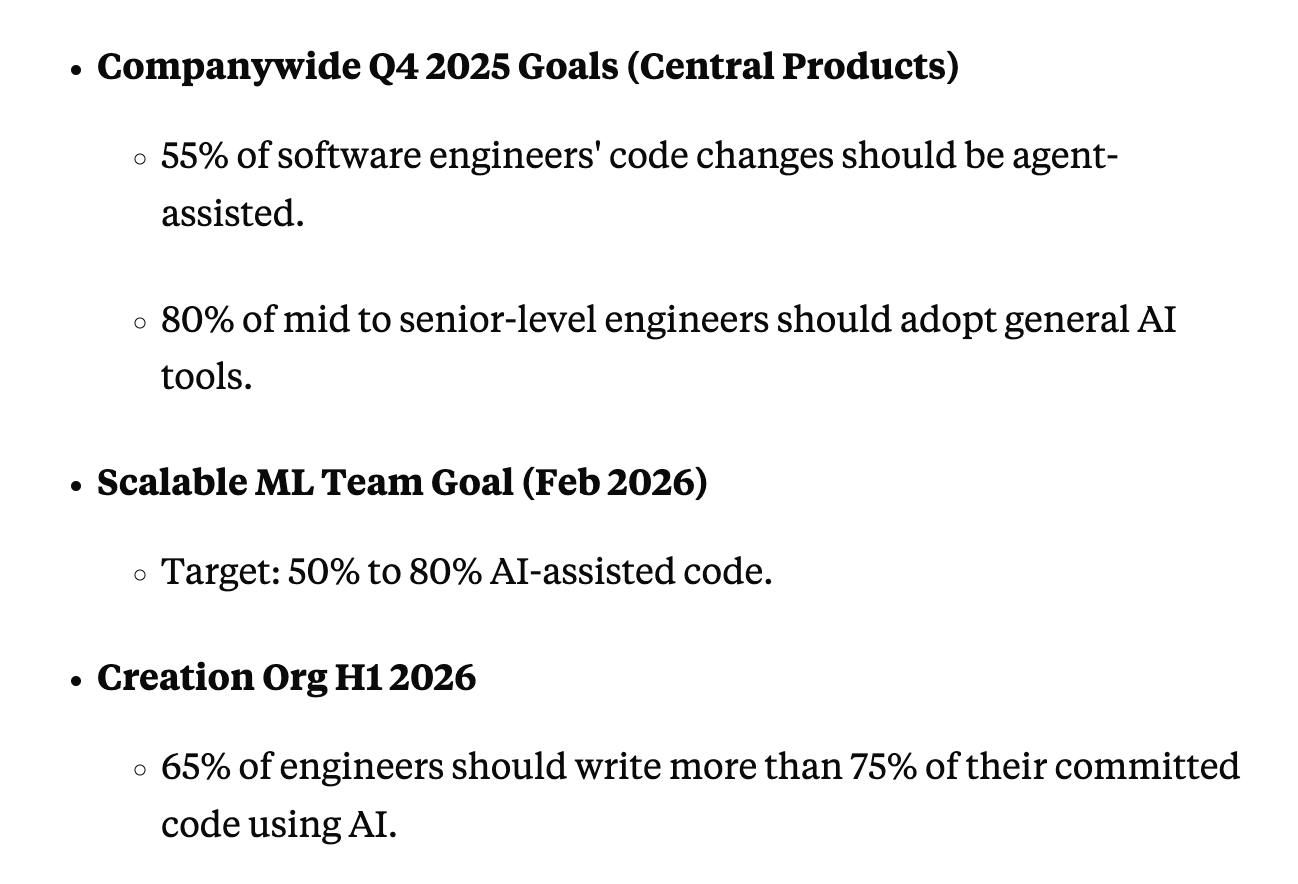
Business Insider reported last month that it learned from leaked internal Meta documents that Meta is encouraging employees to use AI tools more actively, with a goal set for mid-2026 that 65% of engineers need to have more than 75% of code written with AI involvement.
According to the self-media Official Layoff (@LayoffAI), which focuses on layoffs in large companies, it disclosed (without its sources, not guaranteed to be true): 'Starting this year, Meta has incorporated 'AI-driven influence' into the performance evaluation of all employees, making it a core indicator. If AI is not used, promotions cannot be obtained. Meta has become the first large tech company to officially link AI usage to promotions.'
AI iteration white-collar, is no longer an isolated case
Using 'AI iteration productivity' as a reason for layoffs is no longer an isolated case.
Last October, Amazon cut up to 30,000 positions across logistics, payments, video games, and cloud computing departments. The company's CEO Andy Jassy had previously indicated this round of layoffs: 'As the company increasingly uses AI to perform tasks originally done by humans, Amazon's workforce may shrink.'
At the end of February this year, Jack Dorsey (also the founder of Twitter) announced that his fintech company Block would cut 4,000 positions, reducing its total workforce from over 10,000 to less than 6,000, to promote a more streamlined, flat, and AI-centric organizational structure. Block's CFO and COO Amrita Ahuja revealed that after the company announced layoffs, a large number of corporate executives proactively contacted Block, seeking to replicate this 'script.'
Odaily Note: See (Jack Dorsey's company, 4,000 white-collar workers are being eliminated by AI).
Earlier this week, Meta's core product Instagram's direct competitor Snap also cut around 1,000 jobs, with CEO Evan Spiegel stating: “AI will enable our team to reduce repetitive work, improve efficiency, and better support our community, partners, and advertisers.”
Now, the same wind has blown to Menlo Park, California, and Zuckerberg has raised the sword in his hand.
Oh, and there's one more thing worth mentioning. Although Jack Dorsey loudly declared during the layoffs that 'the rapid development of AI is iterating the traditional productivity growth paradigm,' shortly after Block's layoffs, many of the laid-off employees received return-to-work invitations (see 'The first batch of big company employees laid off by AI have returned to work')...
AI iteration of white-collar workers may ultimately become a reality, but being as hasty as Block in cutting 40% of the workforce can easily result in 'taking too big a step and pulling the egg.'