Market Decline Interpretation: Today's Risks and Tomorrow's Opportunities Analysis
Currently, the main index and the ChiNext have fallen again, and many people are concerned about whether there are risks today and whether there are opportunities tomorrow. In fact, as early as yesterday when the market was unanimously optimistic, I had already pointed out the risks and advised everyone to secure profits significantly at the end of the trading session. Today's market has adjusted as expected, with the number of stocks rising falling to over 2000, completely in line with expectations. At this time, one should rather consider: Is it possible to appropriately buy back some positions?
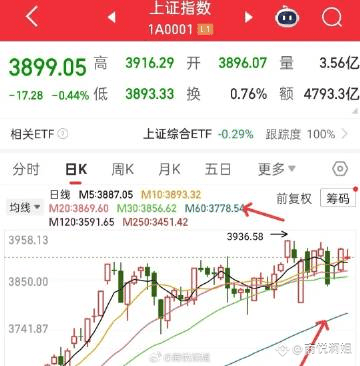
Judging whether to buy today still needs to be based on yesterday's core inference, and the key is to analyze based on the box structure. It was clearly mentioned yesterday that after the main index breaks the box, there is a high probability of a pullback action, and today the main index and the ChiNext are in the pullback process. The current core focus is whether it can effectively stabilize after the pullback — if it can successfully stabilize, the market is likely to continue to rise tomorrow.
Therefore, there is no need to be impatient. Even if there was no timely arrangement when the market fell in the morning, there are still opportunities in the afternoon. It is recommended to patiently wait for clear signals at the end of the trading session before taking action.
It should be noted that even if the market rebounds tomorrow, it is more suitable as an opportunity to reduce positions and exit. From an overall trend perspective, the expectation of the main index pulling back to the 60-day moving average still exists. Currently, most sectors and individual stocks have completed the pullback to the 60-day moving average. If the main index does not follow with a pullback, the logic is not sound. Based on the current rhythm, there is likely still a time window of about three days that will trigger this action.
In terms of operations, if you prefer a stable “lying down” approach, you can continue to maintain existing positions; if you want to grasp the short-term rhythm, you need to strictly control your position participation. The current market is still in a fluctuation cycle, and before a clear breakthrough signal appears, do not blindly “headstrong” increase positions.
Currently, the main index and the ChiNext have fallen again, and many people are concerned about whether there are risks today and whether there are opportunities tomorrow. In fact, as early as yesterday when the market was unanimously optimistic, I had already pointed out the risks and advised everyone to secure profits significantly at the end of the trading session. Today's market has adjusted as expected, with the number of stocks rising falling to over 2000, completely in line with expectations. At this time, one should rather consider: Is it possible to appropriately buy back some positions?
Judging whether to buy today still needs to be based on yesterday's core inference, and the key is to analyze based on the box structure. It was clearly mentioned yesterday that after the main index breaks the box, there is a high probability of a pullback action, and today the main index and the ChiNext are in the pullback process. The current core focus is whether it can effectively stabilize after the pullback — if it can successfully stabilize, the market is likely to continue to rise tomorrow.
Therefore, there is no need to be impatient. Even if there was no timely arrangement when the market fell in the morning, there are still opportunities in the afternoon. It is recommended to patiently wait for clear signals at the end of the trading session before taking action.
It should be noted that even if the market rebounds tomorrow, it is more suitable as an opportunity to reduce positions and exit. From an overall trend perspective, the expectation of the main index pulling back to the 60-day moving average still exists. Currently, most sectors and individual stocks have completed the pullback to the 60-day moving average. If the main index does not follow with a pullback, the logic is not sound. Based on the current rhythm, there is likely still a time window of about three days that will trigger this action.
In terms of operations, if you prefer a stable “lying down” approach, you can continue to maintain existing positions; if you want to grasp the short-term rhythm, you need to strictly control your position participation. The current market is still in a fluctuation cycle, and before a clear breakthrough signal appears, do not blindly “headstrong” increase positions.