


In the stock market, people tend to open a securities account and transfer money into it,
and you don't really think about 'where the stocks are', because you assume 'the brokerage will take care of it for me.'
But when it comes to the cryptocurrency market, many people feel lost, because:
- There are no banks
- There are no securities accounts
You can see the assets on the exchange app, but where are they actually stored?
In fact, many people are unaware that the stocks you buy have never been kept by you.
When you transfer money into the securities account, it is actually going into the 'brokerage firm',
And stocks are registered with the 'Taiwan Stock Central Depository & Clearing Corporation' regulated by the government,
You are just a 'record of ownership.'
In simple terms, it's like buying stocks where someone helps you manage it, with a complete system backing you. In case of trouble, someone is responsible and has your back, so you naturally don't need to understand the underlying logic.
But in the world of cryptocurrency, the default is 'no one helps you keep it',
No brokers, no banks,
There is no central authority telling you: 'Don't worry, I will take care of your money.'
So many people will subconsciously think, 'Isn't this even more dangerous?'
but here lies the key difference; the stock market is about 'passing the responsibility to others',
And what the crypto space does is 'return the responsibility to you.'
---
So if you are still asking 'Where do I put my coins?'
What you should consider is 'Who can access my money?'
I believe mainstream assets can be divided into three types of storage states:
▍The first type, in the bank
To access funds, you need the banking system,
But banks can review, restrict, or even freeze your assets,
The essence is that the bank helps you keep your money, but also controls your money.
▍The second type, carrying cash on you
No one can restrict you,
But if you lose it, it’s really gone.
The essence is that you have complete control over the assets, but are also responsible for their custody.
▍The third type, locked in a safe
You still control the assets,
But you have added an extra layer of security protection,
It also adds a bit of operational threshold.
The essence is that you control the assets, but there are designed protective mechanisms.
Cryptocurrency is actually an extension of the above three types, the difference is:
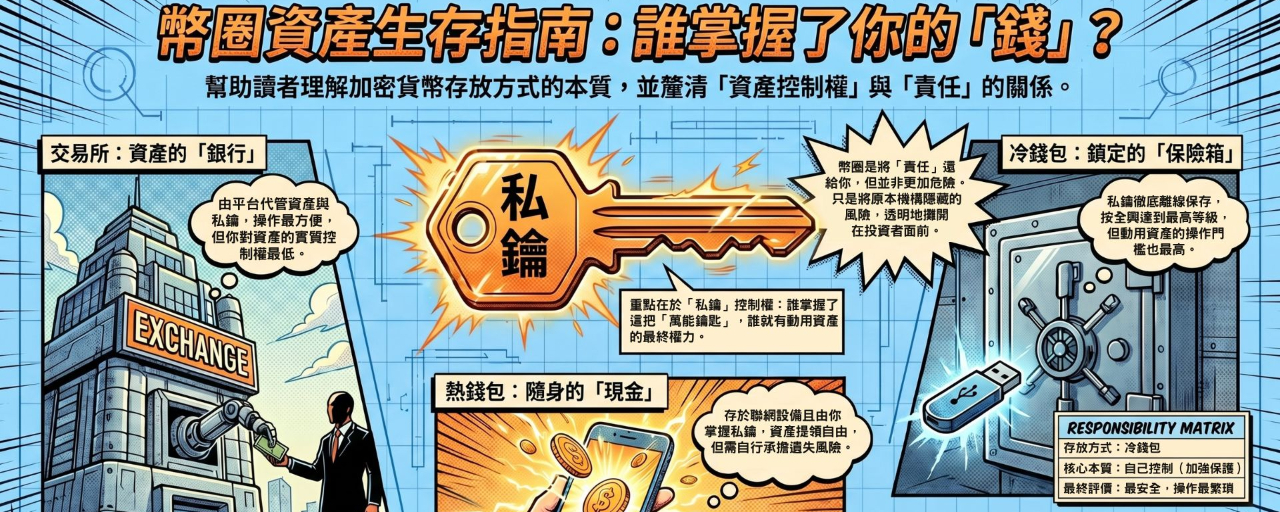
It's not the account password that controls the assets, but a string of 'private keys.'
Whoever holds that string can move your assets.
So the question is never 'Where is the money placed?', but 'In whose hands is the asset control?'
---
Now take the three storage scenarios just mentioned and apply them back to the cryptocurrency market.
▍The first type, exchange (like a bank)
Just like the exchange APP you usually use, you put your assets into the platform,
Operated with account and password, the money platform helps you keep it.
The essence is that the platform controls the assets.
▍The second type, hot wallet (like the cash you have on you)
This type of wallet usually exists on a mobile phone or computer (requires internet),
No customer service, only a set of private keys that you keep yourself,
You are the only controller.
▍The third type, cold wallet (like your safe)
This is a type of 'offline' asset custody method,
The private key is stored in a 'non-networked' place,
It requires extra operations to access, with higher security.
The essence is that you control it yourself, but the security is raised to another level.
So you will find:
- Exchange → the most convenient, but the lowest control
- Hot wallet → the most freedom, but the highest risk
- Cold wallet → the safest, but the most troublesome
None of these three types is better than the others,
The difference is how much responsibility you are willing to bear.
---
So in the crypto space, I believe you should not ask 'Where is the safest place for money?'
Rather, you should think about 'How much responsibility are you willing to bear?'
You can choose like stocks:
Handing over assets to the platform in exchange for convenience and peace of mind.
You can also choose to manage the private key yourself:
This leads to complete control, but also bears all the risks.
There is no right or wrong in both types.
But the difference is whether you realize, 'Are you making a choice?'
Many people say the crypto space is very dangerous,
But a more precise statement should be...
The crypto space just lays out the 'risks that were originally hidden' in front of you!
If you still don't know how to choose now, that's actually very normal.
But as long as you plan to enter this market, you will eventually have to understand this!
I will continue to explain these key concepts in the crypto space in the simplest way.
If you don't want to invest in cryptocurrency in a 'half-understood' state,
You can start by following me.