

The cryptocurrency market is going through a pivotal phase in 2026, oscillating between institutional maturity, persistent volatility, and major technological innovations. After a year in 2025 marked by corrections, the ecosystem is trying to stabilize while attracting new investors.
📈 1. Evolution of the global market
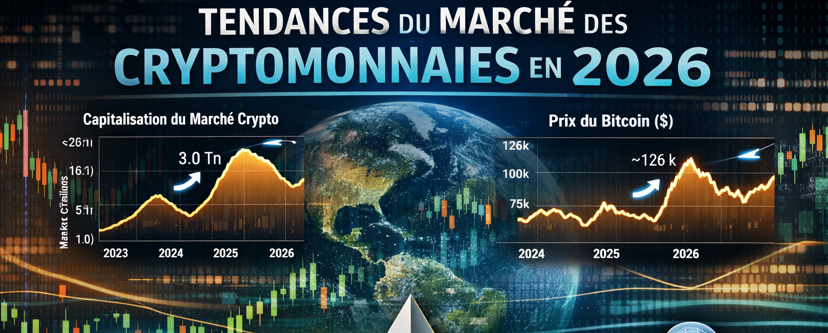
In 2026, the total market capitalization of crypto exceeds 3 trillion dollars, an increase of about 15% compared to 2025.
However, this growth remains irregular, with significant correction phases.
Simplified chart: market cap evolution
Market Cap (in trillions $)
3.5 ┤ ╭───╮
3.0 ┤ ╭───────╯ ╰──╮
2.5 ┤ ╭────╯ ╰─╮
2.0 ┤───╯ ╰──
2023 2024 2025 2026
Interpretation:
Strong rise in 2024 (bull run)
Correction in 2025
Gradual recovery in 2026
2. Bitcoin remains the market leader
Bitcoin still dominantly controls the market, with a market cap close to $1.4 trillion.
Current situation (April 2026)
Price: ~74,000 $
Recent peak: ~76,000 $
Previous high: ~126,000 $ in 2025
Chart: recent Bitcoin trend
BTC price ($)
130k ┤ ╭───────╮
100k ┤ ╯ ╰──╮
75k ┤ ╭──── ╰─╮
50k ┤──╯ ╰──
2024 2025 2026
Analysis:
Correction after a massive bull cycle
Consolidation around 70k–75k
Possible bounce towards 90k–100k if resistance is broken
3. Ethereum and technological innovation
Ethereum remains the backbone of decentralized applications.
Price around $3,000 at the beginning of 2026
Growth driven by:
DeFi (decentralized finance)
NFTs
Smart contracts
Key trend: Layer 2
Layer 2 solutions (rollups) are becoming essential for:
Reducing fees
Speeding up transactions
Fostering mass adoption
🏦 4. Rise of institutional investors
One of the major changes in 2026 is the massive arrival of institutions:
Bitcoin and Ethereum ETFs
Adoption by businesses
Integration into financial systems
👉 This is transforming the market:
Less speculative
More structured
Correlated to macroeconomic markets
🌍 5. Macroeconomic and geopolitical factors
The crypto market is now influenced by:
Global inflation
Interest rates
Geopolitical conflicts
📉 Recent example:
Crypto drop linked to rising energy prices and international tensions
👉 Conclusion:
Bitcoin is now a macro asset, like gold or stocks.
🔗 6. Major new trends
6.1 Tokenization of real-world assets (RWA)
Real estate
Bonds
Stocks
👉 Enables bringing traditional finance onto blockchain
6.2 Explosion of stablecoins
Used as a 'digital dollar'
Base of global crypto payments
6.3 AI + crypto fusion
Trading automation
Smart smart contracts
⚠️ 7. Risks and challenges
Despite its potential, the market remains fragile:
🔻 Volatility
Rapid drops despite good news
⚖️ Regulation
Laws still uncertain
Political scandals potentially hindering adoption
⛏️ Mining issues
High costs
Declining profitability
🔮 8. Outlook for the rest of 2026
Possible scenarios:
📈 Bullish scenario
Bitcoin > $100,000
Massive adoption
New all-time highs
📉 Cautious scenario
Market in consolidation
Slow but steady growth
Conclusion
The cryptocurrency market in 2026 is no longer just a speculative playground. It is evolving towards:
A global financial infrastructure
A market influenced by institutions
A sector driven by technological innovation
In summary:
Short term: volatility
Long term: structural growth