


Summary: Restore the betting trajectory of top traders on Polymarket in this war from on-chain trading data.
Author: Changan I Biteye Content Team
On April 7th, Trump issued a threat on TruthSocial: If Iran does not immediately open the Strait of Hormuz, he will "make the Iranian regime disappear from the earth."
That early morning, everyone was waiting for news of the next round of strikes. As a result, just a few hours later, to everyone's surprise, both the U.S. and Iran announced a ceasefire.
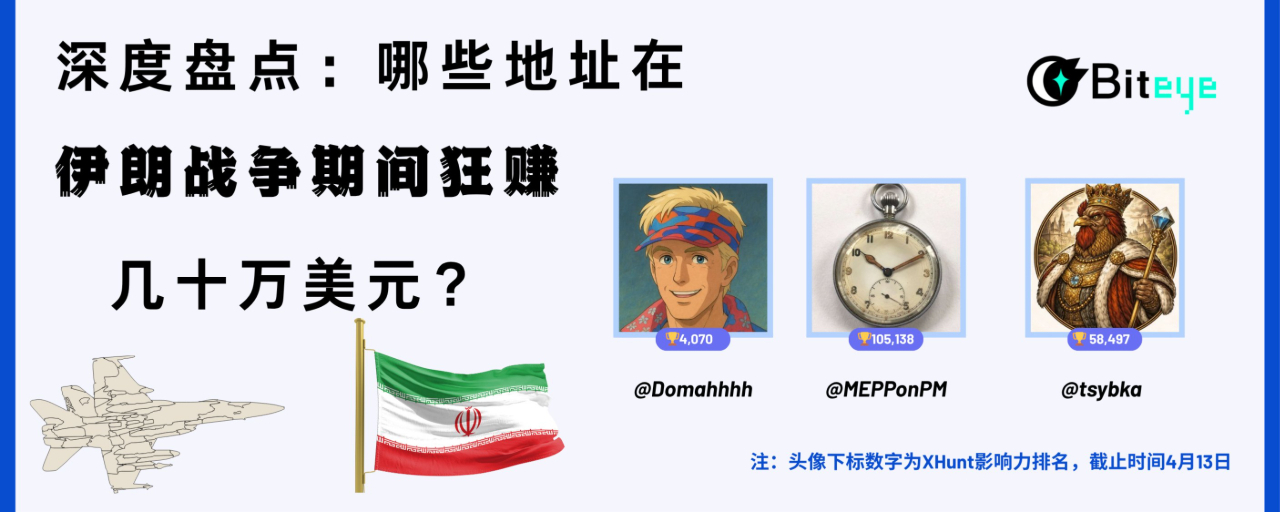
This time, we trace back: How did the top traders on Polymarket perform from the outbreak of war to the ceasefire? How did they make judgments at key points, and what operations did they carry out?
I. A panoramic view of Polymarket during the war
On February 28, the US and Israel launched a joint attack on Iran, killing Iran's former Supreme Leader. Iran announced the closure of the Strait of Hormuz, and oil prices rose from $80 to $112.
The two sides continued to exchange fire thereafter, with the US and Israel launching more than 7,000 strikes against Iranian targets. Iran retaliated with missiles and drones against US military bases in Israel and several neighboring countries, and the battle line spread from Iranian territory to Lebanon.
Ships crossing the Strait of Hormuz plummeted from about 100 per day before the war to less than 5, and black rain containing oil fell on the streets of Tehran. A ceasefire was suddenly declared on April 8th, after 38 days of fighting.
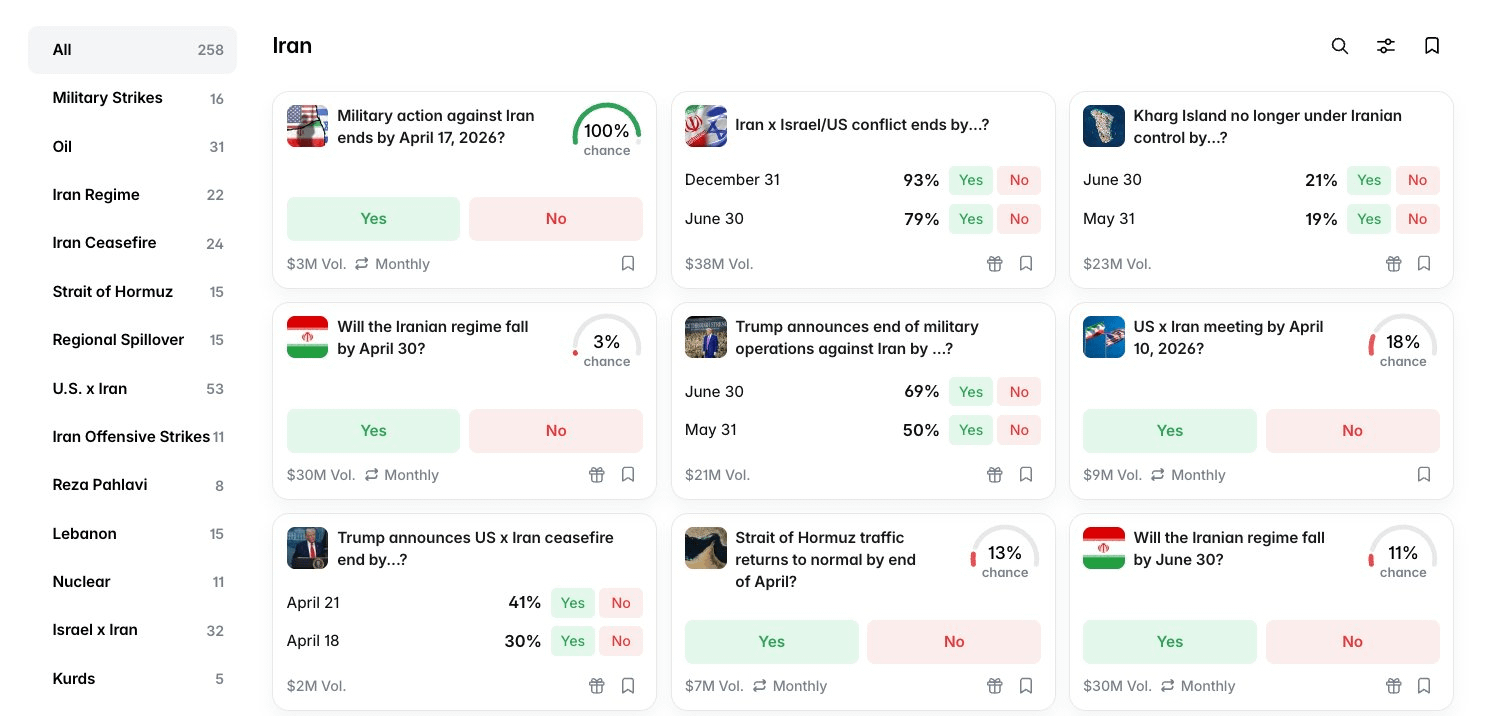
This war has spawned numerous markets on Polymarket, concentrated in five core sectors: U.S. x Iran, Iran Ceasefire, Israel x Iran, Oil, and Iran Regime.
1️⃣U.S. x Iran
The main sectors, and also where the most capital is concentrated, are where the market is betting on the overall course of the war: "When will Trump announce the end of military action against Iran?", "Which countries will join the strikes against Iran?", and "Can a permanent peace agreement between the US and Iran be reached?"
Those who bet on this sector are betting on whether the intensity of the war will escalate, or when the conflict will come to an end.
2️⃣Iran Ceasefire
It specializes in tracking the ceasefire process. From "Will the US and Iran cease fire before April 7?" to "Will the conflict between Iran and Israel/the US end before the end of the year?", each time point has an independent market with real-time pricing.
Knowing the probability of a ceasefire allows us to predict when the conflict will likely end and when the situation will return to normal.
3️⃣Israel x Iran
Tracking Israel as a separate variable. The market covers "Will Iran launch military action against Israel?", "Will Israel take action against Lebanon?", and "Will Hezbollah launch an attack on Israel?".
Even if the US and Iran ceasefire, Israel's actions remain an independent variable, and this section helps determine whether the situation in the Middle East is truly moving towards stability.
4️⃣Oil
Tracking energy market trends. Market coverage includes questions such as "What price range will WTI crude oil reach in April?", "Will the Harge Island oil terminal be hit?", and "Will crude oil reach a new all-time high?".
Knowing these probabilities allows for the prediction of the potential upside and downside for oil prices, providing an important reference for those holding energy positions.
5️⃣Iran Regime
Tracking the stability of the Iranian regime. The market covers whether the Iranian regime will collapse at various points in time, whether Reza Pahlavi will return to Iran, and whether there will be a change in the Iranian leadership.
Knowing the probability of regime stability allows us to determine whether Iran still has the capacity to continue negotiations and in what form this conflict will ultimately end.
The five components are interconnected. The intensity of military action affects the probability of a ceasefire, the ceasefire process influences the expected resumption of air traffic over Hormuz, the stability of the Iranian regime determines whether negotiations can proceed, and Israel's potential independence could disrupt any existing balance at any time.
Understanding this logical chain is essential to comprehending why operations at those header addresses always seem to occur a step ahead.
II. A Review of Polymarket's Top Profit Performers
After the ceasefire, we wanted to know: what did the truly active people on Polymarket bet on during those 38 days, and what were the results?
We looked at the profit rankings, examined some well-known traders in the community, and also investigated the addresses with large holdings in several core markets. Combined with the lists we usually track and accumulate, we pieced together the following chart.
🌟ImJustKen @Domahhhh (XHunt Ranking: 4067)
Address: 0x9d84ce0306f8551e02efef1680475fc0f1dc1344
During this war, ImJustKen made a total profit of $81,000 in Iranian-related markets.
His trading covers a wide range of markets, from "Another Iran strike on Israel," "Khamenei out as Supreme Leader," and "US strikes Iran by," to "US x Iran ceasefire by April 15," spanning the three sectors of military strikes, regime change, and ceasefire processes.
His trading strategy is characterized by advance planning and long-term holding. For example, in the ceasefire market, he bought "US x Iran ceasefire by April 15" at 19% and ultimately settled it at 100%, a gain of 426%. From purchase to settlement, this position waited a considerable amount of time in a low-probability range.
ImJustKen also mentioned on Twitter that a position betting on "no US troops entering Iran" was incorrectly settled due to a rule issue, which could have earned him an extra 120,000.
🌟MEEP @MEPPonPM (XHunt ranking: 105759)
Address: 0x6d9fc316c3b8377060a44b852ba664adbfd59790
MEEP is one of the most consistent performers in this war. It boasts a 90% win rate throughout 2026, with total profits of $397,000, the majority of which came from the Iranian market.
His operations focused on ceasefire and regime-related markets. He bought "US x Iran ceasefire by April 30" at 42% and profited 138%; he bought "US x Iran ceasefire by May 31" at 44.6% and profited 124%.
In addition, he also bet on "Will the Iranian regime fall by June 30" at the 69.1% level, and is currently making a profit of $230,000.
What impressed me most was that when Trump posted that he would wipe the Iranian regime off the face of the earth, and everyone was waiting for news of the next round of strikes, MEEP bought "Yes" at that moment, stating that "the conflict between Iran and Israel/the United States will end on April 7th," at a price of 26.2%. A few hours later, a ceasefire actually occurred!
MEEP's position size is more restrained, but its direction is almost always correct. During the war, it had positive returns every month, with a single-month profit of 131,000 in March, which was also the highest-performing month this year.
🌟 tsybka @tsybka (XHunt ranking: 58124)
Address: 0xd5ccdf772f795547e299de57f47966e24de8dea4
tsybka's strategy was completely different from the previous two. He made a total profit of $113,000, with positive returns every month and never a losing month.
He doesn't chase high odds; he specializes in betting on markets with high certainty. He buys "Yes" at a 99.6% probability of "US forces enter Iran by April 30" and "No" at a 95.1% probability of "Will the Iranian regime fall by April 30". His individual returns are extremely low, but his position sizes are enormous, relying on volume to achieve success.
This strategy stands out as particularly unconventional in the highly uncertain environment of war. While others are betting on the course of the war, he is looking for answers in the market that are close to certain, and then betting large sums of money to capture the remaining, more predictable gains.
🌟 Anoin123
Address: 0x96489abcb9f583d6835c8ef95ffc923d05a86825
Not everyone made money in this war.
Anoin123 was a major bettor on Polymarket who primarily wagered on "No". Before the war broke out, he heavily bet on "No" in the "US strikes Iran by" series of markets, believing that the US would not take action. When news of the surprise attack came on February 28, these positions were wiped out almost simultaneously, resulting in a loss of $5.9 million in a single month.
In March, he attempted a comeback, shifting his focus to betting on regime change and the spread of conflict, earning $818,000 that month. His winnings included $876,000 from "The end of the conflict between Iran and Israel," $526,000 from "Will Hargh Island no longer be under Iranian control by March 31?", $862,000 from "Will the Iranian regime collapse before June 30?", and $207,000 from "Will Reza Pahlavi be able to enter Iran before June 30?".
But when the ceasefire was announced in April, he had bet heavily on "Trump announcing the end of military action against Iran," and the war ended sooner than he expected, resulting in a loss of $851,000.
💡Possible insider address
In addition to these publicly identified front-ends, Biteye saw several more suspicious addresses on the PolyBeats @poly_beats channel.
One of the new wallets, "0xa4eb52229991c074bc560f825bf2776d77acd010," registered six hours before the outbreak of this conflict. Upon entering the market, its first bet was on the US attacking Iran, multiplying its position fivefold. Three weeks later, it invested all its profits in the ceasefire market, having already established its position when the market was still pricing in single-digit probabilities.
$20,000, in 5 weeks, increased 20-fold. Shortly after the ceasefire announcement, the account changed its username to a string of random characters and then withdrew the money.
From the moment the account was created to its disappearance, every bet placed on this address was placed just before the event occurred.
The logic of prediction markets is this: if you possess information that others don't, you have the right to use it to place bets. Whether the information itself has value, and how much it's worth, the market will provide the answer. The $400,000 earned by this address is, in a sense, the market price of this information.
III. The War Is Not Over Yet: Three Deadlocks in the Islamabad Negotiations
On the first day the ceasefire took effect, Israel launched a massive airstrike on Lebanon, killing more than 200 people. The Iranian president warned that this was a blatant violation of the ceasefire agreement, while the Revolutionary Guard stated that their fingers were still on the trigger.
From April 11 to 12, the United States and Iran held their highest-level face-to-face talks in Islamabad since 1979. After 21 hours of marathon consultations, no agreement was reached.
The market for the next phase has already been launched on Polymarket, and the most crucial question is whether negotiations can proceed.
The probability of "Trump announcing the collapse of the US-Iran ceasefire" occurring before April 21 is 32%. The market is already pricing in the possibility that the ceasefire will break down as soon as it takes effect.
The probability of the US-Iran ceasefire agreement being extended before April 21 is 52%, indicating that the market believes the possibility of reaching an extension agreement within two weeks is extremely low.
The probability of a permanent peace agreement between the US and Iran being reached before May 31 is 37%, compared to only 20% before April 30.
Lebanon is a variable that could break the negotiations at any time. "Trump supports an Israeli ceasefire in Lebanon by April 30th" - priced at 50%.
There is an 83% probability that "diplomatic talks between Israel and Lebanon" will be held before April 30, but there is still a long way to go between diplomatic talks and a real ceasefire.
"What conditions will Trump agree to with Iran in April?" The core differences in the negotiations were broken down into three markets: the probability of Iran obtaining uranium enrichment rights is only 9%, the probability of oil sanctions exemptions is 41%, and the probability of transit fees through the Strait of Hormuz is 26%.
The US may have room for compromise on sanctions, but uranium enrichment is Trump's red line, and this is precisely the core of his 10-point proposal regarding Iran. No one knows if two weeks will be enough time to loosen this deadlock.
IV. In Conclusion
Polymarket uses this phrase in its Middle East market analysis: "The value of market prediction lies in pooling collective wisdom to make accurate and unbiased predictions about the most important events in society." This ability is especially valuable in such anxious times, providing answers that television news and social media cannot.
This statement is particularly apt in the context of this war. During the 38 days of the war, while everyone was watching the news, guessing Trump's next move, and waiting for Iran's statement, Polymarket was doing something else entirely: aggregating everyone's judgments into a single number, telling you in real time the probability of this event occurring.
We don't know what MEEP was thinking when it bought in that early morning, nor do we know what ImJustKen's judgment was based on when it established a position at 19%. All we can see are Polymarket's trading records.
But these transaction records already tell a story. In the early morning when Trump issued his threat, some were buying into a ceasefire. While everyone thought war was imminent, some were already waiting for a ceasefire announcement.
The war is not over yet. The Islamabad negotiations ended without result, but both sides claim "progress," putting the ball back in each other's court. Over the next two weeks, whether the ceasefire window will extend and whether negotiations can resume are still being priced in by the markets, and it's worth continuing to monitor their bets.