

Bernstein stated on Monday that the Bitcoin sell-off largely reflected the market's fear surrounding quantum computing, arguing that this threat is real but still manageable rather than an immediate existential risk.
The decline of Bitcoin (BTC) by nearly 50% from the all-time high of $126,198 in October 2025 is evidence that the market has "priced in" many risks related to the quantum breakthrough, partly due to technological advancements in zero-knowledge privacy and quantum-resistant cryptography that help "counterbalance" the acceleration of AI and quantum, Bernstein said in a note on Monday.
This note comes two weeks after researchers at Google indicated that future quantum computers could break elliptic curve cryptography used on many blockchains with fewer than 500,000 physical qubits in some architectures, reigniting the debate on how quickly Bitcoin needs a post-quantum upgrade roadmap. This research suggests that a quantum computer could unlock a Bitcoin private key in nine minutes, in a theoretical scenario, less than Bitcoin's 10-minute block production time.
However, Bernstein stated that Bitcoin's core developers have “enough time” to determine the post-quantum roadmap. Last week, Bernstein predicted that Bitcoin has about three to five years to prepare for the post-quantum security upgrade.
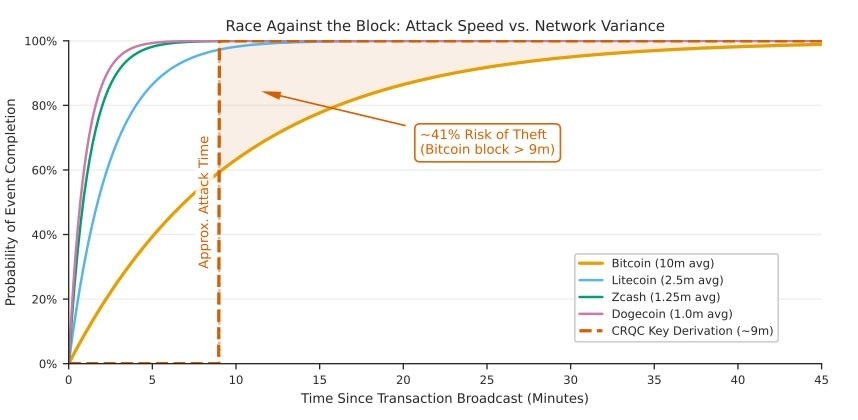 The chart shows the risk that a quantum attack while spending takes 9 minutes to successfully find a private key against Bitcoin. Source: Google Quantum AI
Organizations will play a building role in countering quantum risks for Bitcoin
Bernstein stated that large holders, including exchange-traded fund (ETF) issuers and corporate reserve buyers like MicroStrategy, are likely to play a building role in any final consensus regarding a post-quantum upgrade.
“We expect existing institutional partners with billions of dollars at stake to play a building role in establishing consensus on the post-quantum roadmap.”
The notes also highlighted the recently introduced BIP-360 proposal and added that the slower consensus from Bitcoin developers is seen as responsible behavior for an asset worth $1.5 trillion.
BIP-360 is a draft Bitcoin Improvement Proposal that proposes a Pay-to-Merkle-Root output designed to reduce long-term quantum exposure risk by eliminating Taproot's key-path vulnerability, although it does not add post-quantum digital signatures itself.
Bernstein stated that BIP-360 could be implemented as a soft fork for exposed Bitcoin addresses, but added that this still leaves about 8% of the BTC supply in inactive addresses vulnerable to future quantum breakthroughs.
Countering quantum risks for Bitcoin is a societal issue, not a technical one
The real challenge of countering quantum risks for Bitcoin lies in the acceptance of new standards from society, rather than technical development, according to Arthur Breitman, co-founder of the Tezos blockchain.
“The programming work could be done right this afternoon,” but Bitcoin holders still need to transition to this new standard, Breitman said in an interview at EthCC 2026.
“If Bitcoin needs to move in the next month, they can do so from a technical standpoint […] but they cannot make everyone move their keys in a month,” Breitman said. “It will take years for people to move their keys properly,” he added.
 Arthur Breitman, co-founder of Tezos, answered an interview at EthCC 2026. Source: Cointelegraph
The head of research at asset management firm Grayscale, Zach Pandl, also shared similar views in a research report last Monday. He stated that Bitcoin's post-quantum challenges are “more social than technical,” given that its UTXO model lacks native smart contracts and certain types of addresses are not easily vulnerable to quantum attacks.
However, he warned that the community needs to reach a consensus on how to counter quantum risks for wallets where private keys have been lost or are inaccessible.
https://coinphoton.com/bernstein-khang-dinh-dot-ban-thao-bitcoin-da-phan-anh-rui-ro-tu-may-tinh-luong-t.html