



Hello, brothers, I am Brother B. In the last episode, we learned about 'arbitrage in tariff', today we are going to learn another one, which is its good brother, 'arbitrage in revolving loans'. This is another advanced skill, and the name suggests it's about making money, right? That's right, it really is, but if you're not proficient, don't use a large position. You must master it well before scaling up.
This article took a long time to write, and the word count is a bit high. If you can finish reading it, you've already outperformed 95% of people. Get your notebook ready, let's go~
1: What is arbitrage in revolving loans?
Arbitrage in revolving loans (also called 'recursive borrowing' or 'revolving pledge') essentially utilizes the rules of DeFi lending platforms to 'leverage for profit'. The core premise is simple: the returns on the deposited assets (interest + platform rewards) must be higher than the cost of borrowing funds (interest). Repeated operations can allow the principal to 'leverage' more assets and earn more.
A simple example: Suppose you deposit 1000 USD and earn 1 USD daily, borrow 1000 USD and spend 0.5 USD daily, then 'deposit 1000 and borrow 800 to deposit', which is equivalent to controlling 1800 assets with 1000 principal, netting daily (1800×0.1% - 800×0.05%)=1.4 USD, which is 40% more than originally earned.
Here are three key rules to remember:
Must over-collateralize: The amount borrowed cannot exceed the value of the collateral. For example, if 120 USD is collateralized, the maximum loan is 100 USD (platforms usually require a collateralization rate of 120%-150%);
Leverage has limits: determined by the 'Loan-to-Value (LTV)' ratio. For example, LTV=80% means that for 100 USD in collateral, the maximum you can borrow is 80 USD. Theoretically, the maximum leverage = 1÷(1-80%)=5 times;
Earnings rely on 'interest spread + rewards': Platforms often issue token subsidies (for example, Aave issues AAVE, Venus issues XVS), which are often the core of earnings. For example, earn 2% interest on deposited assets + 5% token rewards, borrow funds at 3% interest, and actually net 0.04 USD per dollar every day.
Two: Comparison of mainstream platforms: Which one to choose in 2025?
Different platforms have different rules, and earnings and risks also vary. Choosing the right platform can save you from detours. Here is a comparison of the four most mainstream platforms as of October 2025:
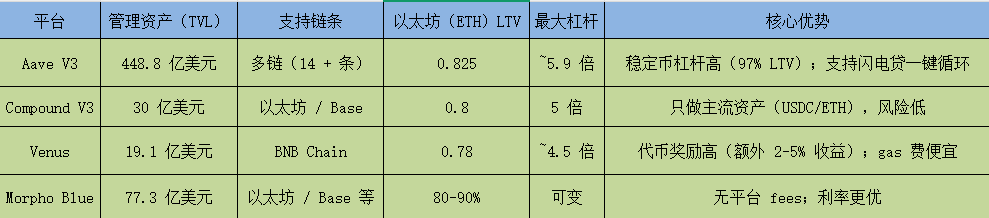
In simple terms: beginners wanting stability should choose Aave/Compound, while those wanting to save on gas fees and earn high rewards should select Venus. Those who are knowledgeable should pursue flexibility with Morpho Blue.
3. Practical operation: How to operate on Ethereum Aave?
Understanding the theory is useless; what are the actual steps for operation? Taking 'using 1 ETH (assumed value 3000 USD) to leverage 5 times on Aave V3' as an example, let me walk you through the process:
Preparation work:
A wallet (like MetaMask) with 1 ETH and a small amount of ETH for gas fees;
A monitoring tool (like DeFi Saver, which can automatically alert risks)
Specific steps (5 rounds of cycles)
Round 1: Initial deposit + first loan
Deposit 1 ETH into Aave, and the platform will give you a token called 'aETH' (representing your deposit and also earning interest);
With this 1 ETH as collateral, you can borrow up to 3000×82.5%=2475 USD, actually borrowing 2400 USDC (keeping a safety margin to avoid liquidation);
At this time: Collateral 1 ETH (3000 USD), borrowing 2400 USDC, health factor ~1.25 (the higher, the safer; below 1 will be liquidated).
Round 2: Exchange coins and deposit again, magnifying collateral.
Exchange the borrowed 2400 USDC for ETH on Uniswap (decentralized exchange), deducting a 0.3% fee, you can exchange for approximately 0.8 ETH;
Deposit this 0.8 ETH into Aave; now the total collateral becomes 1.8 ETH (5400 USD), allowing you to borrow a maximum of 5400×82.5%=4455 USD, which is an increase of 2000 USD in borrowing limit;
Borrow another 1920 USDC (similarly leaving a safety margin).
Rounds 3-5: Repeat operations to approach target leverage.
Round 3: Exchange 1920 USDC for 0.64 ETH to deposit, totaling 2.44 ETH in collateral, then borrow 1450 USDC;
Round 4: Exchange 1450 USDC for 0.48 ETH and deposit it, totaling 2.92 ETH in collateral, then borrow 1100 USDC;
Round 5: Exchange 1100 USDC for 0.37 ETH to deposit, totaling 3.29 ETH in collateral.
Final result:
Total collateral: approximately 5 ETH (15000 USD);
Total borrowing: approximately 12000 USD (equivalent to 4 ETH);
Your own money (net equity): still 1 ETH (3000 USD);
Actual leverage: 5 times, health factor 1.1-1.2 (safe but requires caution).
Subsequent monitoring and exit
Monitor the health factor daily: If it falls below 1.2, add some collateral or repay part of the loan
When you want to exit: follow the reverse order of 'repaying the loan → withdrawing collateral', which allows Aave to use flash loans to easily dismantle the cycle.
Four: Earnings calculation
Just looking at the process is not enough; you need to know how much you can actually earn. Here are real income cases from 2025, with significant differences in earnings across different platforms and assets:
Case 1: Aave ETH cycle (5 times leverage)
Initial principal: 1 ETH (3000 USD);
Earnings rules: Deposit ETH to earn 2% interest + 5% AAVE rewards (total 7%), borrow USDC at 4% interest;
Daily earnings: (5 ETH×3000×7%÷365) - (12000×4%÷365)≈2.76 - 1.28=1.48 USD;
Annualized return: 1.48×365÷3000≈18%;
Key point: AAVE token rewards account for 70%, which is the main source of earnings.
Case 2: Compound USDC cycle (4.6 times leverage)
Initial principal: 1000 USDC (stablecoin, price unchanged);
Earnings rules: Deposit USDC to earn 3.18% interest + 0.93% COMP rewards (total 4.11%), borrow USDC at 2.39% interest;
Annual earnings: (4600×4.11%) - (3600×2.39%)≈189 - 86=103 USD;
Annualized return: 10.3%;
Advantages: Stablecoins have no volatility, and are unlikely to be liquidated, suitable for conservative investors.
Case 3: Venus BNB cycle (4 times leverage)
Initial principal: 1 BNB (600 USD);
Earnings rules: Deposit BNB to earn 4% interest + 6% XVS rewards (total 10%), borrow USDC at 1.5% interest;
Monthly income: approximately 60 USD (XVS rewards account for 80%);
Annualized return: approximately 22%;
Advantages: BNB chain gas fees are super cheap (around 1 USD per transaction), low cost.
Five: Risks
Having discussed earnings, let's talk about potential risks.
1. Liquidation risk: The easiest pitfall leading to zero principal
When the price of collateral falls close to the loan amount, the platform will forcibly liquidate the collateral to repay the debt, which may lead to a loss of principal. For example, if ETH falls from 3000 USD to 2400 USD, 5 ETH's value will just cover the loan, and will be liquidated in full.
Avoidance strategy:
Beginners should keep leverage at 2-3 times and avoid 5 times or more.
Keep the health factor > 2, staying away from the liquidation line of 1.1.
Prioritize using stablecoins like USDC, reducing the probability of liquidation by 70%.
2. Smart contract risk: Invisible asset traps
DeFi platforms rely on code execution, and contract vulnerabilities may be exploited by hackers. In 2023, Euler Finance was hacked for 200 million USD due to vulnerabilities, and users lost everything.
Avoidance strategy:
Only choose top platforms like Aave and Compound that have been audited 50+ times.
Spend 0.5%-2% of your assets on insurance in Nexus Mutual to reduce loss risks.
Use Tenderly to simulate transactions and check for anomalies in advance.
3. Cost risk: Fees may consume all profits
On Ethereum mainnet during peak periods, single transaction gas fees are between 50-200 USD, needing 250-1000 USD for 5 cycles. If the principal is only 1000 USD, the fee ratio exceeds 50%, possibly leading to no profit.
Cost reduction strategy:
Using Layer 2 networks like Arbitrum and Base, single transaction fees are 1-5 USD, reducing costs by 90%.
Ensure your principal is at least 1000 USD before operating to avoid excessive fee ratios.
Six: Suggestions for beginners
1: Small test: Start with $1,000-2,000
2: Choose stablecoins: USDC cycles to reduce liquidation risk
3: Use Layer 2: Arbitrum/Base to lower costs
4: 2-3 times leverage: Conservative start
5: Daily monitoring: Check health factor and interest rate changes
Advanced strategies
1: Hybrid strategy: Combine funding rate arbitrage + cyclical lending.
2: Use flash loans: Aave one-click setup/dismantling of cycles.
3: Automated robots: 24/7 monitoring and rebalancing
4: Multi-protocol diversification: Reduce single-point risks
Make good use of tools; after all, sharpening the knife does not delay the work of cutting firewood. To do a good job, one must first sharpen their tools. Here are a few tools that I think are quite useful and suitable for beginners:
DeBank/Zapper: Real-time health factor
DeFi Saver: Automatic rebalancing
CoinGlass: funding rate monitoring
Alright, the above basically outlines the play of cyclical lending arbitrage. This entire piece might be hard to read for many, but it’s very useful. If you can get this far, you may have already outperformed 95% of people.
Learning and mastering these two arbitrage methods basically means you are a higher-level player in the crypto circle. At this point, you are no longer a novice but a special forces soldier who can quickly respond to market fluctuations. You can swiftly capture opportunities brought by any sudden black swan events.
You should suffer the pain of learning, not the pain of liquidation.
Follow me to learn more useful and profitable crypto skills.
Done.