

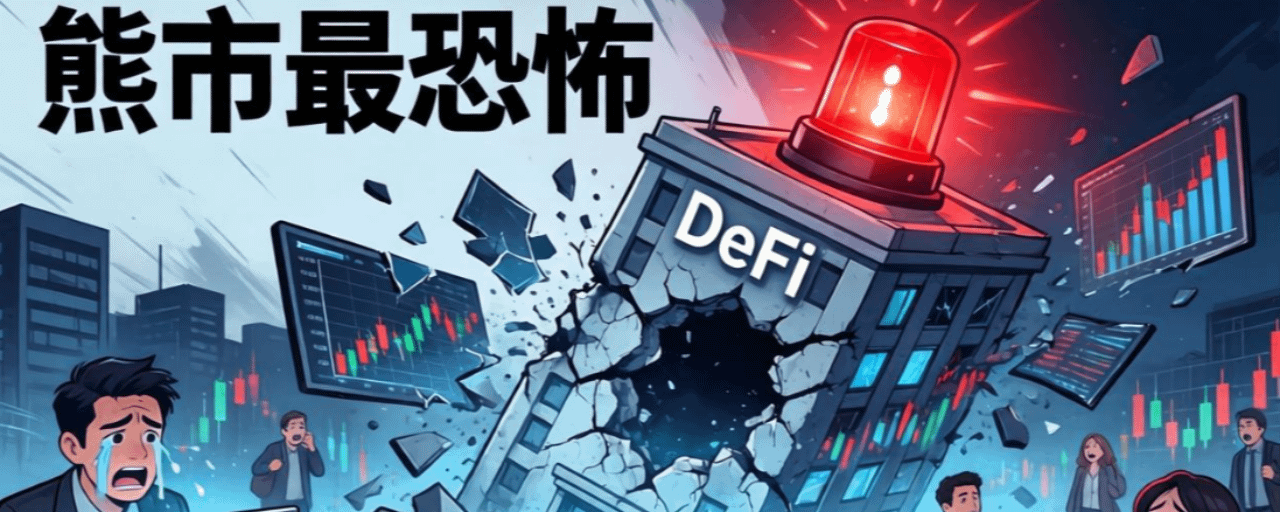

Did you think the most terrifying aspect of a bear market is the plummeting coin prices and locked-in losses? You're completely mistaken! While you're still struggling with whether to cut losses or buy the dip, a silent 'slaughter' is crazily unfolding in the DeFi track—an average of projects quietly shutting down every day, once leading protocols that raised hundreds of millions collapsing overnight, hundreds of millions of funds evaporating into thin air, and this is just the beginning.
Open on-chain data, the shocking numbers are enough to shatter all illusions: In Q1 2026, over 80 crypto projects have officially ceased operations, with DeFi protocols accounting for over 60%. From the leading protocols in the Solana ecosystem to benchmark projects in Layer 2, from lending platforms to derivatives protocols, mass 'casualties' have become the norm, with no exceptions, only sequences.
Just a week ago, the integrated derivatives and lending protocol Drift Protocol in the Solana ecosystem suddenly collapsed, with hackers stealing $285 million in funds through a new type of attack. The protocol urgently shut down all deposit and withdrawal functions, and its governance token DRIFT plummeted over 40% in 24 hours. The annualized negative fee rate for perpetual contracts surged to over 6000%, with short sellers crushing the market, leaving countless users to lose everything overnight. Even scarier is that this attack is not an isolated incident, but rather a concentrated outbreak of vulnerabilities in DeFi under the bear market — attackers only took a few weeks to prepare, easily breaching the protocol's so-called 'perfect' risk control barriers through social engineering and permission loopholes, turning the rules into tools for plundering funds.
Some say that the crash of Drift was an accident, but the truth is far harsher than we imagine: this is not the failure of a single project, but rather the systemic collapse of the entire DeFi sector. As of now, top lending protocols in the Base ecosystem like Seamless Protocol, the largest lending protocol of zkSync, ZeroLend, and the established DeFi platform in the Solana ecosystem, Step Finance, have all announced cessation of operations or liquidation; well-known Web3 wallets such as Leap Wallet and ME Wallet have gone offline one after another, and even Dmail, which has over 4.05 million on-chain accounts, has officially announced it will gradually shut down by mid-May, leaving users with only a hasty window to transfer assets.
Many people do not understand: most of these projects have top-tier capital backing, some have completed financing of tens of millions, and some had TVL exceeding hundreds of millions of dollars. Why are they crumbling in the bear market? The answer lies in the core truth of the bear market — the prosperity of DeFi has never been supported by real value, but rather by liquidity bubbles and speculative funds.
In a bull market, funds are overflowing. Even 'air protocols' without real user demand or profit models can attract substantial funds through token incentives and speculative trading, masking all hidden dangers. But when the bear market arrives, the tide goes out, and all disguises are torn apart: leverage contraction leads to liquidity exhaustion, retail trading volumes plummeting 16%, setting a record for the largest quarterly decline in history. Projects relying on speculative trading lose their funding support, struggling to even cover operational costs; capital collectively flees to more stable assets like Bitcoin ETFs and stablecoins, leaving small and medium-sized DeFi projects with only one way out: death. Even more fatal is that many projects have inherent critical vulnerabilities — either governance mechanisms are imbalanced, and multi-signature permissions are easily breached; or business models are fragile, relying on 'Ponzi-like' financing for survival. Once the capital chain breaks, they can only run away or shut down.
What’s even scarier is that this "mass extinction" is still spreading, and no project can stand alone. Among the DeFi projects that are still barely surviving, many protocols have earned less than $3,000 in fees over the past 30 days, unable to even pay their team's salaries, relying only on depleting remaining funds to barely hold on. Closure is just a matter of time. And ordinary users are often the last to know the truth — one day they can still make deposits and withdrawals, and the next day they receive a notice that the project has ceased operations, with assets either non-withdrawable or significantly diminished, leaving them with no recourse to complaints and no hope for rights protection.
Veterans in the crypto space often say that bear markets are the best filter, but this time, what is being filtered out is not quality projects, but rather 'survivors.' Those DeFi projects relying on hype and capital accumulation cannot ultimately escape the fate of being eliminated by the market; those that can truly survive the bear market will undoubtedly be projects with real user demand, stable profit models, and sound risk control systems.
At this moment, is the DeFi token in your hands the next 'casualty' or a potential survivor? Is the money you've invested waiting for a rebound, or is it gradually sinking into the abyss?
Bear markets are not frightening; what is frightening is our ignorance of the truth, swimming naked in the bubble with a sense of luck. The mass death in DeFi is not the end of the bear market, but rather the beginning of industry reshuffling — shedding the bubble and returning to essence is the true way out for the crypto industry.
Let's chat in the comments section. Do you have any DeFi projects that you've lost money on? Which DeFi sectors do you think can survive this bear market? Follow me for continuous updates on on-chain dynamics to help you avoid bear market traps and protect your holdings🔥#defi