


Introduction: A global stock market that is being moved on-chain
If I told you that a global stock market nearing $150 trillion is slowly starting to move on-chain, and that in this newly emerging track, one project has already captured nearly 60% of the market share, what would your first reaction be?
Many people's first reaction might be: isn't this just another big story in the crypto space?
But this time is a bit different.
Because this time, it's not just cryptocurrency native projects that are coming down, but also custodial institutions, compliance frameworks, on-chain trading entrances, and potentially stock assets that may connect to DeFi in the future.
And now, the name standing in the middle of this story is Ondo.
Let’s talk about a core question: Why can Ondo become the absolute C position in the tokenized stock sector? Is it really opening a new era of infrastructure, or is it merely repackaging traditional finance and moving it on-chain?

What is truly worth paying attention to about Ondo?
First, let’s state the conclusion: what is most worth paying attention to about Ondo right now is not just that it ranks first, but that it is turning the concept of "buying stocks on-chain" into a truly liquid, distributable capability that is supported by a certain compliance framework.
Once this matter is successfully executed, its significance will not just be whether a certain project will rise, but whether traditional assets like stocks will, like stablecoins, become standardized assets on-chain, beginning to flow between wallets, exchanges, lending protocols, and aggregators. That is where the real excitement of the market lies.
Why Ondo is not a "PPT leader"
Let’s first look at a few key data points.
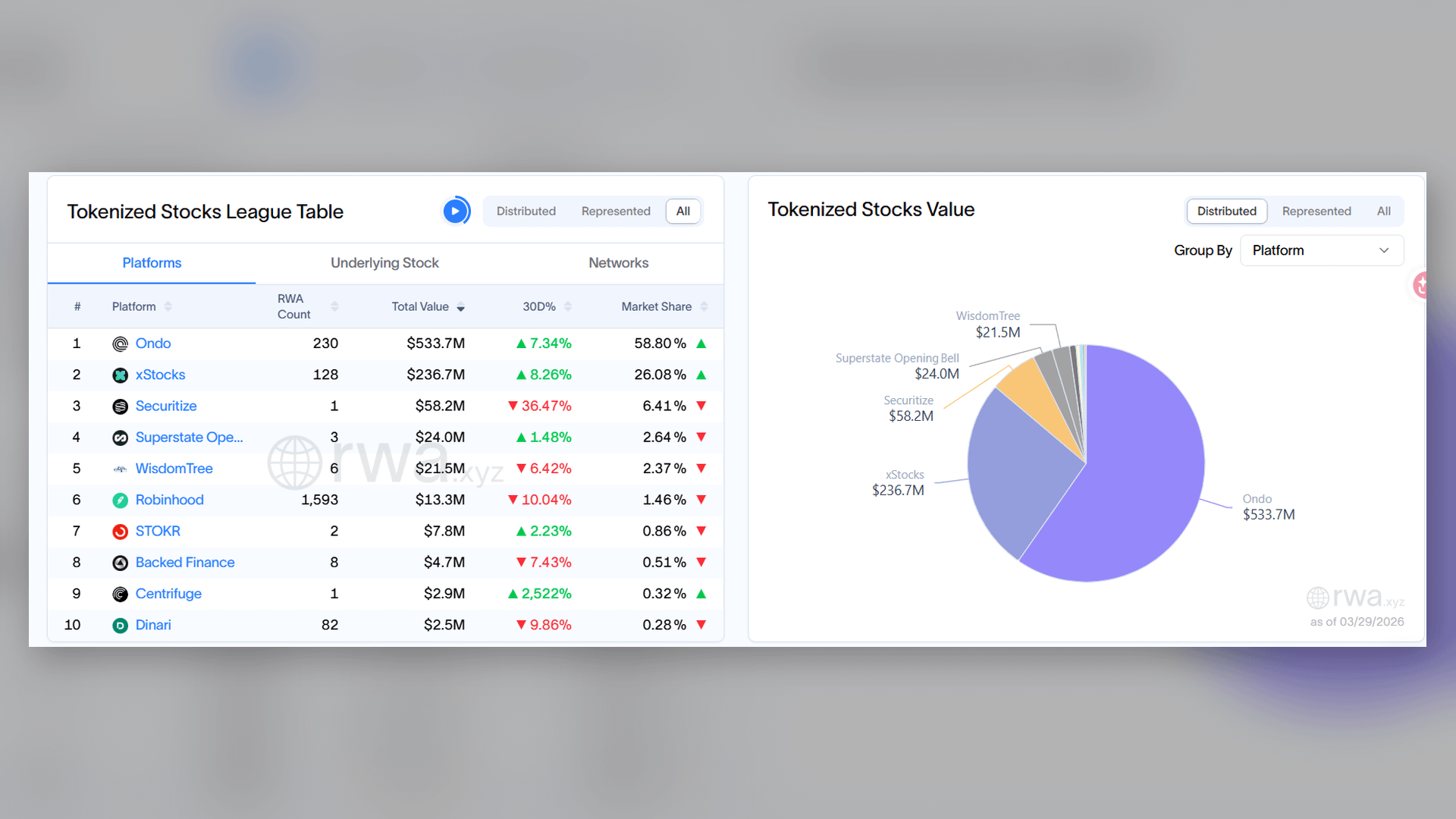
According to the tokenized stocks dashboard from RWA.xyz, the overall scale of the on-chain tokenized stock sector has already exceeded $1 billion. In this market, Ondo's share has approached sixty percent, clearly leading the way; while the second tier is also chasing, the gap is still significant.
If it only leads in market share, you could argue that this is just a short-term bonus.
But if you look at Ondo's official page and the related dashboard on Dune together, you will find that what it leads in is not just a number, but a complete set of product capabilities: broader asset coverage, increased trading volume, growing user addresses, and a scale of on-chain activity.
Ondo does not rely on just telling a concept to boost market sentiment, but is genuinely turning "stocks on-chain" into a market where trading occurs, people hold, and it continues to expand.
In other words, it is not a PPT leader, but the center where real transactions happen.
Why is it specifically Ondo?
In my view, Ondo's ability to reach the top is not relying on a single point of advantage, but rather hitting three key factors at the same time: a sufficient number of assets, a smooth trading experience, and a wide distribution.
Let’s discuss it one by one.
The first thing,its shelves are full. From the public page of Ondo Global Markets, the platform has already covered a large number of tokenized stocks and ETFs, and the number of underlying assets is no longer at the level of "a few popular stocks in trial operation," but has begun to take shape as an on-chain asset supermarket. When users come to a platform, the first question is never "Is your technology the most advanced?" but rather "Do you have what I want to buy here?"
If a platform only has a dozen popular stocks, it feels more like a demo; but if it has already stocked enough stocks and ETFs, then it truly has the opportunity to retain users, and thus has the potential for subsequent trading frequency, ecological expansion, and distribution efficiency.So from this perspective, the first layer of advantage Ondo has seized is not technology, but choice.
The second thing,it has made the trading experience more like an internet product, rather than a traditional brokerage process.
You can imagine a typical scenario. For example, one day NVIDIA, Tesla, or a certain AI concept stock suddenly breaks a big news, and you immediately assess that this direction will continue to strengthen. Under traditional paths, you might still need to open an account, deposit funds, exchange currency, wait for the market to open, and even face cross-border friction and various fees.
But if it is in a model like Ondo, the logic is completely different. From public product descriptions and market data, Ondo focuses on longer tradable periods, smaller price differentials, and lower friction costs. Moreover, it is not merely creating a closed small pool on-chain, but attempting to connect price anchoring and liquidity to a larger real market.
What it sells is not just the concept of "stocks on-chain," but rathera smoother, lower-threshold, and more global way of acquiring assets.The third thing, which is also something many people tend to overlook:Ondo is very good at seizing entry points. A strong productdoes not guarantee it will win. What truly determines the growth rate is often not the technical ceiling, but the distribution efficiency.
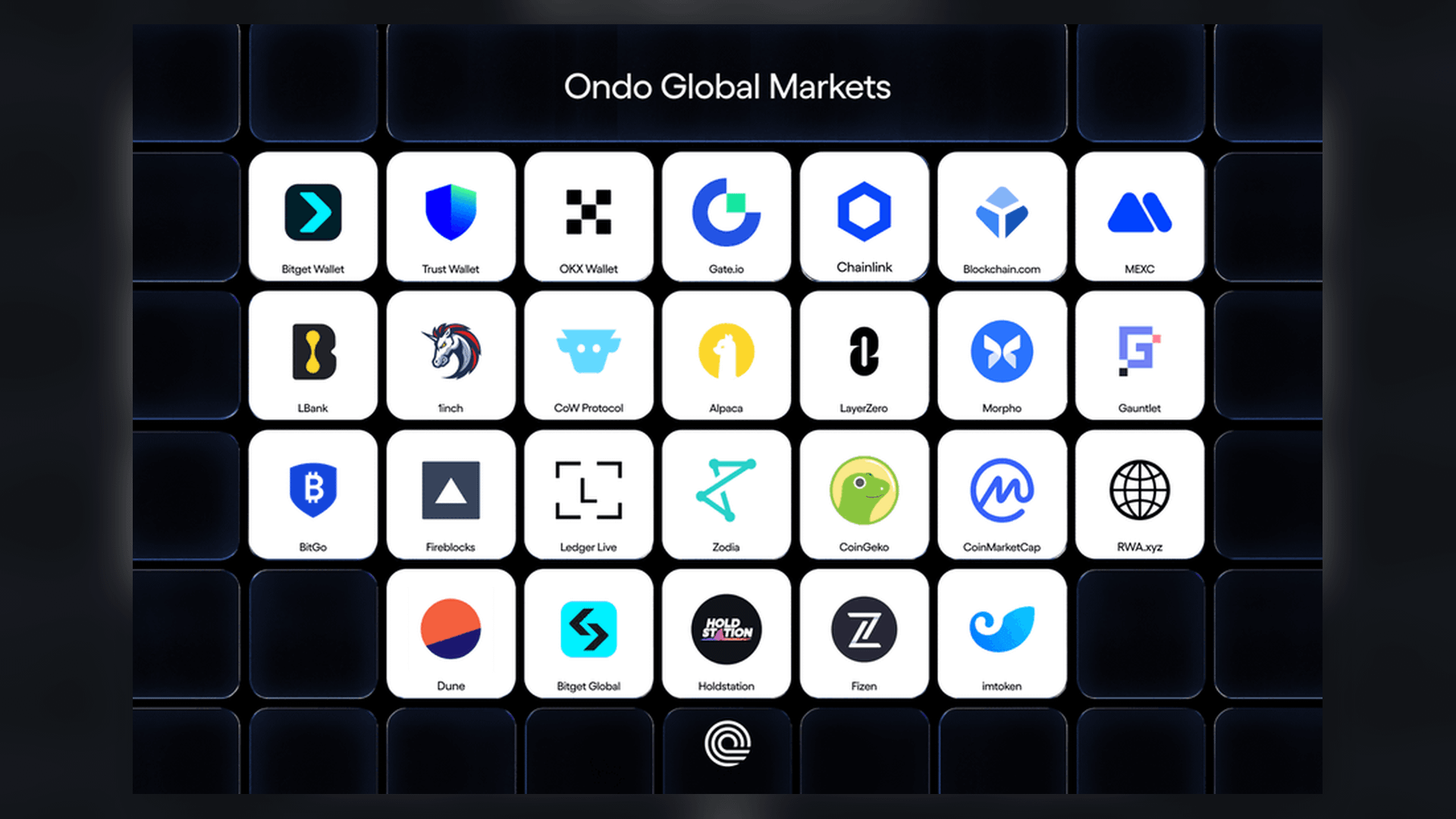
From Ondo's official disclosures and ecological pages, it is continuously spreading its assets and liquidity towards wallets, trading platforms, aggregators, and DeFi scenarios, while also expanding its reach in a multi-chain environment.
Users do not necessarily need to specifically open a website called Ondo to first encounter Ondo. A more likely scenario is that you were already in a wallet, already on a trading platform, already in a DeFi scenario, and then you start to see Ondo's assets, Ondo's entry points, and Ondo's liquidity more frequently. At this point,Ondo is no longer just a project, but begins to have a taste of basic infrastructure.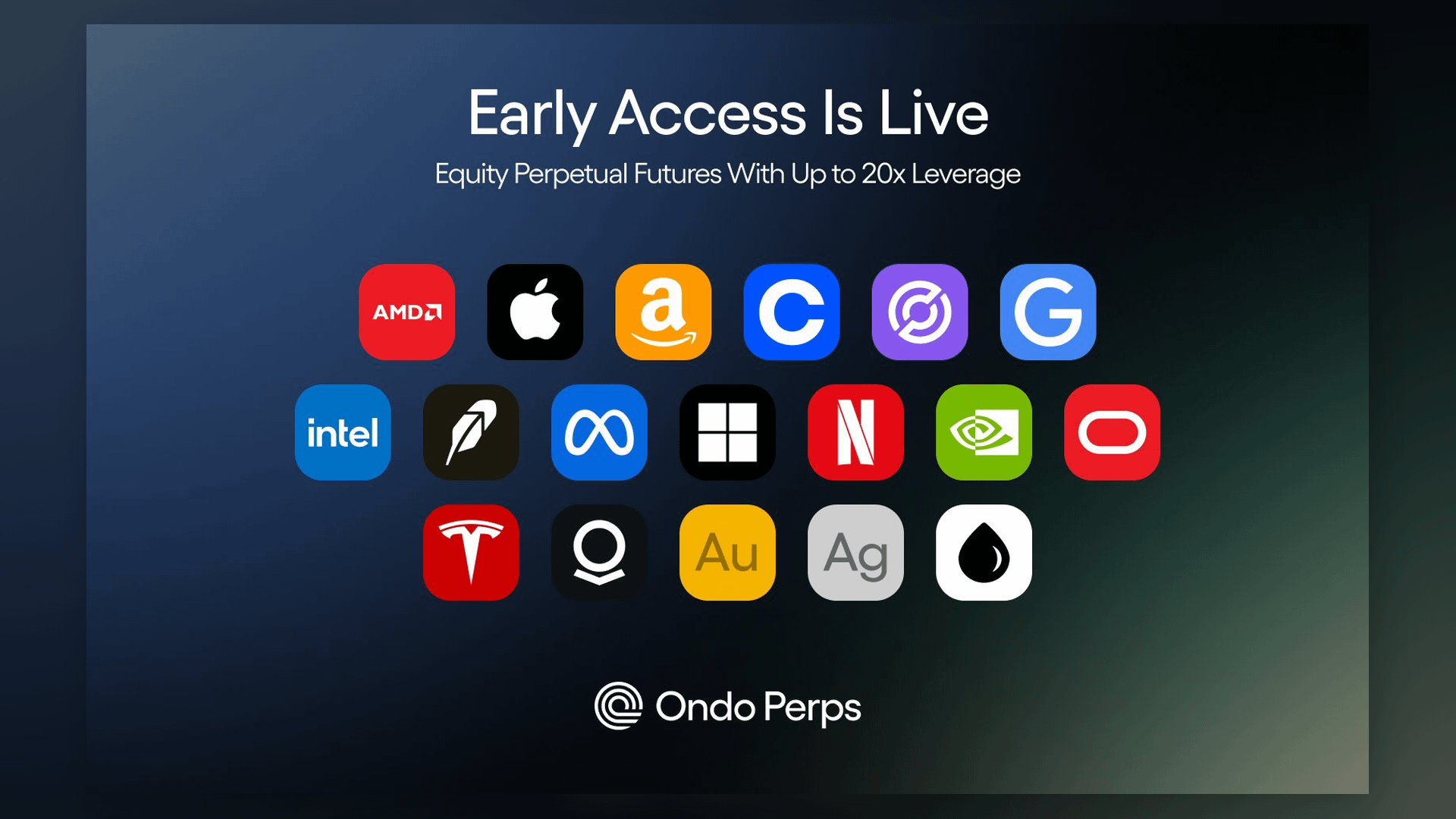
How exactly does Ondo bring stocks on-chain?
If this matter cannot be explained clearly, then all the advantages mentioned earlier are merely surface phenomena.
Its real underlying logic can be condensed into two keywords: encapsulated tokenization and on-demand minting and redemption.
First, let’s talk about the first point, encapsulated tokenization. Simply put, you can liken it to stablecoins.
Stablecoins do not mean putting a real dollar bill into the blockchain, but rather anchoring real-world dollars using an on-chain token; similarly, Ondo does not allow stocks to grow natively on-chain, but ratherBy using regulated custody and legal structures to lock real stocks off-chain, then mapping them onto on-chain stock tokens..
This token does not equal holding that stock directly in a traditional securities account, but it does give you an entry point for on-chain trading around the underlying asset price and exposure.
Why not use a more "purely on-chain native" approach? The reason is very practical. If you really want every token to directly rewrite the equity registration, issuance structure, and clearing processes in the real world, the compliance costs and advancement speed would be much slower, making it impossible to expand so quickly. Therefore, Ondo is taking a more realistic, engineering-driven, and scalable route.
This is also why I say thatOndo's success is not purely a success of decentralized narrative, but rather a success in simultaneously getting "compliance, custody, liquidity, and distribution" right.
If you see it as a project pursuing extreme decentralization, you may be disappointed; but if you view it as an interface layer and infrastructure for Wall Street assets entering the chain, then its commercial logic is actually very strong.Let’s discuss the second logic, on-demand minting and redemption. This name sounds very technical, but in layman's terms, it is quite simple.
Many people think the play of on-chain stocks is for the platform to first accumulate a large inventory of assets, and then you go in to trade. But a more reasonable path is often that when users have a demand, the system connects to the underlying assets and the minting process; when users exit, it then completes the corresponding redemption and recovery.
The biggest advantage of this mechanism is that it is easier to obtain liquidity and also easier to expand the types of assets.
Because it does not confine everything in a small pool on-chain for self-entertainment, but rather tries to connect to a larger source of liquidity in the real world. This is why Ondo can relatively quickly expand its asset shelves and make the trading experience closer to the real market. Many projects' problems are not that the story is not big enough, but that the story lacks engineering grounding.
But Ondo at least demonstrates one thing:it first figured out "how to bring assets on-chain, how to make them scalable, how to make users willing to trade" before telling a bigger narrative.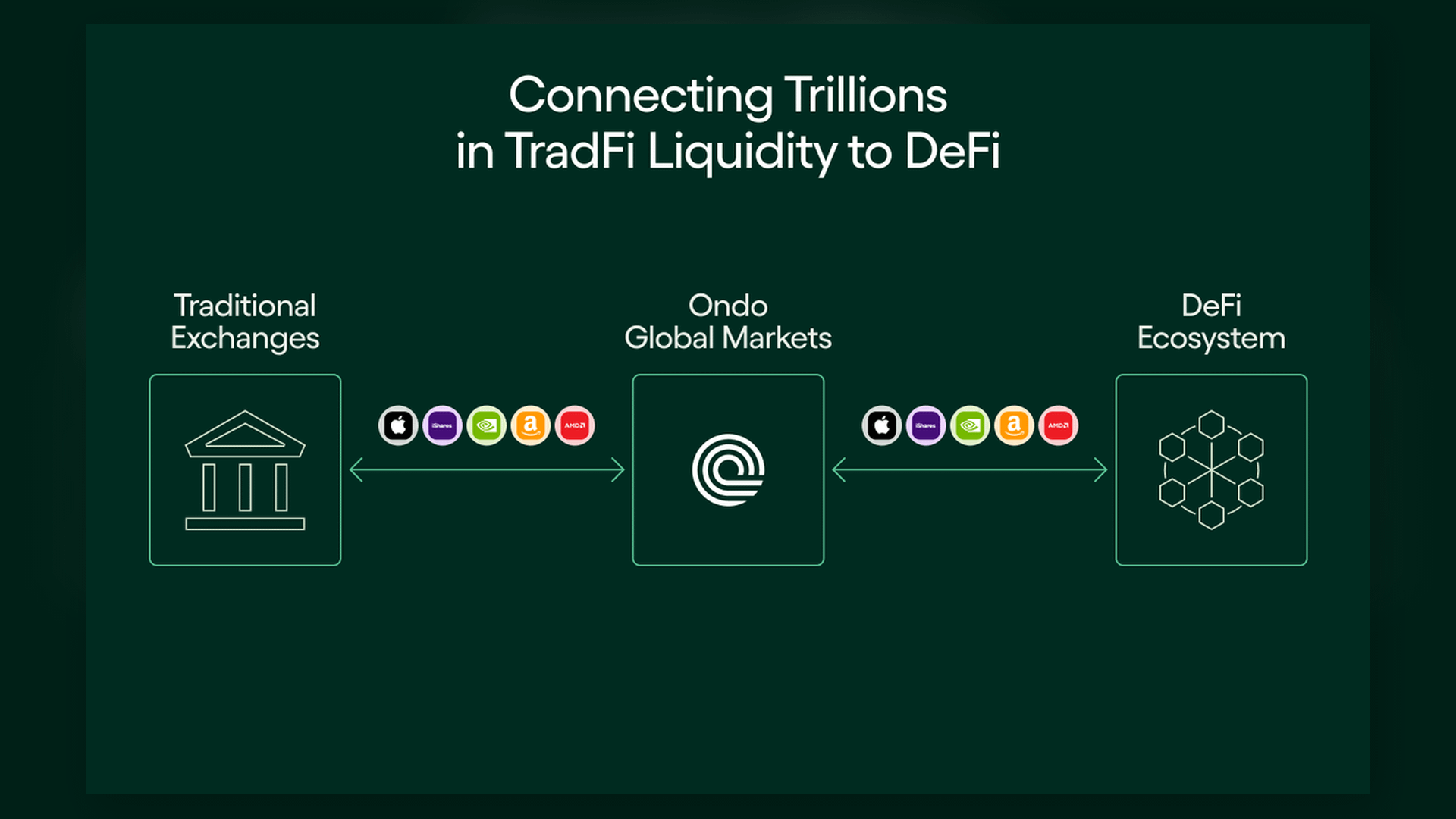
Risks that cannot be ignored: What challenges does Ondo face?
What is truly worth discussing is where Ondo's risks lie. I think there are at least four points that everyone must be clear about.
The core risk of the encapsulation model is essentially still dependent on custody and legal frameworks. The stablecoin market has gradually made everyone accept the logic of "off-chain assets + on-chain mapping," but stablecoins themselves have always faced issues of custody transparency, regulatory standards, and redemption pathways.
Now, applying the same logic to stocks, you must continue to ask: If regulation tightens in the future, or if there are changes in custody, clearing, and legal structures, how stable are the rights boundaries of these on-chain stock tokens?This is not being bearish, but rather a fundamental risk control issue.
It is still not a fully independent 7×24 system from traditional financial infrastructure.
You will find that the progress of the tokenized stock sector today is significant, but it still deeply relies on the brokerage, custody, and clearing systems of the real world. So if you imagine it as a completely on-chain native, completely independent of the real world securities system, that is at least not the case now.Leading does not mean that the moat is completely locked. Today, Ondo is number one, and there is no question about that. But if the regulatory environment becomes clearer, and more traditional brokerages, large trading platforms, and even stronger traditional financial institutions enter the arena, the competition intensity in this sector will certainly increase significantly.
In other words, Ondo has indeed emerged first, but what it faces in the future may not only be crypto-native competitors, but also larger traditional financial players.Ondo's success, to some extent, also means that this sector will become increasingly centralized.In the direction of stock tokenization, the ultimate decision of victory often does not depend on who is the most decentralized, but ratherwho has more stable custody, more comprehensive licenses, deeper liquidity, and more cooperative channels.
This means that the one who ultimately emerges is likely not the most idealistic player, but the one who resembles a new type of financial infrastructure company.
From this perspective,Ondo is more like a stronghold of Wall Street on-chain, rather than a replacement for Wall Street. Whether this is a boon or a hidden danger, different people will have different answers.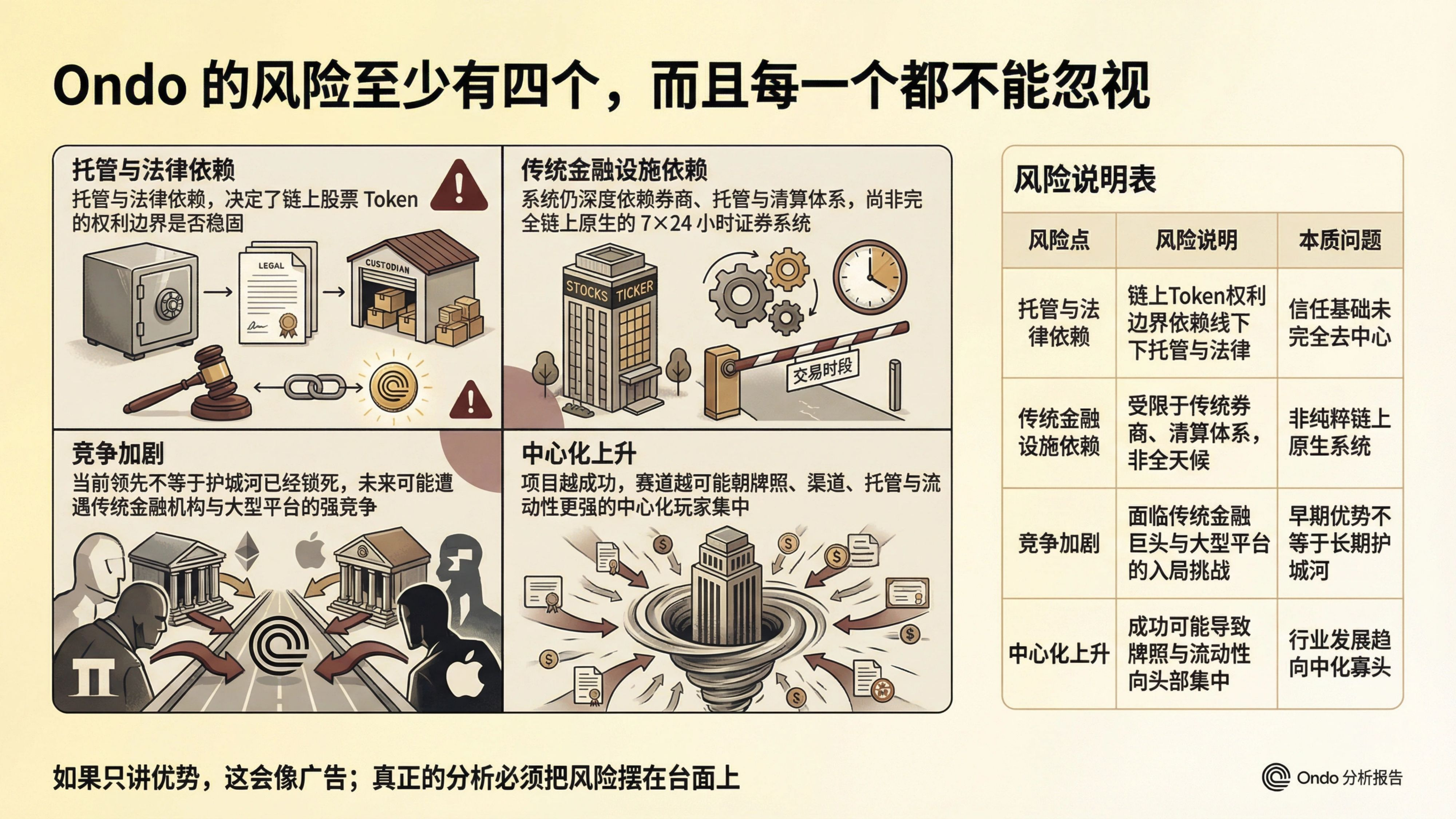
Imagination space: Will on-chain stocks become new financial building blocks?
The imagination space behind Ondo is still quite large. Its real upper limit may not just be as simple as "buying stocks on-chain." More importantly, once stocks are standardized into on-chain tokens, they will no longer just be passive securities, but may become a composable on-chain asset.
In a traditional securities account, when you hold a stock, most of the time you are just waiting for the price to rise or fall, collecting dividends, or doing some limited margin trading. But if it becomes an on-chain token, theoretically, the things you can do will suddenly increase: you can trade it, combine it, connect it to aggregators, integrate it into lending scenarios, and even in the future enter more DeFi modules, becoming new financial building blocks.
If these scenarios truly land gradually, then the significance of stocks on-chain will not just be "a new trading entry point," but rather it transforms from a static asset into a new building block in the entire on-chain financial system. This imagination space is far larger than simply "buying NVIDIA on-chain."
Summary and personal opinions
If you see Ondo as a short-term speculative tag, it will certainly experience market sentiment, narrative rotation, and valuation fluctuations. Many times, the project itself runs faster than the coin price, which is not uncommon in the crypto market. But if you see it as a player in the tokenized stock sector that is the first to achieve product closed-loop, liquidity closed-loop, distribution closed-loop, and partial compliance closed-loop, then it indeed qualifies for a revaluation now.
However, the truly worrisome aspect lies here: the more successful it is, the more it indicates that the endgame of this sector may not be a victory for pure Crypto narratives, but rather traditional finance using blockchain to reinvent itself.
This may not necessarily be a bad thing. But it certainly differs from many people's initial imagination of the "decentralized finance revolution." So in my view, Ondo is not a project that can be blindly praised right now, nor is it a project that can be easily ignored.
As for whether it will really secure this position in the end and even continue to expand its advantages to more stocks, ETFs, and other real-world assets in the future, we need to continue watching two things.
First, can it continue to maintain its compliance and liquidity advantages?
Second, can it truly integrate these assets into broader on-chain financial scenarios, rather than just stopping at the step of "bringing stocks on-chain"?
If these two things are accomplished, then what is most worth paying attention to about Ondo in the future is not just its nearly sixty percent market share, but that it may really become a new asset entry point.
