




When machines start paying each other, what is needed is a financial layer natively prepared for machines.
Author: Cathy

On April 9, B.AI (Chinese name: 白B.AI) officially debuted.
It positions itself with just one sentence: the underlying financial infrastructure for the AI Agent era. Simply put, it creates a dedicated payment and identity track for AI, allowing machines to autonomously complete transactions without relying on human bank accounts. Its further ambition is to become the underlying economic engine driving the evolution of AGI.
It is worth noting that TRON founder Justin Sun participated in B.AI as an advisor, making it easier for the outside world to understand it within the context of TRON's recent layout around 'AI + payment network'. After the product announcement, Justin Sun also expressed on the X platform, stating: 'B.AI drives the quick arrival of AGI, this is my sole mission and goal!' This makes B.AI not just a product launch, but also carries the meaning of a long-term strategic layout.
From the development path of AI, the emergence of this phenomenon is not accidental.
Discussions about AI in the industry have never ceased; new terms like models, parameters, inference, and Agents emerge almost weekly. But one question is rarely asked: As AI becomes stronger, who is providing the infrastructure for its real operation?
It’s not computing power, it’s not data; it’s that deeper layer. When an Agent needs to make hundreds of calls per second, pay for each call, and prove its identity to another Agent, which path should it take?
B.AI aims to connect at this layer.
01
Why now, why payment?
On the surface, such a layout can easily be understood as a cross-border attempt. However, if we extend the time dimension, it appears more like a natural extension of infrastructure capabilities.
In the past two years, the meaning of the term AI Agent has quietly changed. It is no longer just an assistant that can chat, but has begun to transform into an executor that can autonomously call tools, make decisions, and complete tasks. It will book flights for you, execute trades for you, and work for another Agent. Once it starts 'doing things on its own,' it means it needs to spend money, settle accounts, and pay for each API call.
This is something that traditional payment gateways cannot accommodate. Systems like Stripe are designed for people; they require accounts, KYC, card binding, and a fixed fee of $0.30 + 2.9% for credit card transactions. Asking an AI Agent to fill out a form and then pay a card fee for a $0.001 query is a misalignment of logic.
B.AI has made a practical choice on the admission threshold: it integrates multiple mainstream wallets, allowing users to use directly with their on-chain addresses. More notably, it also supports email login. This means that a Web2 user who has never encountered a wallet can directly enter B.AI to access AI services. The intention behind this design is clear—to lower the threshold as much as possible and expand the user pool from on-chain natives to a broader internet population.
B.AI is betting on four things: the agent identity system, stablecoin payment track, tokenization of real-world assets, and development tools for autonomous financial systems. None of these are focused on building models; all are invested in 'the infrastructure needed for a machine economy.'
In simple terms, what B.AI is doing is not creating another AI model, but establishing the financial track that AI must go through to achieve autonomous operation.

02
Integrating 'banks' into APIs
B.AI's product system can be broken down into three main pillars: an AI agent on-chain payment network, an entry point covering multiple top large models, and an out-of-the-box intelligent assistant BAIclaw.
The first pillar: the AI agent's on-chain payment network. This is the core layer of B.AI and the key distinguishing factor from all AI products. Two protocols are at work here, x402 and 8004.
The core idea of x402 is not complicated: directly embed payment capabilities into the network calling process, allowing Agents to complete settlements when requesting resources, without human intervention. An Agent calls a paid interface, the server returns 402, the Agent automatically signs a transaction for on-chain stablecoin payment, re-initiates the request, and obtains the resources. The entire process is a closed loop within a few seconds, with no human involvement.
8004 addresses another issue: Who is this Agent? Does it have credibility? What has it done in the past? Through on-chain identity registries, reputation registries, and verification registries, each Agent has a readable 'on-chain business card.' B.AI's implementation also adds an event reporting registry specifically for recording violations and anomalies.
This payment network enables Agents to achieve true economic independence: they can recharge autonomously, purchase computing power autonomously, and settle with other Agents autonomously, forming a complete business cycle without needing a human account behind to guarantee it.
The second pillar: an entry point to invoke the world’s top models. B.AI's LLM Service integrates multiple industry-leading large language models, including OpenAI, Claude, Gemini, z.ai, MiniMax, Kimi, etc., allowing users to select the most suitable model on demand without having to register on each platform.
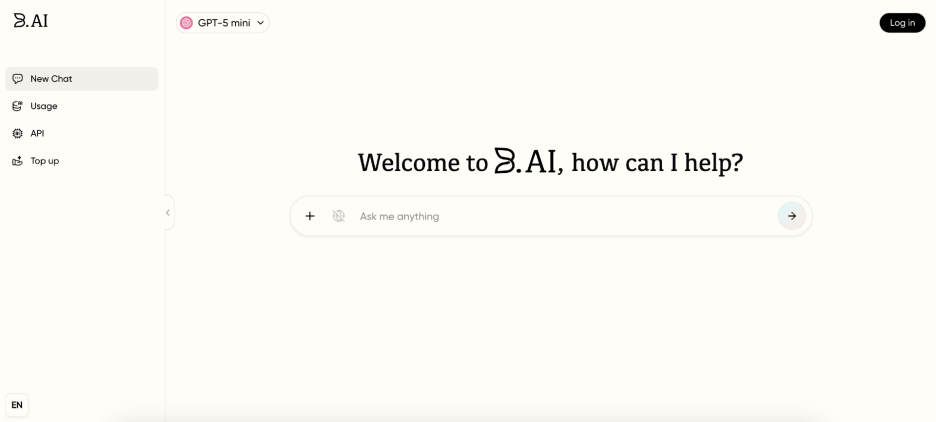
This service covers two usage scenarios: multi-model AI dialogues for ordinary users and a complete API interface for developers and Agents. The chat addresses 'how people use AI,' while the API addresses 'how systems invoke intelligence.' B.AI does not choose between the two but paves both paths—when you are an individual user wanting to try different models, you can switch directly in the dialogue interface; when you are a developer or part of an automated process, the API can embed intelligence into any code running in the background.
What truly distinguishes LLM Service from traditional AI platforms is the underlying Web3 native experience. Users can log in and authenticate via mainstream Web3 wallets, supporting multi-chain mainstream Token payments, with advantages of quick confirmation and low fees. This means that with just a wallet address, you can anonymously call the world's strongest models—without needing to register an account, bind a card, or leave any payment traces or behavioral profiles. Through resource optimization and efficient on-chain interactions, LLM Service is also more cost-competitive. This experience is somewhat like OpenRouter, but adds a Web3 native track that accommodates extreme privacy and low costs.
The third pillar: BAIclaw and the Agent toolbox. BAIclaw is an out-of-the-box AI assistant launched by B.AI, where developers only need to call an interface, and the system will distribute requests to the most suitable model based on task type.
Surrounding BAIclaw, B.AI is equipped with a complete set of tools for Agents. Skills are a set of preset skill packages that cover the most common needs of Agents during on-chain operations: DeFi and DEX operations (such as executing transactions on SunSwap and managing positions on SunPerp), payment settlement based on the x402 protocol, account recharges, multi-signature permission management, and on-chain data querying and analysis. An Agent on B.AI does not need to start from scratch to build capabilities; basic financial operation skills are readily available.
OpenClaw is a plug-and-play extension, allowing developers to integrate payment capability and identity registration into their Agents with just one line of code; MCP Server enables large models to understand on-chain states, using on-chain data as context when generating responses.
For Agents, B.AI is a birthplace. A newly generated Agent can obtain its own on-chain identity and autonomous funding account here, giving it the ability to spend money and the basis for being trusted.

03
The payment and identity of Agents: why they represent true long-term value.
At this point, a trend begins to become clear: in the age of Agents, the infrastructural factors beyond model capabilities are becoming equally important.
The progress of the past two years has made this very clear. GPT, Claude, Gemini, and various open-source models are continuously approaching each other's capabilities, with the gap rapidly narrowing. Going forward, models will become increasingly homogenized, just like the shrinking differences between cloud computing providers after 2010.
What will truly settle down are not parameters, but three things: invocation history, payment accumulation, and identity credibility.
Once these three things grow on a certain network, they will form an infrastructure effect. The longer an Agent runs on a certain chain, the more valuable its credibility becomes, the more complete its payment history accumulates, and the harder it is to migrate. This stickiness cannot be created by product features; it can only be created by time and network effects.
And the current issue is that almost all AI Agents are still parasitic within human account systems. They use human credit cards, human API keys, and human KYC qualifications. This means that Agents can never truly operate 'independently'; every expansion requires going back to find a human account for guarantees.
B.AI bets that this situation will change. As the number of Agents grows from thousands today to millions in the future, the model of feeding on human accounts will inevitably collapse. What is needed is a financial layer inherently designed for machines, where the address is identity, the signature is authorization, and payment is settlement.
Whether this judgment is correct will depend on time. But at least at the product level, AI Detective has already started to demonstrate the feasibility of this on a small scale. This system analyzes on-chain data related to case amounts exceeding $1 billion and, relying on B.AI's payment capabilities, has established a $100 million bounty pool to automatically allocate funds to white hats and law enforcement agencies providing leads. Once an Agent truly has an identity and wallet, it can handle more than just demonstrations.
In summary, this is an early bet on 'where should future AI put its money.'
04
Still being improved
Zooming out, there are still some aspects along B.AI's path that will evolve with the maturity of the Agent economy.
One direction of concern is the boundaries of Agent autonomy. When Agents have on-chain identities and funding accounts, and their execution capabilities are unlocked, how to give them a reasonable 'operating radius' becomes a new topic. B.AI consistently emphasizes that users retain ultimate control in the product and continuously refines the segmentation of permissions and threshold settings. This is something that will become clearer with real scenarios and is a direction the entire industry is exploring together.
Another direction is the evolution of underlying computing power. Logically, everything on-chain is decentralized; Agents actually operate on computing power, and the global supply system of computing power itself is also continuously evolving. B.AI's choice is to first lay down the most critical track of payment and identity, so that as the upper layer of computing power matures over time, the underlying financial infrastructure is already there waiting.
As for the different routes within the industry, several paths currently seem to be collectively opening up this ecosystem. Ethereum is promoting a decentralized coordination layer standard through ERC-8004; Solana, with its 400 millisecond block time, has achieved some early cases in the x402 protocol; TRON's differentiation lies in the depth of stablecoins and the high-frequency economic efficiency of payments, with several routes complementing each other in different directions.
B.AI is making a long-term judgment: when AI truly enters the autonomous execution stage, that financial track specifically designed for machines will become indispensable. This is being gradually verified by more and more products and data.
05
Ending
While everyone focuses on model capabilities, B.AI is betting on something else.
What it does is not a smarter brain, but a more open pipeline. Externally, this may not seem flashy, but as AI truly transitions from a tool to autonomous execution in the coming years, that pipeline will be harder to replace than the model itself.
What B.AI explores is laying down that financial and operational channel specifically for machines before AI transitions to autonomous execution.
From a long-term perspective, the importance of this channel may be re-understood to be as significant as the model capabilities themselves.