What backtesting actually does (and doesn’t do)
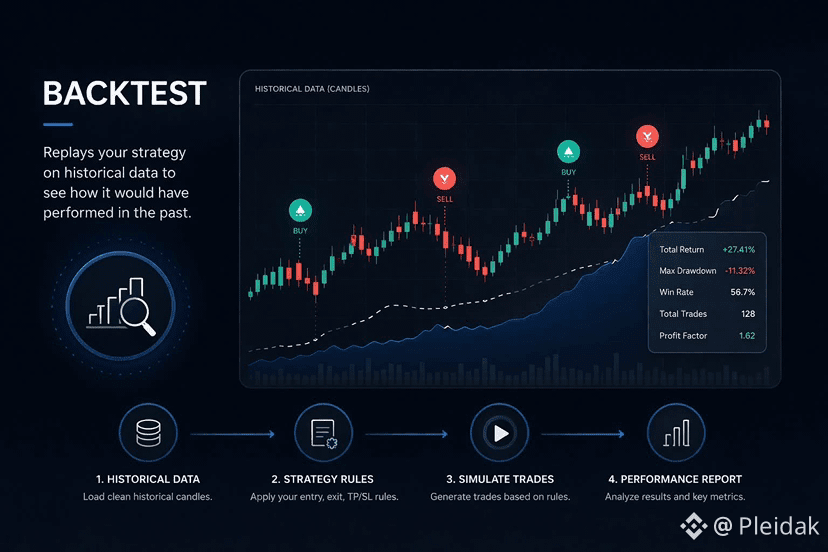
Backtesting replays your strategy on historical data to estimate how it would have behaved.
It’s useful — but often misunderstood.
What it’s good for:
• Validating entry/exit logic
• Catching obvious implementation errors
• Estimating turnover, fees, and drawdown
• Generating candidate ideas
What it cannot prove:
• Robustness across different market regimes
• Survival under different price paths
• Stability of parameters
• Real execution under live conditions
A strong backtest alone is not evidence of a robust strategy.
Correct workflow:
Backtest → Walk-Forward → Monte Carlo → Sensitivity
If you skip the rest, you’re not validating — you’re overfitting.
Backtesting replays your strategy on historical data to estimate how it would have behaved.
It’s useful — but often misunderstood.
What it’s good for:
• Validating entry/exit logic
• Catching obvious implementation errors
• Estimating turnover, fees, and drawdown
• Generating candidate ideas
What it cannot prove:
• Robustness across different market regimes
• Survival under different price paths
• Stability of parameters
• Real execution under live conditions
A strong backtest alone is not evidence of a robust strategy.
Correct workflow:
Backtest → Walk-Forward → Monte Carlo → Sensitivity
If you skip the rest, you’re not validating — you’re overfitting.