

Event Overview
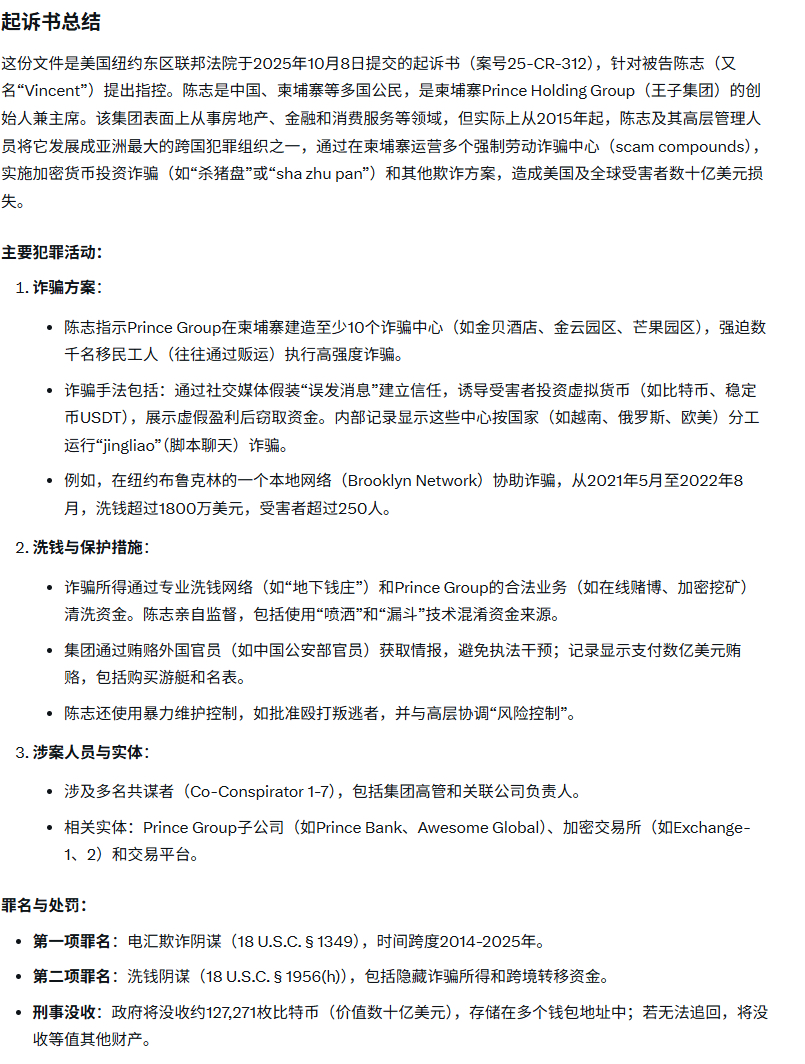
On October 14, 2025, the U.S. Department of Justice (DOJ) and the Federal Bureau of Investigation (FBI) announced the indictment of Chen Zhi (also known as Vincent), founder and chairman of Cambodia's Prince Holding Group, and successfully seized approximately 127,271 Bitcoins (BTC), valued at approximately $15 billion (approximately RMB 105 billion). This was the largest asset forfeiture action in DOJ history, targeting a transnational criminal organization suspected of causing billions of dollars in losses to victims worldwide through a "pig butchering" cryptocurrency investment scam. Chen Zhi, a 37-year-old British-Cambodian dual national, remains at large. The case was part of a joint U.S.-UK operation targeting a forced labor scam network in Southeast Asia.
Background
Chen Zhi founded Prince Holding Group in 2011. The group was ostensibly a multinational corporation focused on real estate, financial services, and consumer services, operating over 100 subsidiaries in over 30 countries worldwide. However, starting in 2015, Chen Zhi and his senior management secretly transformed the group into one of Asia's largest transnational criminal organizations. They operated at least 10 "scam compounds" in Cambodia, prison-like structures surrounded by high walls and barbed wire, housing thousands of trafficked people (including victims from over 60 nationalities). These workers were forced to use thousands of mobile phones and millions of virtual numbers to contact victims through social media or messaging apps such as WeChat and Telegram, gradually building trust (often disguised as romantic relationships) and tricking them into transferring cryptocurrency to designated accounts. The funds were then stolen.
The scam primarily involves a "pig butchering" scheme: scammers first "raise the pigs" (establish an emotional connection) before "slaughtering" them (inducing investment in fake crypto platforms, resulting in the evaporation of funds). These camps are equipped with "phone farms," where workers are forced to make hundreds of fraudulent calls daily. Those who resist are subjected to violence, including beatings, electric shocks, and torture. Chen Zhi personally issued instructions, even noting in the records, "Do not beat them to death." The scam primarily targets victims in the United States, Europe, and Asia. In 2024 alone, the FBI's Internet Crime Complaint Center (IC3) reported over $5.8 billion in losses from crypto investment scams, and Prince Group's activities are estimated to have caused tens of billions of dollars in losses globally.
The funds were laundered through complex methods: encryption techniques such as "spraying" and "funneling," shell companies, online gambling platforms, and Bitcoin mining farms (such as Warp Data Technology in Laos). Some of the funds flowed into legitimate businesses, such as the Jin Bei Casino in Cambodia and the Grand Legend Resort project in Palau. Chen Zhi and his accomplices used these funds to purchase luxury goods, including multimillion-dollar yachts, private jets, luxury watches, and rare artworks (such as a Picasso purchased at auction in New York). They also protected their criminal activities by bribing foreign officials, including the Chinese police and the Ministry of State Security.
Details of the allegations
On October 14, the Eastern District of New York Federal Court unsealed an indictment against Chen Zhi, charging him with two counts of wire fraud conspiracy and money laundering conspiracy. Specifically:
• Directly manage the scam camps and record the scam profits, bribery accounts and violence incidents.
• Coordinated a global fraud network, including a branch in Brooklyn, New York, that stole millions of dollars from more than 250 U.S. victims.
• Monitor fund laundering using Prince Group subsidiaries (such as Huione Group Financial Services, which processed $98 billion in crypto inflows between 2021 and 2025, of which $4 billion was illicit, including $37 million stolen by North Korean hackers).
• Involved in human trafficking, extortion, and violence: camp workers had their passports confiscated and were tortured; Chen Zhi possessed photos showing victims beaten to a bloody pulp.
If convicted, Chen Zhi faces up to 40 years in prison. His co-defendants include seven unnamed accomplices, including real estate executives, financial operators, and shell company owners. The indictment emphasizes that Chen Zhi's private wallet addresses (e.g., bc1qeth6n6ryxexvkx34wnx3nuynun4474h3j0gkhw) received over $1.77 billion in Bitcoin over the past two and a half years, directly linked to the mining farm and the scam funds.
Seizure details
• Quantity and Value: 127,271 BTC, with a current market value of approximately $15 billion (the Bitcoin price at the time of seizure was approximately $118,000 per coin), were seized. These Bitcoins were stored in unhosted wallets personally controlled by Chen Zhi and represent proceeds of fraud and money laundering.
• Process: The FBI gained control by tracing blockchain transactions and Chen Zhi’s private keys. This operation, a result of the DOJ’s National Security Division and the New York-based Joint Asian Criminal Enterprise Task Force, set a record for the largest cryptocurrency seizure in U.S. history (surpassing the $360 million seized in the 2022 Bitfinex hack and the $1 billion seized in the 2020 Silk Road case).
• Follow-up: The Bitcoin is now in the custody of the US government and will be used to compensate victims. The Treasury Department's Office of Foreign Assets Control (OFAC) also imposed sanctions on Prince Group and 146 of its associated targets (including individuals, shell companies, banks, and exchanges), freezing their assets and severing their access to the US financial system. The UK's National Crime Agency (NCA) and the Foreign, Commonwealth, and Development Office also imposed sanctions, freezing assets including London real estate.
Detailed analysis
1. Innovation and scale of crime patterns
This incident reveals the industrialized nature of Southeast Asian fraud networks: a closed loop from human trafficking to AI-assisted scams and laundering through crypto mining operations. Prince Group, far larger than a single fraud ring, disguised itself as a legitimate business and expanded through political influence (such as land leases in Cambodia and Palau). Chainalysis analysis reveals that its Bitcoin mining operations directly convert illicit funds into "clean" assets, highlighting the double-edged sword of cryptocurrency: facilitating fraud but also making it easy to trace. Compared to previous cases, such as the 61,000 BTC (worth $6.7 billion) seized in the UK in 2022, this operation focused more on targeting both upstream (the operations) and downstream (the laundering operations).
2. Impact of law enforcement and international cooperation
The joint US-UK operation marks an escalation in the global crackdown on "pig slaughter" scams. OFAC's 146 sanctions, covering Huione Group (designated a "primary money laundering concern") and the Byex exchange, are expected to disrupt billions of dollars in illicit funds. The FBI emphasized that the case utilized blockchain analysis tools, such as Chainalysis Reactor, to track funds, demonstrating a shift in law enforcement from reactive response to proactive infrastructure dismantling. However, challenges remain: Chen Zhi remains at large, the operation may have relocated to Myanmar or Laos, and global losses from crypto scams are estimated to be in the hundreds of billions of dollars.
3. Implications for victims and the industry
Most of the victims were middle-class individuals who lost their personal savings. This case may accelerate compensation for victims, but the recovery rate is low (historically less than 10%). For the crypto industry: Exchanges need to strengthen Know Your Customer (KYC) and Anti-Money Laundering (AML) screening to prevent Southeast Asian IP addresses and suspicious inflows. Bitcoin prices may fluctuate in the short term, but long-term benefits will benefit from transparent regulation. On a societal level, this case exposes the cruelty of forced labor and calls on the international community to combat human trafficking.
4. Potential risks and prospects
While this is a significant victory, similar networks (such as the North Korean Lazarus Group) may fill the vacuum. In the future, more AI-driven scams and DeFi (decentralized finance) vulnerabilities will test law enforcement. The DOJ is urging the public to report tips (PrinceGroupTips@fbi.gov), which are expected to lead to more arrests.
Original link
Here are the main original source links to the incident (based on official announcements and reliable reports):
• U.S. Department of Justice official press release: Chairman of Prince Group Indicted for Operating Cambodian Forced Labor Scam Compounds Engaged in Cryptocurrency Investment Fraud 0
• CNBC report: DOJ seizes $15 billion in bitcoin in ‘pig butchering’ fraud 2
• Wired报道:Feds Seize Record-Breaking $15 Billion in Bitcoin From Alleged Scam Empire 4
• Chainalysis Analysis: DOJ Seizes $15 Billion in Bitcoin 7
• U.S. Treasury Announcement: U.S. and U.K. Take Largest Action Ever Targeting Cybercriminal Infrastructure 1
 These links provide the full indictment, sanctions list, and blockchain tracking details. For further updates, please visit the FBI website.