


Written by: Glendon, Techub News
On October 11, a sudden 'black swan' storm swept through the entire cryptocurrency circle. In just 12 hours, the total liquidation amount in the cryptocurrency market approached 20 billion USD, with over 1.6 million traders being liquidated, among which DEX platforms became the hardest hit by this storm.
DeFiLlama released data on the X platform and pointed out that just last week, the weekly trading volume of DEX once broke through 177 billion USD, setting a historical record. However, under the impact of this market flash crash, the open contracts of Perp DEX have sharply shrunk from 26 billion USD to less than 14 billion USD, nearly halving.
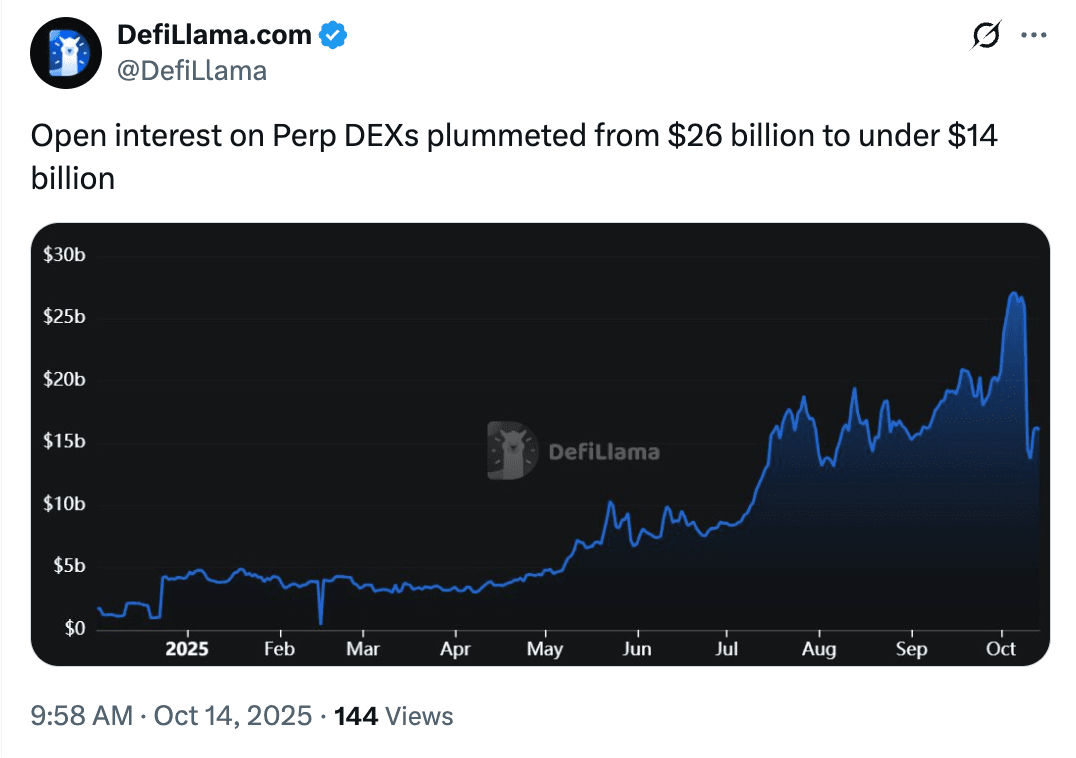
Particularly notable was the heavy losses suffered by the Hyperliquid platform during this incident, with its margin calls soaring to over $10.3 billion, far exceeding Bybit (approximately $4.6 billion) and Binance (approximately $2.4 billion). During this period, a HyperLiquid whale, who once held over 100,000 BTC and sold over $4.23 billion worth of BTC for ETH, attracted industry attention. Just an hour before Trump announced a 100% tariff on China, Bitcoin was massively shorted, which became one of the triggers for the subsequent market crash and sparked a storm of questions about insider trading.
On October 12, the on-chain detective Eye tweeted that the Hyperliquid whale who "sold over $4.23 billion in BTC to switch to ETH" was suspected to be former BitForex CEO Garrett Jin, who was the mastermind behind the $735 million BTC short order on the same platform.
Who is Garrett Jin? He graduated from Boston University with a degree in economics in 2008 and subsequently interned at China Construction Bank, where he worked until 2011. In 2012, he founded his first company, Da Yo Trading (HK), which he ran until 2014. He then keenly recognized the unlimited potential of the cryptocurrency sector and plunged into it, serving as Director of Operations at Huobi (HTX) until 2015. From 2017 to 2020, Garrett Jin served as CEO of the BitForex exchange.
It's worth noting that BitForex was embroiled in controversy for allegedly fabricating trading volume. In 2023, it was flagged by Japan's Financial Services Agency (FSA) as operating without a registration. In February 2024, the exchange's hot wallet private keys were compromised, and approximately $57 million was quietly withdrawn without any clear explanation. Soon after, the website became inaccessible, all operations ceased, and users were unable to withdraw their funds.
It wasn't until July 2024 that BitForex officially released a belated statement, stating that its team had been detained and investigated by police in Jiangsu Province, China, preventing timely notification to users. The company also promised to reopen KYC-based withdrawal services and resume platform operations. However, as of October 12th of this year, the exchange had still not processed all user withdrawal requests. Eye noted that the Hong Kong Securities and Futures Commission had previously issued a warning to BitForex regarding suspected fraud, and the exchange has been repeatedly accused of withholding and misappropriating funds, but these issues remain unresolved.
Between 2021 and 2023, Garrett Jin also launched the wallet project TanglePay, the cross-chain exchange DEX IotaBee based on "IOTA/Shimmer" (closed in 2024), and the free Web3 messaging protocol GroupFi (now received seed round financing and is still in operation).
Garrett remained active after the BitForex collapse, founding a new company, XHash, in 2024, which claims to provide decentralized ETH staking services for institutions. Industry insiders have speculated that he may be using this to transfer old funds into the formal system through "legal staking."
So, how did Eye identify the HyperLiquid whale as Garrett Jin? According to its tracking and analysis, during August and September, this whale sold over 35,000 Bitcoins for Ethereum through the Hyperliquid/Hyperunit platform, using a series of Bitcoin wallet addresses. The key insight lies in the fact that the address used to deploy the ETH-staking contract received funds from a specific wallet. Further tracing revealed that the initial funds to this wallet came from "ereignis.eth."
Meanwhile, Eye's in-depth analysis of the whale address (beginning with 0xb317) responsible for a $735 million BTC short position revealed that it received transaction fees from wallet 0x52d3. Prior to sending these fees, wallet 0x52d3 deposited $4.1 million in USDC to a Binance address called 0xD5D7, which had recently received $7.54 million from wallet 0x9536. Notably, wallet 0x9536 had sent $40,000 worth of USDT to ereignis.eth two weeks before the shorting began.
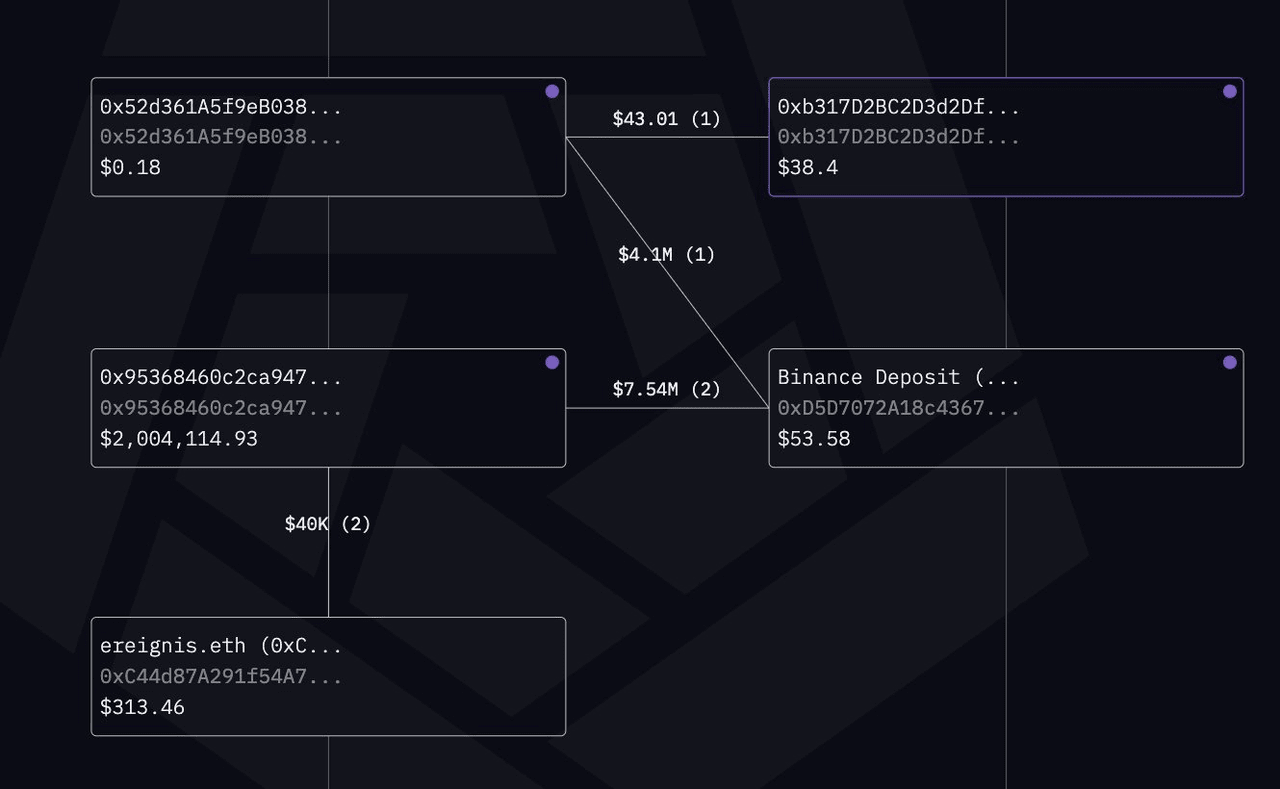
Finally, after a comprehensive investigation of the "ereignis.eth" address, Eye discovered that the second ENS domain name "garrettjin.eth" associated with the address clearly pointed to Garrett Jin, indicating that he may be the mastermind behind the large-scale operation of Hyperliquid/Hyperunit.
According to Eye, as of September 12, Garrett still holds a total of 46,295 Bitcoin (worth approximately $5.23 billion at the time of writing) in multiple addresses, including:
1C9dhpbtosmxW4L2ctTpPLdKwE2iaEHj7B
bc1qh3g2qyq2akw7ep03nsnmfyy8sgxs92q7jfc2jf
12XqeqZRVkBDgmPLVY4ZC6Y4ruUUEug8Fx
1DjmZD4ph1AQP1PhUGYtrd1G6HjwHFKpa6
1CKJYQPP9xhqjMMYAnzNux3h5wC2vb6Y5M
17MWdxfjPYP2PYhdy885QtihfbW181r1rn
bc1qmqqr5y3r7ud3dnznejsp3sf06fgrtfz4p5mefr
bc1q3vhptfhz48znfsshh9j2xey2nlkjd8qe64uq5p
Later, Eye further added in a post, "After I posted the relevant tweet, Garrett Jin immediately changed his Telegram privacy settings, hiding all previously public photos and phone numbers. He also deleted XHash from his profile. This series of actions seems to suggest that he is hiding some secrets."
Eye's tweet, like a stone that caused a thousand ripples, quickly attracted the attention of industry insiders such as Binance founder Changpeng Zhao and on-chain detective ZachXBT.
Changpeng Zhao stated that he's currently unsure whether the information is accurate and hopes someone can verify it. ZachXBT, however, believes that "there are still too many unknowns in this incident, and all the posts currently receiving attention are simply exaggerated versions of immature theories. Based on what he has learned, Garrett Jin (or Exe) appears to be collaborating with a Chinese whale, who previously had tens of digits of funds on the blockchain that lay dormant until recently."
In this regard, many people even suspect that Garrett Jin's funds come from the stolen BitForex user funds.
Faced with overwhelming doubts, Garrett Jin quickly responded on the X platform: "To clarify, I have no connection with the Trump family or Trump Jr. - this is not insider trading. This money is not my personal property, but belongs to my clients. We operate nodes and provide internal insights and strategic support to our clients."
He also explained in detail why he chose to be bearish before the market flash crash: "From a technical analysis perspective, US stocks, A-share tech stocks, and mainstream cryptocurrencies have all shown overbought signals, such as MACD divergences. The crypto market is highly positively correlated with US stocks, and the US stock market structure has recently shifted from risk-on to risk-off, so we believe the crypto market will follow suit. In addition, since September 26, Sino-US trade tensions have continued to escalate, but the market sentiment is so bullish that investors have largely ignored this risk. For this reason, both A-shares and US stocks entered a risk-off mode before the crash on October 11. It is important to emphasize that we cannot predict when President Trump will take retaliatory measures against China."
This explanation seems satisfactory, but it does not completely dispel the public's doubts.
Today, on-chain detective Eye tweeted again, sharing a bombshell: Thanks to the help of multiple anonymous sources, the investigation into the suspected insider trading group has made significant progress. Sources revealed that Garret may not be the true mastermind, but rather a "front," but he is a key starting point in tracking down the real insider.
He analyzed that if the leaker didn't disclose the information directly to Garrett Jin, but instead passed it on to someone else, this further supports the "front" hypothesis. The key information provided to him likely originated from a group of insiders. They have long exploited confidential information from White House rumors and official announcements, relayed by aides close to the US president to a group of insiders, to establish extremely favorable trading positions and maximize their profits before significant price fluctuations.
Eye also revealed that the core individuals currently confirmed to be involved are Zach Witkoff and Chase Herro, co-founders of the Trump family's crypto project, World Liberty Financial. It's worth noting that Trump's sons may also be involved.
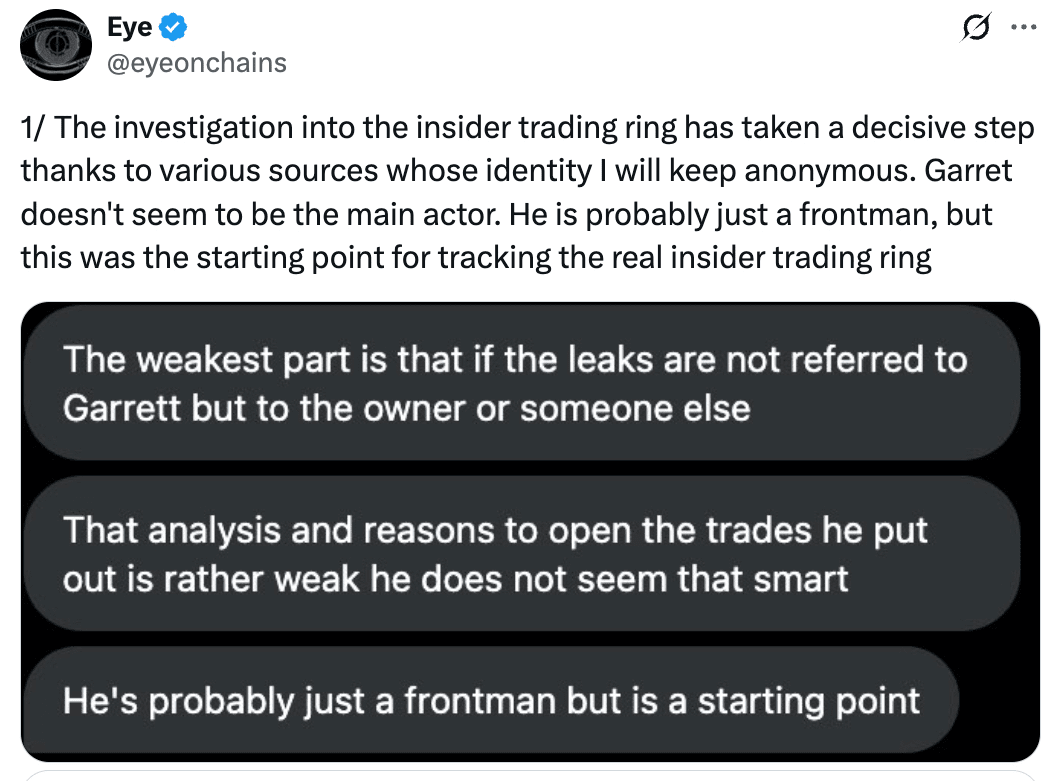
Finally, Eye added: "For personal safety reasons, I will no longer publish content on this topic and will leave it to the public to dig deeper into more information."
As of the time of writing, Garrett Jin has sent out multiple tweets in an attempt to prove his innocence, saying that his team's long-term optimistic stance is not inconsistent with short-term hedging operations.
"We are bullish in the long term, but that doesn't mean we won't hedge in the short term. If short positions are blamed when prices fall, should long positions be blamed when prices rise and short positions are liquidated? There are so many conspiracy theories in the world. Stop making excuses for your ignorance and unprofessionalism."
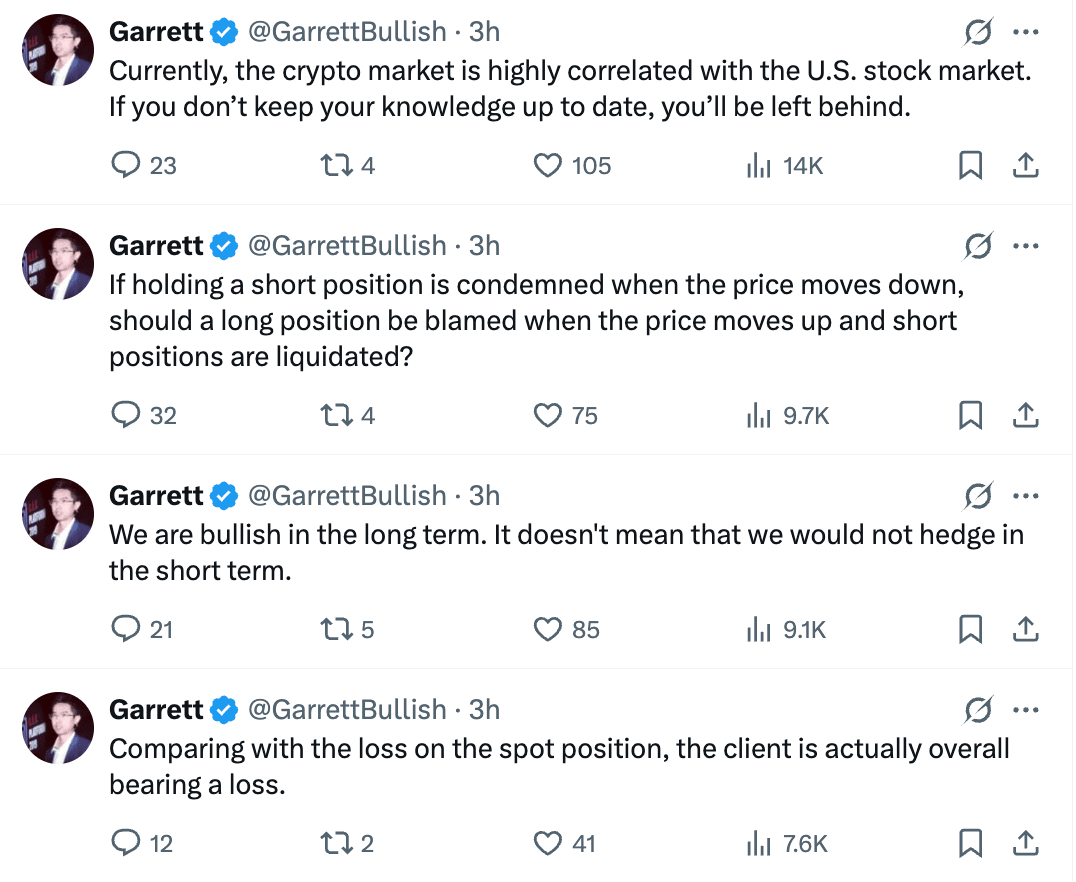
He emphasized that clients hold a significant amount of cryptocurrency in spot form, with short positions providing only partial hedging. Further positions could be established if liquidity were sufficient. Currently, clients are actually losing money overall compared to the losses incurred on their spot positions. The crypto market is highly correlated with the US stock market, and they remain bearish. The recent price rebound was primarily driven by overly long leveraged funds. The October 11th crash wiped out most leveraged traders. A sustained market rally is highly unlikely until exchanges establish stabilization funds to restore market confidence. While clients may have some biased judgment, they possess deep expertise in risk management.
At this stage, while Eye has provided clear analysis and conclusions, it ultimately fails to provide definitive, substantive evidence. Meanwhile, Garrett Jin's clarification is somewhat self-explanatory. With Eye's closure on the incident, the biggest "insider trading" controversy surrounding the October 11th flash crash may finally be resolved.
This flash crash also offers a lesson for crypto investors: they need to draw on the experience of traditional finance, rather than relying solely on market narratives and personal emotions to formulate investment strategies. Given the current context of the industry being closely connected to the macro market, if the industry and investors fail to shift their perspectives in a timely manner, similar incidents could occur again.