
Kelly Chow
534 Posts

Kelly Chow
Report
Block User
1.3K+ Following
16.8K+ Followers
6.5K+ Liked
Posts
All
Quotes
Videos
·
--
The Fed bought $1.756 billion in short-term Treasury bills this morning, adding a little more liquidity to the system.
Don’t rush to call it QE’s return. This is mainly reinvestment of principal from maturing MBS. This cycle is around $14 billion, while reserve management purchases remain paused. But the Fed is indeed continuing to buy securities in the secondary market.
What’s really worth watching is net liquidity. Last week, it was already near $5.85 trillion, and the TGA keeps falling, with money slowly flowing back in. Most people are still watching BTC’s candlestick; those in the know are watching to see whether the pipes keep loosening.
If conditions ease further, risk assets often have more upside potential than you might expect. Adding the Fed’s operations calendar to your watchlist is more useful than simply watching prices.
#英伟达财报大超预期,Q4营收展望1300亿美元
{web3_wallet_create}(10x42778037d69350508cdd34d9fa17053970591101)
{future}(ZECUSDT)
{future}(ETHUSDT)
The Fed bought $1.756 billion in short-term Treasury bills this morning, adding a little more liquidity to the system.
Don’t rush to call it QE’s return. This is mainly reinvestment of principal from maturing MBS. This cycle is around $14 billion, while reserve management purchases remain paused. But the Fed is indeed continuing to buy securities in the secondary market.
What’s really worth watching is net liquidity. Last week, it was already near $5.85 trillion, and the TGA keeps falling, with money slowly flowing back in. Most people are still watching BTC’s candlestick; those in the know are watching to see whether the pipes keep loosening.
If conditions ease further, risk assets often have more upside potential than you might expect. Adding the Fed’s operations calendar to your watchlist is more useful than simply watching prices.
#英伟达财报大超预期,Q4营收展望1300亿美元

3
388
·
--
Partly True
The FOMC minutes come out tomorrow at 2 p.m. Eastern.
$BTC briefly reached around 64k, and a December rate hike was all but signaled. Although the minutes are from the October meeting (before that hot CPI reading), the key issue isn’t “whether to hike or not,” but how broad the support for a hike was. If “many” members favored tighter policy, or even mentioned accelerating the pace, the market could take another hit in the short term. If it was just those two dissenting votes, with everyone else leaning cautious, we could instead see an oversold bounce.
Don’t just read the headlines—watch for words like “many” and “several.”
#英伟达财报大超预期,Q4营收展望1300亿美元
{web3_wallet_create}(10x42778037d69350508cdd34d9fa17053970591101)
{future}(ZECUSDT)
{future}(ETHUSDT)
The FOMC minutes come out tomorrow at 2 p.m. Eastern.
$BTC briefly reached around 64k, and a December rate hike was all but signaled. Although the minutes are from the October meeting (before that hot CPI reading), the key issue isn’t “whether to hike or not,” but how broad the support for a hike was. If “many” members favored tighter policy, or even mentioned accelerating the pace, the market could take another hit in the short term. If it was just those two dissenting votes, with everyone else leaning cautious, we could instead see an oversold bounce.
Don’t just read the headlines—watch for words like “many” and “several.”
#英伟达财报大超预期,Q4营收展望1300亿美元

1
593
·
--
Verified
Nvidia scored 100 on its earnings report, but its stock only got a 2.5? 🤣
Nvidia’s latest earnings report, released last night:
Quarterly revenue of $115.8 billion, up 103% year over year!
Revenue guidance of $130 billion for next quarter, beating Wall Street expectations!
With results like these, any tech company would probably be setting off fireworks to celebrate.
Yet the stock rose only about 2.5% after hours.
Grok’s explanation was pretty down-to-earth:
Although results beat expectations, the market is more concerned about the leadership transition after Jensen Huang steps down, future strategy, and risks around China business and profit margins.
What’s even more interesting is that Huang himself also published a long post.
He thanked friends, employees, and investors for their support, reminisced about coming to the United States 53 years ago, and said he would be honored to serve as CEO again if the board believed it was in the best interests of the company, its shareholders, and its employees.
The whole scene is a little surreal:
The company is using its earnings report to prove it can make money without Huang, while Huang is using a long post to say he’s willing to come back.
One is handing in a report card; the other is writing a cover letter.
Now it’s the board’s turn to make a choice.
What do you think Nvidia really needs: better earnings reports, or that guy in the leather jacket? 🤣
#英伟达财报超预期AI云股盘后上涨
#本周财报与宏观事件密集,市场再迎波动考验 #黄仁勋能否复任CEO?英伟达董事会:暂不考虑
{web3_wallet_create}(10x42778037d69350508cdd34d9fa17053970591101)
{spot}(NVDABUSDT)
{future}(ZECUSDT)
Nvidia scored 100 on its earnings report, but its stock only got a 2.5? 🤣
Nvidia’s latest earnings report, released last night:
Quarterly revenue of $115.8 billion, up 103% year over year!
Revenue guidance of $130 billion for next quarter, beating Wall Street expectations!
With results like these, any tech company would probably be setting off fireworks to celebrate.
Yet the stock rose only about 2.5% after hours.
Grok’s explanation was pretty down-to-earth:
Although results beat expectations, the market is more concerned about the leadership transition after Jensen Huang steps down, future strategy, and risks around China business and profit margins.
What’s even more interesting is that Huang himself also published a long post.
He thanked friends, employees, and investors for their support, reminisced about coming to the United States 53 years ago, and said he would be honored to serve as CEO again if the board believed it was in the best interests of the company, its shareholders, and its employees.
The whole scene is a little surreal:
The company is using its earnings report to prove it can make money without Huang, while Huang is using a long post to say he’s willing to come back.
One is handing in a report card; the other is writing a cover letter.
Now it’s the board’s turn to make a choice.
What do you think Nvidia really needs: better earnings reports, or that guy in the leather jacket? 🤣
#英伟达财报超预期AI云股盘后上涨
#本周财报与宏观事件密集,市场再迎波动考验 #黄仁勋能否复任CEO?英伟达董事会:暂不考虑

3
8
1.3k
·
--
Verified
U.S. October retail sales data is due at 9:30 tonight. The market expects just 0.1%–0.2%, well below last month's 0.8%.
If the data is significantly weaker than expected, the dollar may come under pressure, opening up room for a short-term rebound in risk assets. If it exceeds expectations, rate-hike expectations may rise, and $BTC could retest support near 62K.
BTC is currently trading between 64K and 65K. Tonight's data will most likely determine the short-term direction, and volatility could be high.
#Anthropic获批以ANT代码在纳斯达克上市
#美国10月零售销售今晚2130公布
{web3_wallet_create}(10x42778037d69350508cdd34d9fa17053970591101)
{future}(ETHUSDT)
{future}(DOGEUSDT)
U.S. October retail sales data is due at 9:30 tonight. The market expects just 0.1%–0.2%, well below last month's 0.8%.
If the data is significantly weaker than expected, the dollar may come under pressure, opening up room for a short-term rebound in risk assets. If it exceeds expectations, rate-hike expectations may rise, and $BTC could retest support near 62K.
BTC is currently trading between 64K and 65K. Tonight's data will most likely determine the short-term direction, and volatility could be high.
#Anthropic获批以ANT代码在纳斯达克上市
#美国10月零售销售今晚2130公布

3
942
·
--
Verified
U.S. stocks took another heavy hit today. The Nasdaq plunged 2.5%, while the S&P 500 fell nearly 2%, leaving tech stocks badly battered. Nvidia led the declines, with chipmakers and AI-related stocks getting hammered. Traders were clearly wary of tomorrow’s earnings and Anthropic’s IPO this week.
The Fed just called out AI financing risks in its financial stability report: off-balance-sheet liabilities at major tech companies and data center debt have piled up too high. The market is starting to worry that this wave of capital spending may not deliver the returns investors expect. The VIX jumped nearly 20%, and sentiment feels even more strained than the numbers suggest.
By the closing bell, nobody dared to step in and buy the dip, while defensive sectors held up relatively well. Nvidia reports tomorrow—will this sell-off prove to be a shakeout, or are stocks headed even lower? We’ll find out tonight.
#标普500与纳指期货创季度新低
{web3_wallet_create}(10x42778037d69350508cdd34d9fa17053970591101)
{spot}(NVDABUSDT)
{future}(1000PEPEUSDT)
U.S. stocks took another heavy hit today. The Nasdaq plunged 2.5%, while the S&P 500 fell nearly 2%, leaving tech stocks badly battered. Nvidia led the declines, with chipmakers and AI-related stocks getting hammered. Traders were clearly wary of tomorrow’s earnings and Anthropic’s IPO this week.
The Fed just called out AI financing risks in its financial stability report: off-balance-sheet liabilities at major tech companies and data center debt have piled up too high. The market is starting to worry that this wave of capital spending may not deliver the returns investors expect. The VIX jumped nearly 20%, and sentiment feels even more strained than the numbers suggest.
By the closing bell, nobody dared to step in and buy the dip, while defensive sectors held up relatively well. Nvidia reports tomorrow—will this sell-off prove to be a shakeout, or are stocks headed even lower? We’ll find out tonight.
#标普500与纳指期货创季度新低

4
860
·
--
The market has felt a little off these past couple of days.
Gold is down, silver is down, Nvidia keeps getting hammered, and U.S. stocks are following suit. Even $BTC and $XRP couldn’t hold up. In the past, when markets got chaotic, you could at least take shelter in gold and silver. This time, though, almost everything is being sold off at once. It doesn’t feel like a simple rotation of funds so much as the entire market scrambling for cash.
The reasons seem fairly concentrated: the fallout from Jensen Huang’s sudden resignation hasn’t died down, and the board has made it clear it doesn’t want him back. Add hotter-than-expected inflation data, rising expectations of Fed rate hikes, and Nvidia’s earnings report and Anthropic’s IPO just around the corner, and people are clearly seeking safety. A stronger dollar and elevated yields are hitting high-valuation assets first, and precious metals haven’t been spared either.
It reminds me of March 2020. Back then, everything was falling too, and cash was king. But after the plunge, the market staged a powerful rally. Could this time be similar—a thorough shakeout of positions before another rally? Hard to say. This time, after all, the catalysts are turmoil inside a major tech company and tighter macro conditions, which is quite different from the pandemic shock back then.
But sometimes that’s just how markets work: when things look closest to collapse, short-term sentiment may actually be nearing its low. In any case, those who aren’t heavily invested right now can keep a close eye on Nvidia’s earnings tonight and how liquidity develops afterward. If we get another big sell-off, that might be the opportunity.
#XRP跌至0.89美元创2024年11月以来新低
#比特币连续六周下跌
#英媒报道黄仁勋正考虑重返英伟达
{web3_wallet_create}(10x42778037d69350508cdd34d9fa17053970591101)
{spot}(NVDABUSDT)
{future}(ETHUSDT)
The market has felt a little off these past couple of days.
Gold is down, silver is down, Nvidia keeps getting hammered, and U.S. stocks are following suit. Even $BTC and $XRP couldn’t hold up. In the past, when markets got chaotic, you could at least take shelter in gold and silver. This time, though, almost everything is being sold off at once. It doesn’t feel like a simple rotation of funds so much as the entire market scrambling for cash.
The reasons seem fairly concentrated: the fallout from Jensen Huang’s sudden resignation hasn’t died down, and the board has made it clear it doesn’t want him back. Add hotter-than-expected inflation data, rising expectations of Fed rate hikes, and Nvidia’s earnings report and Anthropic’s IPO just around the corner, and people are clearly seeking safety. A stronger dollar and elevated yields are hitting high-valuation assets first, and precious metals haven’t been spared either.
It reminds me of March 2020. Back then, everything was falling too, and cash was king. But after the plunge, the market staged a powerful rally. Could this time be similar—a thorough shakeout of positions before another rally? Hard to say. This time, after all, the catalysts are turmoil inside a major tech company and tighter macro conditions, which is quite different from the pandemic shock back then.
But sometimes that’s just how markets work: when things look closest to collapse, short-term sentiment may actually be nearing its low. In any case, those who aren’t heavily invested right now can keep a close eye on Nvidia’s earnings tonight and how liquidity develops afterward. If we get another big sell-off, that might be the opportunity.
#XRP跌至0.89美元创2024年11月以来新低
#比特币连续六周下跌
#英媒报道黄仁勋正考虑重返英伟达

4
996
·
--
Write CZ as CƵ!
It looks like a casual stroke
but it’s packed with love!
You’ll draft the preface, and the signature must include one
You’ll be the happiest person in the world 👸
#CƵ
{web3_wallet_create}(560xb2d0cae2e196e4b4a7c1647f9319fa115d614444)
Write CZ as CƵ!
It looks like a casual stroke
but it’s packed with love!
You’ll draft the preface, and the signature must include one
You’ll be the happiest person in the world 👸
#CƵ
It looks like a casual stroke
but it’s packed with love!
You’ll draft the preface, and the signature must include one
You’ll be the happiest person in the world 👸
#CƵ

1
243
·
--
Musk's fortune of 749 billion makes him a legend! The true 'super dealer' in the cryptocurrency world has never been the exchanges.
A ruling from the Delaware Supreme Court has made Musk the world's first billionaire in the 700 billion dollar club, with a net worth of 748.9 billion, leaving second-place Page nearly 500 billion behind. The impact of this move on the cryptocurrency market is far deeper than imagined. As a top player spanning technology, aerospace, and cryptocurrency, Musk's wealth restructuring essentially reinforces the 'narrative power'.
Many people only focus on the recovery of the 139 billion dollar stock options, but those in the cryptocurrency sphere should see through the core logic: Musk's business empire is already deeply intertwined with the crypto market. Tesla holds 11,509 bitcoins, and SpaceX has made three large BTC transfers totaling over 475 million dollars in the past two months, with no signs of selling, as the two giants hold nearly 2 billion dollars in digital assets. This long-term holding itself is the strongest endorsement of confidence.
More crucially, the upgrade of the 'Musk effect'. Historical data shows that he has mentioned Dogecoin 27 times, with a maximum increase of 132.74%; he has talked about Bitcoin 13 times, with a peak surge of 22.74%. Now that his wealth has hit a new high, the market weight of his statements will only grow stronger—especially in the wave of AI and cryptocurrency integration, the trading demand of AI agents under his ecosystem naturally points to cryptocurrencies that do not require KYC.
Barclays has long pointed out that the logic behind Tesla and Bitcoin's rise is the same, both are typical of 'narrative-driven' growth. Now Musk's wealth myth further strengthens this narrative, and institutional funds are likely to accelerate their inflow into his related ecosystem. For investors in the cryptocurrency market, the focus should not be on chasing short-term concept stocks, but rather on the on-chain movements of Tesla and SpaceX, as well as the long-term opportunities in the AI + cryptocurrency track—after all, the super players who can influence global capital flows are the true market barometers.
$BTC
{future}(BTCUSDT)
$BNB
{future}(BNBUSDT)
$ETH
{future}(ETHUSDT)
Musk's fortune of 749 billion makes him a legend! The true 'super dealer' in the cryptocurrency world has never been the exchanges.
A ruling from the Delaware Supreme Court has made Musk the world's first billionaire in the 700 billion dollar club, with a net worth of 748.9 billion, leaving second-place Page nearly 500 billion behind. The impact of this move on the cryptocurrency market is far deeper than imagined. As a top player spanning technology, aerospace, and cryptocurrency, Musk's wealth restructuring essentially reinforces the 'narrative power'.
Many people only focus on the recovery of the 139 billion dollar stock options, but those in the cryptocurrency sphere should see through the core logic: Musk's business empire is already deeply intertwined with the crypto market. Tesla holds 11,509 bitcoins, and SpaceX has made three large BTC transfers totaling over 475 million dollars in the past two months, with no signs of selling, as the two giants hold nearly 2 billion dollars in digital assets. This long-term holding itself is the strongest endorsement of confidence.
More crucially, the upgrade of the 'Musk effect'. Historical data shows that he has mentioned Dogecoin 27 times, with a maximum increase of 132.74%; he has talked about Bitcoin 13 times, with a peak surge of 22.74%. Now that his wealth has hit a new high, the market weight of his statements will only grow stronger—especially in the wave of AI and cryptocurrency integration, the trading demand of AI agents under his ecosystem naturally points to cryptocurrencies that do not require KYC.
Barclays has long pointed out that the logic behind Tesla and Bitcoin's rise is the same, both are typical of 'narrative-driven' growth. Now Musk's wealth myth further strengthens this narrative, and institutional funds are likely to accelerate their inflow into his related ecosystem. For investors in the cryptocurrency market, the focus should not be on chasing short-term concept stocks, but rather on the on-chain movements of Tesla and SpaceX, as well as the long-term opportunities in the AI + cryptocurrency track—after all, the super players who can influence global capital flows are the true market barometers.
$BTC
$BNB
$ETH

758
341
74
758
·
--
CZ's heavyweight voice! Tokenization is not speculation, but a super financial tool for national industrial upgrading.
As a long-term observer rooted in the Binance ecosystem, CZ's statement in the year-end Q&A directly pointed out the next core explosion point in the crypto industry—tokenization of real-world assets (RWA), elevated to a strategic height of national industrial development!
Many people still regard tokenization as a speculative game for a small circle, but CZ's observation points to the essence: many high-level officials in several countries are already seriously discussing the tokenization of state-owned assets. The logic behind this is quite simple, just like the example he gave of the American oil industry—high-quality resources lack funding and technological transformation, and developed capital markets have become the key driving force. Tokenization provides more countries with a more efficient "industrial starter."
For those countries holding precious resources but finding it difficult to realize them, the advantages of tokenization are too obvious: without selling ownership of core assets, they can quickly raise initial funds by issuing tokens that represent their value, investing in technological research and development and industrial implementation. This model not only avoids the cumbersome processes of traditional financing but also attracts global capital participation, effectively equipping the country's industrial development with a "financial accelerator."
What is more noteworthy is that CZ's judgments have never been baseless. The Binance ecosystem has long laid out its plans in the RWA field, from building compliance frameworks to supporting underlying technologies, all paving the way for the tokenization of such assets. For users of Binance Square, this is not only a signal of industry trends but also means new opportunities—when national levels begin to embrace tokenization, compliant, safe projects backed by actual assets will undoubtedly become the core consensus of the market.
In the future, as more countries and assets join the wave of tokenization, the crypto industry will truly shed the label of "pure speculation" and become a bridge connecting real industries with global capital. As the industry leader, Binance is likely to play a key role in this transformation, and it is recommended that everyone continues to pay attention to its related ecological layout to seize industrial-level opportunities!
$ZRC
{future}(ZRCUSDT)
$ACT
{future}(ACTUSDT)
$HMSTR
{future}(HMSTRUSDT)
CZ's heavyweight voice! Tokenization is not speculation, but a super financial tool for national industrial upgrading.
As a long-term observer rooted in the Binance ecosystem, CZ's statement in the year-end Q&A directly pointed out the next core explosion point in the crypto industry—tokenization of real-world assets (RWA), elevated to a strategic height of national industrial development!
Many people still regard tokenization as a speculative game for a small circle, but CZ's observation points to the essence: many high-level officials in several countries are already seriously discussing the tokenization of state-owned assets. The logic behind this is quite simple, just like the example he gave of the American oil industry—high-quality resources lack funding and technological transformation, and developed capital markets have become the key driving force. Tokenization provides more countries with a more efficient "industrial starter."
For those countries holding precious resources but finding it difficult to realize them, the advantages of tokenization are too obvious: without selling ownership of core assets, they can quickly raise initial funds by issuing tokens that represent their value, investing in technological research and development and industrial implementation. This model not only avoids the cumbersome processes of traditional financing but also attracts global capital participation, effectively equipping the country's industrial development with a "financial accelerator."
What is more noteworthy is that CZ's judgments have never been baseless. The Binance ecosystem has long laid out its plans in the RWA field, from building compliance frameworks to supporting underlying technologies, all paving the way for the tokenization of such assets. For users of Binance Square, this is not only a signal of industry trends but also means new opportunities—when national levels begin to embrace tokenization, compliant, safe projects backed by actual assets will undoubtedly become the core consensus of the market.
In the future, as more countries and assets join the wave of tokenization, the crypto industry will truly shed the label of "pure speculation" and become a bridge connecting real industries with global capital. As the industry leader, Binance is likely to play a key role in this transformation, and it is recommended that everyone continues to pay attention to its related ecological layout to seize industrial-level opportunities!
$ZRC
$ACT
$HMSTR

1.4k
680
118
1.4k
·
--
Gulsby’s warning to "take away the wine bowl" is no joking matter! The dovish faction's reversal reveals the truth about the Federal Reserve's easing
The crypto market just celebrated the rate cut for December for two days, and Gulsby’s call to "take away the wine bowl" doused the market with cold water—this former dovish heavyweight not only voted against the rate cut but also stated that easing should be withdrawn when the economy overheats. This operation hides signals that the crypto market should be most wary of.
Don’t think this is just “hawkish rhetoric”; Gulsby’s reversal has been foreshadowed. The trend of falling inflation has already stagnated, with the core PCE still at 2.8% in September. Businesses and consumers are still viewing prices as a major concern, and key data like November's non-farm payrolls have yet to be released. In this context, rushing to cut interest rates is essentially betting that inflation will cool off on its own. More importantly, he pointed out the core logic: to combat inflation, the Federal Reserve should take away the wine bowl when the party is at its peak, rather than waiting for the bubble to burst before remedying the situation.
The impact on the crypto sphere is far more direct than one might imagine. Cryptocurrencies are liquidity-sensitive assets, and the narrative of the “easing cycle starting” that the market previously fervently speculated on has crumbled in the face of the internal division within the Federal Reserve—this week, three officials have already opposed a rate cut, and Gulsby’s statement further confirms that easing will not be smooth sailing. It’s worth noting that after the rate cut in October, altcoins surged due to liquidity injection, but now the warning of “taking away the wine bowl” suggests that future liquidity may not meet expectations, with highly leveraged altcoins being the first to bear the brunt.
The key variables ahead are the delayed inflation and employment data releases. If the data shows that inflation remains resilient, Gulsby’s “take away the wine bowl” theory may gain more support, and expectations for rate cuts next year will further cool, potentially leading to a valuation adjustment for Bitcoin and Ethereum; if the data cools down, the market may temporarily digest hawkish pressure, but long-term expectations for easing have already been questioned.
It is advisable to currently reduce leverage positions, focus on the core data outcomes and adjustments in the Federal Reserve's dot plot, and not be swayed by short-term market movements. The crypto market has always been about “liquidity determining life and death,” and Gulsby’s dovish reversal serves as a reminder to everyone: amid the celebration, don't forget that the Federal Reserve could take away the wine bowl at any time.
$JELLYJELLY
{future}(JELLYJELLYUSDT)
$PROMPT
{future}(PROMPTUSDT)
$BEAT
{future}(BEATUSDT)
Gulsby’s warning to "take away the wine bowl" is no joking matter! The dovish faction's reversal reveals the truth about the Federal Reserve's easing
The crypto market just celebrated the rate cut for December for two days, and Gulsby’s call to "take away the wine bowl" doused the market with cold water—this former dovish heavyweight not only voted against the rate cut but also stated that easing should be withdrawn when the economy overheats. This operation hides signals that the crypto market should be most wary of.
Don’t think this is just “hawkish rhetoric”; Gulsby’s reversal has been foreshadowed. The trend of falling inflation has already stagnated, with the core PCE still at 2.8% in September. Businesses and consumers are still viewing prices as a major concern, and key data like November's non-farm payrolls have yet to be released. In this context, rushing to cut interest rates is essentially betting that inflation will cool off on its own. More importantly, he pointed out the core logic: to combat inflation, the Federal Reserve should take away the wine bowl when the party is at its peak, rather than waiting for the bubble to burst before remedying the situation.
The impact on the crypto sphere is far more direct than one might imagine. Cryptocurrencies are liquidity-sensitive assets, and the narrative of the “easing cycle starting” that the market previously fervently speculated on has crumbled in the face of the internal division within the Federal Reserve—this week, three officials have already opposed a rate cut, and Gulsby’s statement further confirms that easing will not be smooth sailing. It’s worth noting that after the rate cut in October, altcoins surged due to liquidity injection, but now the warning of “taking away the wine bowl” suggests that future liquidity may not meet expectations, with highly leveraged altcoins being the first to bear the brunt.
The key variables ahead are the delayed inflation and employment data releases. If the data shows that inflation remains resilient, Gulsby’s “take away the wine bowl” theory may gain more support, and expectations for rate cuts next year will further cool, potentially leading to a valuation adjustment for Bitcoin and Ethereum; if the data cools down, the market may temporarily digest hawkish pressure, but long-term expectations for easing have already been questioned.
It is advisable to currently reduce leverage positions, focus on the core data outcomes and adjustments in the Federal Reserve's dot plot, and not be swayed by short-term market movements. The crypto market has always been about “liquidity determining life and death,” and Gulsby’s dovish reversal serves as a reminder to everyone: amid the celebration, don't forget that the Federal Reserve could take away the wine bowl at any time.
$JELLYJELLY
$PROMPT
$BEAT

3
6
1.7k
·
--
The Bank of Canada warns of a hawkish interest rate cut; is the frenzy in the crypto market just a flash in the pan?
Seeing the statement from Skiba of the Bank of Canada, I immediately flipped through the Federal Reserve's interest rate meeting minutes from the past six months. This wave of 'cutting rates but not continuing to cut' is like throwing a bucket of cold water on the frenzy in the crypto market.
Let's break down the core logic: a hawkish interest rate cut essentially means 'cut once and stop,' which is completely different from the market's previous expectation of an 'interest rate cut cycle.' It's important to understand how sensitive the crypto market is to liquidity—last year, when the Federal Reserve signaled an interest rate cut, BTC surged directly from $60,000 to $100,000, driven by expectations of continued liquidity. But this time is different; the U.S. economic data hasn't collapsed, and both employment and inflation haven't reached a hard landing stage, so the Federal Reserve has no need to continuously cut rates. This means that the market's hope for significant liquidity injection is likely to go down the drain.
For the crypto market, there may be a short-term impulsive rise, as the implementation of rate cuts will release some liquidity, and mainstream coins like BTC and ETH might ride a wave of heat. But don't expect the rise to last too long; once the Federal Reserve clearly indicates a 'pause in rate cuts,' investors will immediately realize the expectation gap, and retail investors who chased the highs could get stuck. Especially for altcoins, many meme coins are already speculating on rate cut expectations, and they are likely to be the first to crash.
Moreover, it's important to note the internal divisions within the Federal Reserve—if any committee member advocates for a more significant rate cut, market sentiment may fluctuate. However, based on the current economic fundamentals, a hawkish stance is likely to prevail since no one wants to repeat the mistakes of uncontrollable inflation in 2021.
The advice for friends in the circle is simple: don’t chase the highs on the day the rate cut is implemented; instead, you can reduce your holdings of mainstream coins when prices are high; if the Federal Reserve really pauses rate cuts later, the crypto market is likely to retest previous support levels, and buying low then would be a more prudent choice.
$PIPPIN
{future}(PIPPINUSDT)
$AIOT
{future}(AIOTUSDT)
$AXL
{future}(AXLUSDT)
The Bank of Canada warns of a hawkish interest rate cut; is the frenzy in the crypto market just a flash in the pan?
Seeing the statement from Skiba of the Bank of Canada, I immediately flipped through the Federal Reserve's interest rate meeting minutes from the past six months. This wave of 'cutting rates but not continuing to cut' is like throwing a bucket of cold water on the frenzy in the crypto market.
Let's break down the core logic: a hawkish interest rate cut essentially means 'cut once and stop,' which is completely different from the market's previous expectation of an 'interest rate cut cycle.' It's important to understand how sensitive the crypto market is to liquidity—last year, when the Federal Reserve signaled an interest rate cut, BTC surged directly from $60,000 to $100,000, driven by expectations of continued liquidity. But this time is different; the U.S. economic data hasn't collapsed, and both employment and inflation haven't reached a hard landing stage, so the Federal Reserve has no need to continuously cut rates. This means that the market's hope for significant liquidity injection is likely to go down the drain.
For the crypto market, there may be a short-term impulsive rise, as the implementation of rate cuts will release some liquidity, and mainstream coins like BTC and ETH might ride a wave of heat. But don't expect the rise to last too long; once the Federal Reserve clearly indicates a 'pause in rate cuts,' investors will immediately realize the expectation gap, and retail investors who chased the highs could get stuck. Especially for altcoins, many meme coins are already speculating on rate cut expectations, and they are likely to be the first to crash.
Moreover, it's important to note the internal divisions within the Federal Reserve—if any committee member advocates for a more significant rate cut, market sentiment may fluctuate. However, based on the current economic fundamentals, a hawkish stance is likely to prevail since no one wants to repeat the mistakes of uncontrollable inflation in 2021.
The advice for friends in the circle is simple: don’t chase the highs on the day the rate cut is implemented; instead, you can reduce your holdings of mainstream coins when prices are high; if the Federal Reserve really pauses rate cuts later, the crypto market is likely to retest previous support levels, and buying low then would be a more prudent choice.
$PIPPIN
$AIOT
$AXL

4
9
669
·
--
Sister Mei was scammed out of a million dollars by a pig-butchering scheme; do you really understand the pitfalls of romance scams in the cryptocurrency world?
Today I came across a big story: a sister from California was scammed out of nearly a million dollars by a cryptocurrency pig-butchering scheme. In the end, she relied on ChatGPT to realize she had fallen into a trap. We seasoned investors in the cryptocurrency world shook our heads in disbelief after reading it.
This sister Margaret met a self-proclaimed rich man named Ed on Facebook in May. He first wooed her with romantic talk, employing emotional PUA tactics, and then got her to invest in cryptocurrency. The sister was bold; she directly withdrew $490,000 from her retirement account and even took out a second mortgage on her house to invest another $300,000. As a result, her account was frozen, and the scammer asked her to invest another $1,000,000 to unfreeze it. This operation was simply the very definition of “butchering pigs.”
We all know in the cryptocurrency world that there’s no such thing as “paying money to unfreeze your account.” This is a classic pig-butchering tactic: first, they lure you in with sweet promises, then they use sunk costs to pressure you to invest more. What’s even more outrageous is that the stolen funds ended up in a Malaysian account. Those in the know understand that once such cross-border pig-butchering funds are transferred out, it’s basically like throwing meat buns to dogs—gone with no return.
In fact, this incident serves as a reminder for us: whether it’s Westerners or us Chinese, if you encounter a “rich handsome guy/beautiful woman” in the cryptocurrency world trying to get you to invest in private schemes, it’s best to turn and run. Even if ChatGPT can recognize scams, once the money is sent out, not even a deity can save you. We trade cryptocurrencies for profits, not to gamble with our lives. Don’t let emotions cloud your judgment, or you’ll end up being the “fat pig” in the eyes of the scammer.
$FHE
{future}(FHEUSDT)
$POWER
{future}(POWERUSDT)
$BNB
{future}(BNBUSDT)
Sister Mei was scammed out of a million dollars by a pig-butchering scheme; do you really understand the pitfalls of romance scams in the cryptocurrency world?
Today I came across a big story: a sister from California was scammed out of nearly a million dollars by a cryptocurrency pig-butchering scheme. In the end, she relied on ChatGPT to realize she had fallen into a trap. We seasoned investors in the cryptocurrency world shook our heads in disbelief after reading it.
This sister Margaret met a self-proclaimed rich man named Ed on Facebook in May. He first wooed her with romantic talk, employing emotional PUA tactics, and then got her to invest in cryptocurrency. The sister was bold; she directly withdrew $490,000 from her retirement account and even took out a second mortgage on her house to invest another $300,000. As a result, her account was frozen, and the scammer asked her to invest another $1,000,000 to unfreeze it. This operation was simply the very definition of “butchering pigs.”
We all know in the cryptocurrency world that there’s no such thing as “paying money to unfreeze your account.” This is a classic pig-butchering tactic: first, they lure you in with sweet promises, then they use sunk costs to pressure you to invest more. What’s even more outrageous is that the stolen funds ended up in a Malaysian account. Those in the know understand that once such cross-border pig-butchering funds are transferred out, it’s basically like throwing meat buns to dogs—gone with no return.
In fact, this incident serves as a reminder for us: whether it’s Westerners or us Chinese, if you encounter a “rich handsome guy/beautiful woman” in the cryptocurrency world trying to get you to invest in private schemes, it’s best to turn and run. Even if ChatGPT can recognize scams, once the money is sent out, not even a deity can save you. We trade cryptocurrencies for profits, not to gamble with our lives. Don’t let emotions cloud your judgment, or you’ll end up being the “fat pig” in the eyes of the scammer.
$FHE
$POWER
$BNB

3
2
688
·
--
QT tonight ends, the liquidity tailwind for BTC has really arrived!
The Federal Reserve officially ends QT tonight at 11:59 PM Eastern Time, and this move directly sends a key signal to the crypto market!
To put it simply, the end of QT means that the market will no longer be drained of liquidity, shifting from liquidity contraction to a stable mode. The tension in interbank funding will ease, and the pressure on US Treasury yields will also decrease. The most crucial point is that the liquidity discount for high β assets like BTC will slowly disappear, and valuation recovery is a done deal.
But don't get it wrong, stopping QT is not the same as restarting QE; it simply means that the tightening cycle has completely come to an end. Going forward, the market's focus will shift from "the extent of balance sheet reduction" to "when will interest rates be lowered, and will there be balance sheet expansion," with the macro logic shifting from passively inflating bubbles to actively stabilizing the market. The policy bottom is already quite clear.
For BTC, this wave of liquidity easing is a solid positive. Coupled with previous expectations of interest rate cuts, its highly elastic characteristics are likely to be amplified. After all, in previous cases of improved liquidity environments, BTC's performance has never disappointed.
$PIPPIN
{future}(PIPPINUSDT)
$UAI
{future}(UAIUSDT)
$FOLKS
{future}(FOLKSUSDT)
QT tonight ends, the liquidity tailwind for BTC has really arrived!
The Federal Reserve officially ends QT tonight at 11:59 PM Eastern Time, and this move directly sends a key signal to the crypto market!
To put it simply, the end of QT means that the market will no longer be drained of liquidity, shifting from liquidity contraction to a stable mode. The tension in interbank funding will ease, and the pressure on US Treasury yields will also decrease. The most crucial point is that the liquidity discount for high β assets like BTC will slowly disappear, and valuation recovery is a done deal.
But don't get it wrong, stopping QT is not the same as restarting QE; it simply means that the tightening cycle has completely come to an end. Going forward, the market's focus will shift from "the extent of balance sheet reduction" to "when will interest rates be lowered, and will there be balance sheet expansion," with the macro logic shifting from passively inflating bubbles to actively stabilizing the market. The policy bottom is already quite clear.
For BTC, this wave of liquidity easing is a solid positive. Coupled with previous expectations of interest rate cuts, its highly elastic characteristics are likely to be amplified. After all, in previous cases of improved liquidity environments, BTC's performance has never disappointed.
$PIPPIN
$UAI
$FOLKS
2
1.4k
·
--
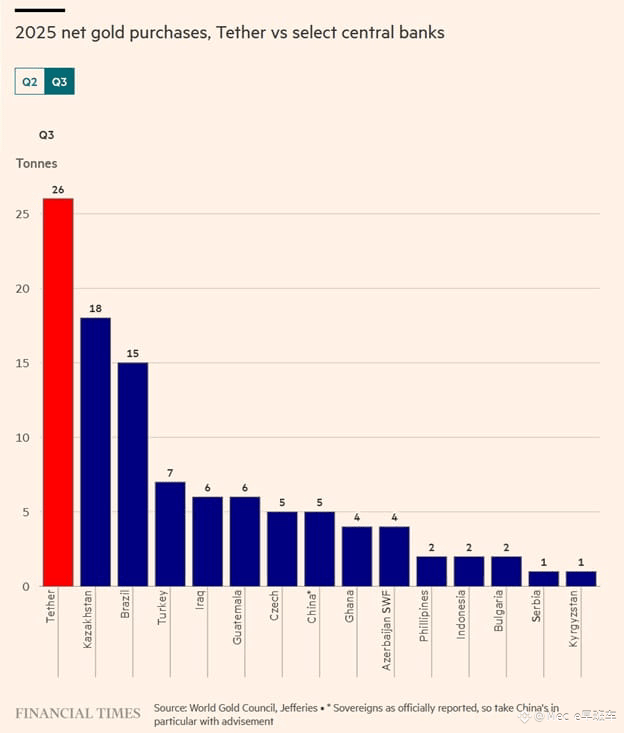
In Q3 2025, a dark horse emerged in the gold market! Tether topped the list of quarterly buyers with a net purchase of 26 tons of gold, far exceeding the central banks of Kazakhstan (18 tons), Brazil (15 tons), and more than five times the 5 tons purchased by the People's Bank of China during the same period.
As a giant in the stablecoin space, Tether's significant investment caught the market by surprise. Its gold purchasing behavior points to two possibilities: one is to increase reserves for USDT as a hedge, given the current intensifying volatility in the global financial markets, where gold remains a hard currency; the second is to boost the gold stablecoin XAUt, with data showing that since August, the issuance of XAUt has increased by over 275,000 ounces, indicating a continuous rise in demand for gold reserves.
However, it is intriguing that the U.S. 'GENIUS Act' has prohibited compliant stablecoins from using gold as reserves, yet Tether is increasing its holdings against the trend. Is this a long-term bet on tokenized gold, or an alternative layout within the dollar system? With crypto giants entering the traditional gold market, is this cross-border operation a hedge strategy or an ambitious play? Share your thoughts in the comments!
$TRADOOR
{future}(TRADOORUSDT)
$Binance Life
{future}(币安人生USDT)
$FUN
{future}(FUNUSDT)
In Q3 2025, a dark horse emerged in the gold market! Tether topped the list of quarterly buyers with a net purchase of 26 tons of gold, far exceeding the central banks of Kazakhstan (18 tons), Brazil (15 tons), and more than five times the 5 tons purchased by the People's Bank of China during the same period.
As a giant in the stablecoin space, Tether's significant investment caught the market by surprise. Its gold purchasing behavior points to two possibilities: one is to increase reserves for USDT as a hedge, given the current intensifying volatility in the global financial markets, where gold remains a hard currency; the second is to boost the gold stablecoin XAUt, with data showing that since August, the issuance of XAUt has increased by over 275,000 ounces, indicating a continuous rise in demand for gold reserves.
However, it is intriguing that the U.S. 'GENIUS Act' has prohibited compliant stablecoins from using gold as reserves, yet Tether is increasing its holdings against the trend. Is this a long-term bet on tokenized gold, or an alternative layout within the dollar system? With crypto giants entering the traditional gold market, is this cross-border operation a hedge strategy or an ambitious play? Share your thoughts in the comments!
$TRADOOR
$Binance Life
$FUN
1.3k
608
130
7.1k
·
--
Ignoring the "Bear Market Arrival" calls, what hidden contrarian operations are Bitcoin whales engaged in?
On November 21, BTC dropped to a low of $80,600, with realized losses on-chain setting historical records, and the panic in the market was palpable. But just as everyone was frantically cutting losses, a whale entity suddenly reversed and aggressively increased their holdings, a move that seemed absurd at the time.
At that moment, the entire network was shouting that $80,000 couldn't hold, with $70,000 and $60,000 BTC just around the corner. Who would be foolish enough to take the bait at this time? As it turned out, the on-chain data revealed that it was a super whale holding over 10,000 BTC who was buying up. Did you think that was surprising enough? There’s even more to challenge your perception...
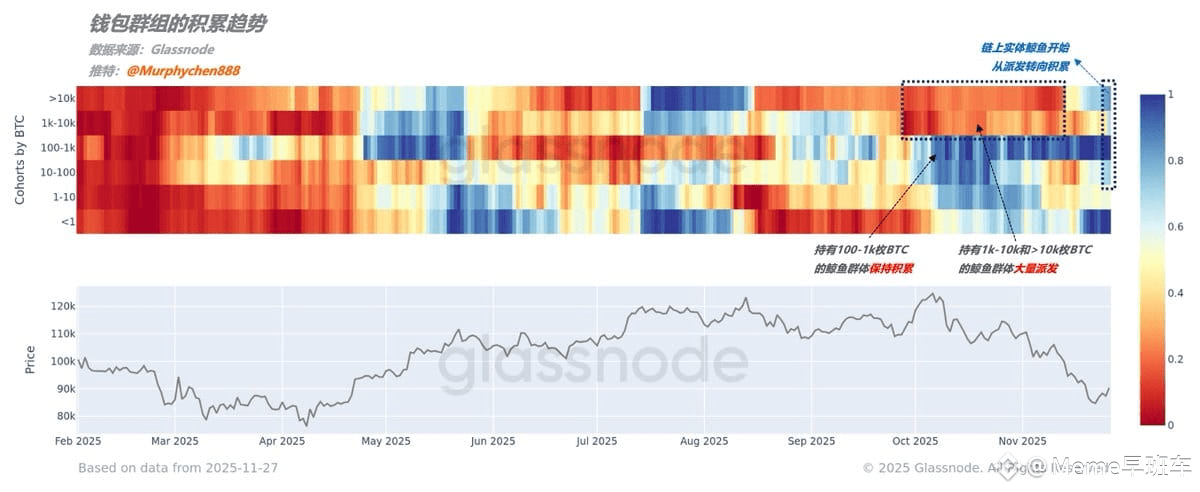
I analyzed the accumulation trends of wallet groups and found that the four major whale groups holding 10-100, 100-1k, 1k-1w, and >1w BTC are all now hoarding coins. Particularly, the two main forces holding 1k-1w and >1w BTC, which were aggressively distributing in early October, have turned around and started accumulating after nearly two months of correction.
Meanwhile, the group holding 100-1k BTC has never stopped increasing their holdings. In short, after October, whales have actually split into two factions: one believes the bull market is over and has run away, while the other quietly buys the dip. Now it seems that these big players have reached a consensus again.
It is worth mentioning that this is the wallet data from the past 15 days, excluding exchange and miner addresses, and the wallet data compiled by Coinbase a few days ago is not included. Therefore, this signal is actually very positive; as long as the whales can maintain their accumulation pace, the underlying structure of the bull market is likely to be rebuilt.
$币安人生
{future}(币安人生USDT)
$MBL
{spot}(MBLUSDT)
$TRADOOR
{future}(TRADOORUSDT)
#加密市场反弹
Ignoring the "Bear Market Arrival" calls, what hidden contrarian operations are Bitcoin whales engaged in?
On November 21, BTC dropped to a low of $80,600, with realized losses on-chain setting historical records, and the panic in the market was palpable. But just as everyone was frantically cutting losses, a whale entity suddenly reversed and aggressively increased their holdings, a move that seemed absurd at the time.
At that moment, the entire network was shouting that $80,000 couldn't hold, with $70,000 and $60,000 BTC just around the corner. Who would be foolish enough to take the bait at this time? As it turned out, the on-chain data revealed that it was a super whale holding over 10,000 BTC who was buying up. Did you think that was surprising enough? There’s even more to challenge your perception...
I analyzed the accumulation trends of wallet groups and found that the four major whale groups holding 10-100, 100-1k, 1k-1w, and >1w BTC are all now hoarding coins. Particularly, the two main forces holding 1k-1w and >1w BTC, which were aggressively distributing in early October, have turned around and started accumulating after nearly two months of correction.
Meanwhile, the group holding 100-1k BTC has never stopped increasing their holdings. In short, after October, whales have actually split into two factions: one believes the bull market is over and has run away, while the other quietly buys the dip. Now it seems that these big players have reached a consensus again.
It is worth mentioning that this is the wallet data from the past 15 days, excluding exchange and miner addresses, and the wallet data compiled by Coinbase a few days ago is not included. Therefore, this signal is actually very positive; as long as the whales can maintain their accumulation pace, the underlying structure of the bull market is likely to be rebuilt.
$币安人生
$MBL
$TRADOOR
#加密市场反弹
4
329
·
--
2026 Cryptocurrency Market Projection: Opportunities for BTC Amidst Federal Reserve Rate Cuts and Election Strategies
The market in 2026 is destined to be a year of conflict between risks and opportunities. Looking solely at the Federal Reserve's rate cut rhythm, the expectation of a rate cut in the September dot plot will be completely rewritten, with at least three rate cuts in 2026 being unavoidable, and the first one could come as early as the first quarter — the scale of layoffs in the U.S. in 2025 has approached 1.1 million, a staggering 65% increase compared to last year and four times that of the same period in 2024. Under the pressure of high unemployment rates, even Powell is likely to turn dovish, not to mention that Trump's tariff policies are likely to be rejected.
After the new Federal Reserve Chair takes office in May, the market's expectation for rapid rate cuts will be completely ignited, and the June dot plot may even signal more than four rate cuts. All of this cannot be separated from the midterm elections in November.
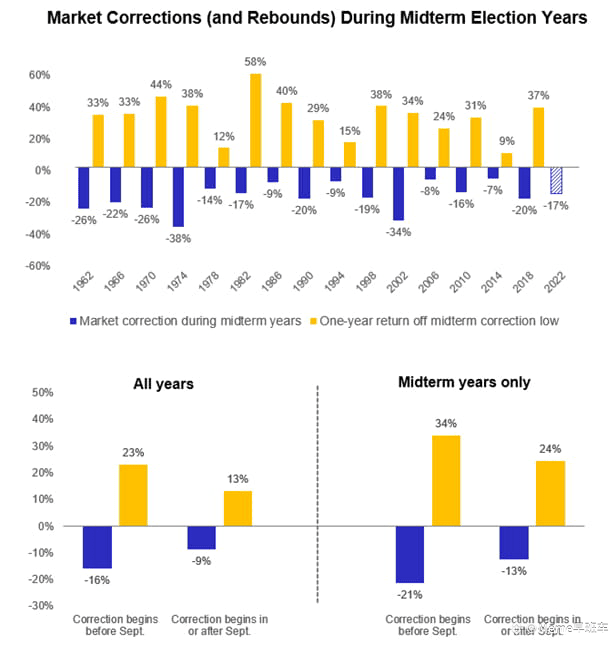
The market rhythm of the midterm elections has shown no deviation in nearly 60 years. However, even if the rate cut expectations are fully priced in, the U.S. economy still buries the risks of recession under high interest rates. The judgment is quite simple: there’s no need to understand complex macroeconomics, just keep an eye on the unemployment rate. Once it breaks 5.3% (the average initial value of past recessions), the probability of recession will skyrocket.
Trump will never allow a recession to happen in 2026; the midterm elections are too critical for the Republican Party — the Senate controls appointments to key positions such as the Cabinet, Federal Reserve Board, and SEC Chair, and can even decide presidential impeachments. The House of Representatives is crucial for legislative progress. Trump lost the House in 2018, and subsequent policies came to a standstill. Therefore, he has recently been frequently addressing the economy, immigration, foreign policy, and trade, all essentially aimed at capturing voter sentiment, even if the return of manufacturing and immigration policies targeting Afghan refugees are all paving the way for the election, at least trying to push the recession beyond the elections.
Ultimately, the core logic remains: if the U.S. stock market is stable, BTC will not weaken. If tech stocks continue to rise, $BTC is likely to rise as well, though the magnitude may vary.
$TRADOOR
{future}(TRADOORUSDT)
$TURBO
{future}(TURBOUSDT)
$ARC
{future}(ARCUSDT)
#加密市场反弹 #加密市场观察
2026 Cryptocurrency Market Projection: Opportunities for BTC Amidst Federal Reserve Rate Cuts and Election Strategies
The market in 2026 is destined to be a year of conflict between risks and opportunities. Looking solely at the Federal Reserve's rate cut rhythm, the expectation of a rate cut in the September dot plot will be completely rewritten, with at least three rate cuts in 2026 being unavoidable, and the first one could come as early as the first quarter — the scale of layoffs in the U.S. in 2025 has approached 1.1 million, a staggering 65% increase compared to last year and four times that of the same period in 2024. Under the pressure of high unemployment rates, even Powell is likely to turn dovish, not to mention that Trump's tariff policies are likely to be rejected.
After the new Federal Reserve Chair takes office in May, the market's expectation for rapid rate cuts will be completely ignited, and the June dot plot may even signal more than four rate cuts. All of this cannot be separated from the midterm elections in November.
The market rhythm of the midterm elections has shown no deviation in nearly 60 years. However, even if the rate cut expectations are fully priced in, the U.S. economy still buries the risks of recession under high interest rates. The judgment is quite simple: there’s no need to understand complex macroeconomics, just keep an eye on the unemployment rate. Once it breaks 5.3% (the average initial value of past recessions), the probability of recession will skyrocket.
Trump will never allow a recession to happen in 2026; the midterm elections are too critical for the Republican Party — the Senate controls appointments to key positions such as the Cabinet, Federal Reserve Board, and SEC Chair, and can even decide presidential impeachments. The House of Representatives is crucial for legislative progress. Trump lost the House in 2018, and subsequent policies came to a standstill. Therefore, he has recently been frequently addressing the economy, immigration, foreign policy, and trade, all essentially aimed at capturing voter sentiment, even if the return of manufacturing and immigration policies targeting Afghan refugees are all paving the way for the election, at least trying to push the recession beyond the elections.
Ultimately, the core logic remains: if the U.S. stock market is stable, BTC will not weaken. If tech stocks continue to rise, $BTC is likely to rise as well, though the magnitude may vary.
$TRADOOR
$TURBO
$ARC
#加密市场反弹 #加密市场观察
2.3k
1k
177
2.3k
·
--
S&P gives USDT the second to last rating! Is Tether really in trouble?
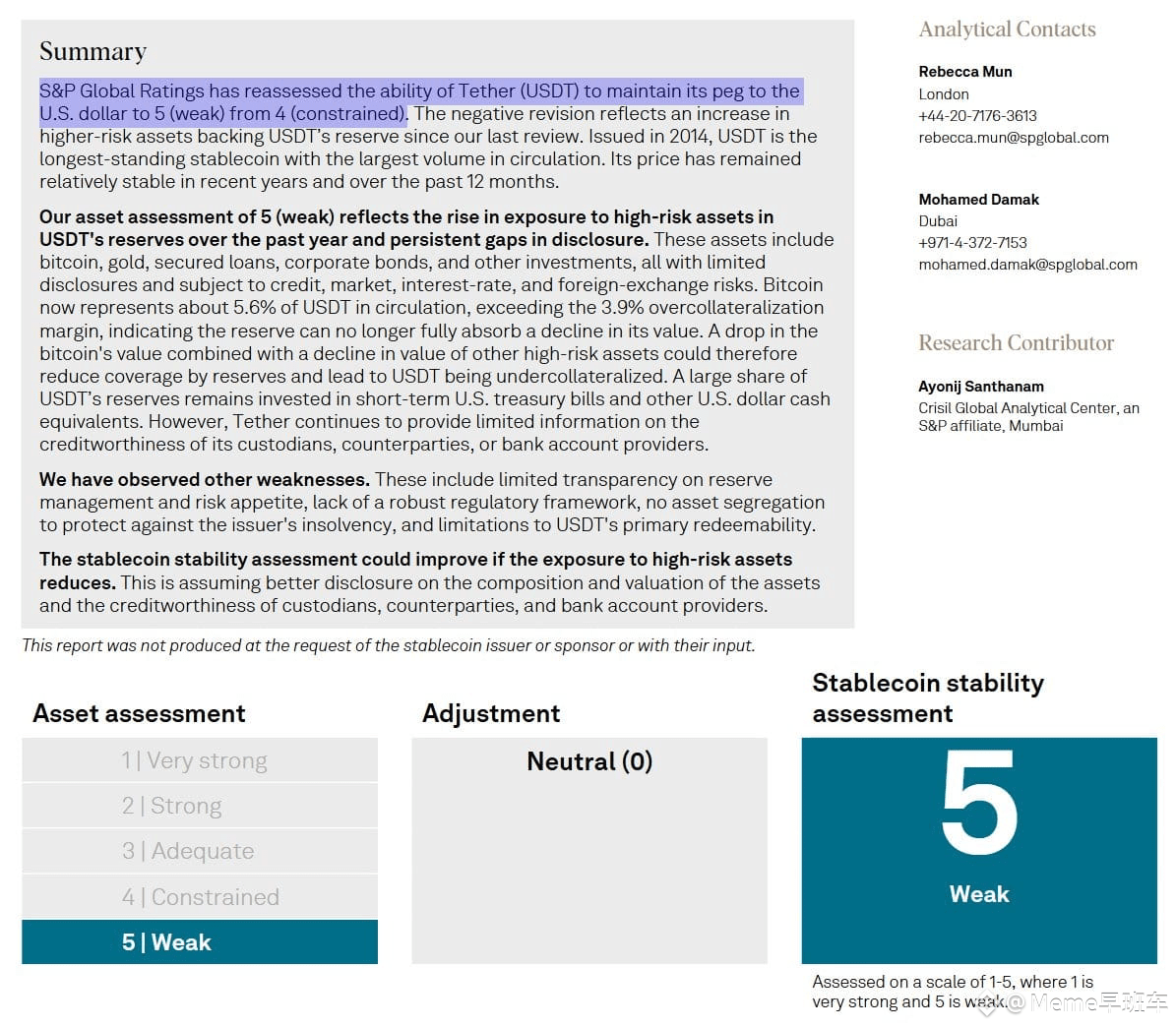
S&P's latest rating is concrete: Tether has been downgraded from 'Restricted' (Level 4) to 'Weak' (Level 5) — the second to last tier in S&P's 6-level system, just one step away from the lowest level!
The core reasons are straightforward: first, the collateral risk is high + insufficient transparency, with 5.6% of USDT reserves in BTC, as well as risk assets like gold and corporate bonds; second, the excess collateral cushion is too thin, with a collateral ratio of 103.9% at the end of September (only 3.9% excess), while the proportion of BTC has already exceeded this value.
Key data exposes the critical issues: at the end of September, the price of BTC was $112,700, now it has dropped to $91,000 (a decline of 19.25%), causing the BTC proportion to fall to 4.5%, and the USDT excess collateral ratio has also dropped to 2.8%. S&P is concerned that if BTC falls further, it may trigger insolvency risk.
But don't panic! S&P did not say Tether will collapse — it holds over $130 billion in U.S. Treasury bonds, making up 75% of its collateral, which is a stabilizing anchor. Moreover, Tether is a cash cow; as long as it doesn’t make reckless moves, it should be fine in the short term.
PS: In S&P's 6-level rating, USDT is now ranked 5th, with risk signals fully activated; stablecoins are not absolutely stable!
$SQD
{future}(SQDUSDT)
$YALA
{future}(YALAUSDT)
$KGEN
{future}(KGENUSDT)
#加密市场反弹 #美联储重启降息步伐
S&P gives USDT the second to last rating! Is Tether really in trouble?
S&P's latest rating is concrete: Tether has been downgraded from 'Restricted' (Level 4) to 'Weak' (Level 5) — the second to last tier in S&P's 6-level system, just one step away from the lowest level!
The core reasons are straightforward: first, the collateral risk is high + insufficient transparency, with 5.6% of USDT reserves in BTC, as well as risk assets like gold and corporate bonds; second, the excess collateral cushion is too thin, with a collateral ratio of 103.9% at the end of September (only 3.9% excess), while the proportion of BTC has already exceeded this value.
Key data exposes the critical issues: at the end of September, the price of BTC was $112,700, now it has dropped to $91,000 (a decline of 19.25%), causing the BTC proportion to fall to 4.5%, and the USDT excess collateral ratio has also dropped to 2.8%. S&P is concerned that if BTC falls further, it may trigger insolvency risk.
But don't panic! S&P did not say Tether will collapse — it holds over $130 billion in U.S. Treasury bonds, making up 75% of its collateral, which is a stabilizing anchor. Moreover, Tether is a cash cow; as long as it doesn’t make reckless moves, it should be fine in the short term.
PS: In S&P's 6-level rating, USDT is now ranked 5th, with risk signals fully activated; stablecoins are not absolutely stable!
$SQD
$YALA
$KGEN
#加密市场反弹 #美联储重启降息步伐
2.3k
1.1k
190
2.3k
·
--
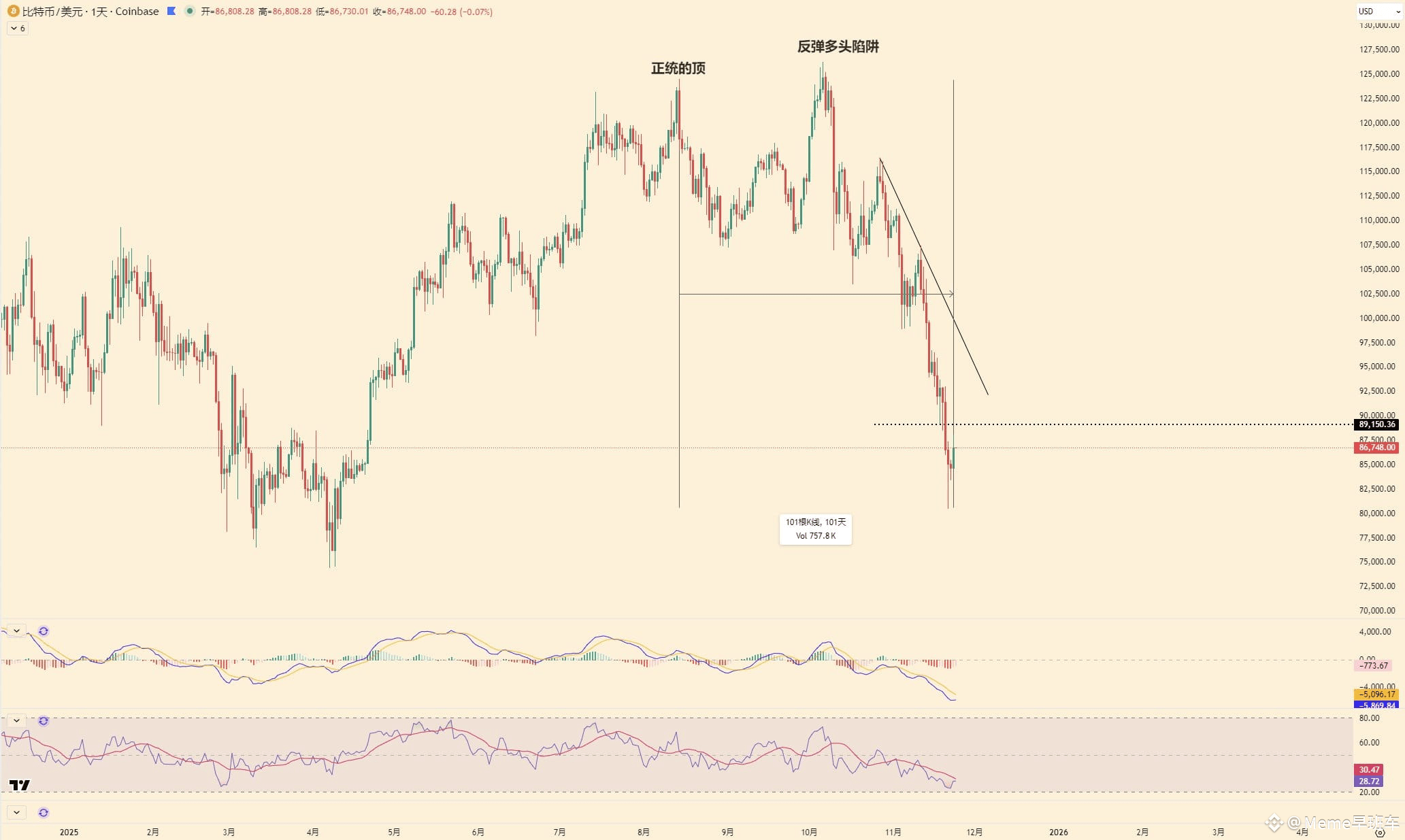
As mentioned before, adjustments require either time or space;
This adjustment is larger than that of March to August 2024 and larger than that of February to April 2025, so relatively speaking, it provides both time and space.
Time and space are the two most important elements of adjustment; space is easy to discern, but time is not necessarily so;
I said that adjustments have been made for more than 3 months, and some friends have doubts. This is the reason for not distinguishing the top clearly, as shown in the figure below:
$BTC
791
361
76
791
·
--
Since Trump took office, almost everything has been controversial, but in the field of cryptocurrency, it surprisingly became a rare consensus between the two parties! Especially with the stablecoin bill, I remember many Democrats voted in favor at the time—ultimately, the House of Representatives passed it with 308 votes in favor, 102 of which were Democratic votes, which is extremely rare for key legislation during Trump's presidency. The Senate was even more supportive, with 68 votes in favor and 30 votes against, both parties standing united.
What’s even more interesting is that another highly bipartisan bill is also related to cryptocurrency—the FIT21 bill, which clearly delineates the regulatory boundaries for cryptocurrency between the CFTC and SEC. This really highlights the issue: the two parties' support for cryptocurrency is not just lip service, but concrete legislative action. The Republican Party may be more radical, but the Democratic Party is definitely not opponents; this point must be clarified.
I am not blindly bullish and acknowledge the risks of the Trump Trade. But even if the Republican Party does not secure a second term in 2028, many of Trump's policies may be overturned, but these two cryptocurrency bills are likely to be preserved—after all, they were passed unanimously by both parties, and the cost of overturning them is too high. Moreover, don't forget that BTC and ETH futures and spot ETFs were established during the Democratic administration; when the White House Financial Committee reviewed Garry, members from both parties were particularly proactive, indicating the recognition of cryptocurrency in Washington.
Let’s discuss a key logic: After the new Federal Reserve Chairman takes office in 2026, the Federal Reserve Board members nominated by Trump will reach four. It’s important to note that the Federal Reserve's monetary policy meetings have only 12 voting rights; as long as Trump pulls in 2 more neutral votes, the likelihood of monetary easing in 2026 will significantly increase—this is clearly paving the way for the midterm elections!
Finally, let me share a historical pattern: every midterm election and presidential election tends to be friendly to risk markets. Either the market is likely to rally three months before and after the election (midterm), or the more it drops before the election, the stronger the rebound three months after the election.
Therefore, the core conclusion is very clear: prepare for a loose environment ahead of the 2026 midterm elections, don't waste funds in the current garbage time, just patiently wait for the wind to come~
$TNSR
{future}(TNSRUSDT)
$PARTI
{future}(PARTIUSDT)
#比特币波动性 #美国加征关税
Since Trump took office, almost everything has been controversial, but in the field of cryptocurrency, it surprisingly became a rare consensus between the two parties! Especially with the stablecoin bill, I remember many Democrats voted in favor at the time—ultimately, the House of Representatives passed it with 308 votes in favor, 102 of which were Democratic votes, which is extremely rare for key legislation during Trump's presidency. The Senate was even more supportive, with 68 votes in favor and 30 votes against, both parties standing united.
What’s even more interesting is that another highly bipartisan bill is also related to cryptocurrency—the FIT21 bill, which clearly delineates the regulatory boundaries for cryptocurrency between the CFTC and SEC. This really highlights the issue: the two parties' support for cryptocurrency is not just lip service, but concrete legislative action. The Republican Party may be more radical, but the Democratic Party is definitely not opponents; this point must be clarified.
I am not blindly bullish and acknowledge the risks of the Trump Trade. But even if the Republican Party does not secure a second term in 2028, many of Trump's policies may be overturned, but these two cryptocurrency bills are likely to be preserved—after all, they were passed unanimously by both parties, and the cost of overturning them is too high. Moreover, don't forget that BTC and ETH futures and spot ETFs were established during the Democratic administration; when the White House Financial Committee reviewed Garry, members from both parties were particularly proactive, indicating the recognition of cryptocurrency in Washington.
Let’s discuss a key logic: After the new Federal Reserve Chairman takes office in 2026, the Federal Reserve Board members nominated by Trump will reach four. It’s important to note that the Federal Reserve's monetary policy meetings have only 12 voting rights; as long as Trump pulls in 2 more neutral votes, the likelihood of monetary easing in 2026 will significantly increase—this is clearly paving the way for the midterm elections!
Finally, let me share a historical pattern: every midterm election and presidential election tends to be friendly to risk markets. Either the market is likely to rally three months before and after the election (midterm), or the more it drops before the election, the stronger the rebound three months after the election.
Therefore, the core conclusion is very clear: prepare for a loose environment ahead of the 2026 midterm elections, don't waste funds in the current garbage time, just patiently wait for the wind to come~
$TNSR
$PARTI
#比特币波动性 #美国加征关税
1
3
397
·
--
The U.S. labor market has turned negative! Is the Federal Reserve out of options for rate cuts?
Two sets of core data have shattered the resilience of U.S. employment, putting the Federal Reserve in a dilemma: either cut rates to stabilize employment and prevent recession, or maintain high rates, which may trigger a hard landing for the economy.
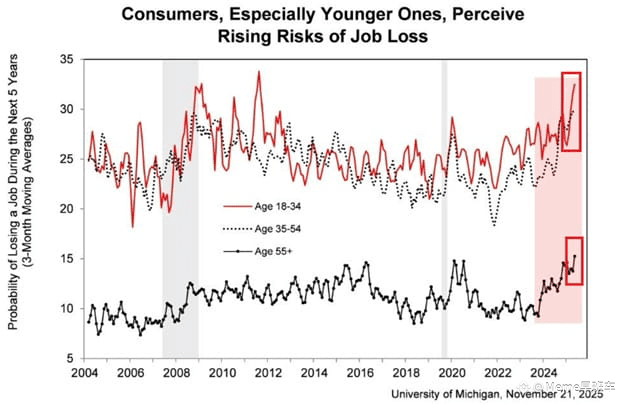
Research from the University of Michigan shows that American workers' anxiety about unemployment has soared to a 20-year high: the perception of unemployment risk for those aged 18-34 has exceeded 33% (surpassing pandemic levels), while the core group aged 35-54 has reached 30% (a 20-year peak), and those aged 55 and above also exceed 15%. High rates are the main cause, leading the public to cut non-essential spending and reduce investments, significantly increasing recession risks.
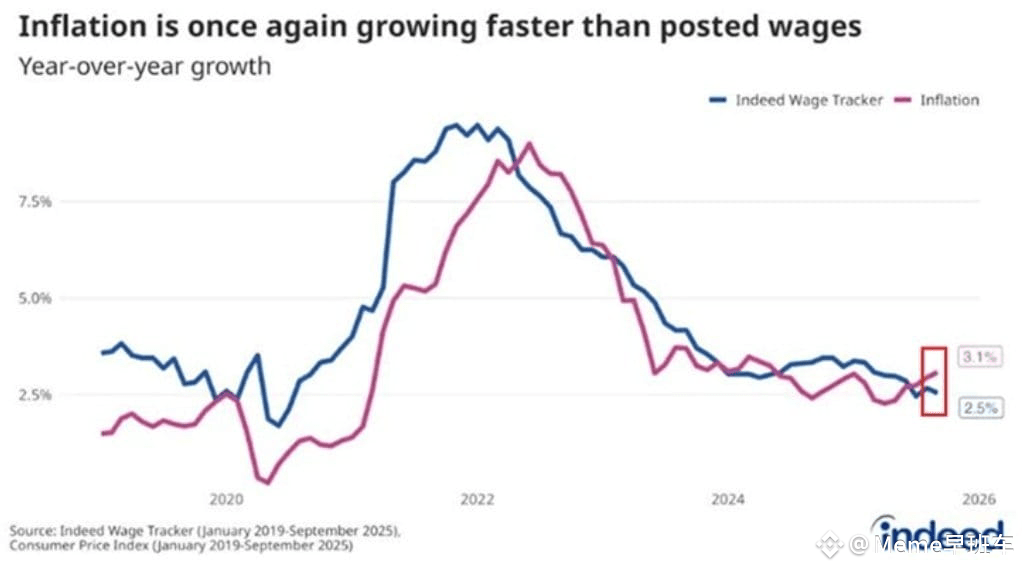
Worse still, by the end of 2025, inflation (3.1%) is expected to outpace wage growth (2.5%) again, resulting in negative real wage growth, making consumers “poorer as they work more,” with frequent bankruptcies in the non-essential goods sector.
In October, U.S. layoffs hit a 20-year monthly high, and non-farm employment fell short of expectations, with data continuously pressuring the Federal Reserve to shift its stance. Currently, market expectations for a rate cut in December have risen to 67%-70%, and the negative signals from the labor market are key anchors for judging the pace of future easing.
$PIPPIN
{future}(PIPPINUSDT)
$TNSR
{future}(TNSRUSDT)
$1000RATS
{future}(1000RATSUSDT)
#比特币波动性
The U.S. labor market has turned negative! Is the Federal Reserve out of options for rate cuts?
Two sets of core data have shattered the resilience of U.S. employment, putting the Federal Reserve in a dilemma: either cut rates to stabilize employment and prevent recession, or maintain high rates, which may trigger a hard landing for the economy.
Research from the University of Michigan shows that American workers' anxiety about unemployment has soared to a 20-year high: the perception of unemployment risk for those aged 18-34 has exceeded 33% (surpassing pandemic levels), while the core group aged 35-54 has reached 30% (a 20-year peak), and those aged 55 and above also exceed 15%. High rates are the main cause, leading the public to cut non-essential spending and reduce investments, significantly increasing recession risks.
Worse still, by the end of 2025, inflation (3.1%) is expected to outpace wage growth (2.5%) again, resulting in negative real wage growth, making consumers “poorer as they work more,” with frequent bankruptcies in the non-essential goods sector.
In October, U.S. layoffs hit a 20-year monthly high, and non-farm employment fell short of expectations, with data continuously pressuring the Federal Reserve to shift its stance. Currently, market expectations for a rate cut in December have risen to 67%-70%, and the negative signals from the labor market are key anchors for judging the pace of future easing.
$PIPPIN
$TNSR
$1000RATS
#比特币波动性
1.1k
537
100
1.1k
Log in to explore more content
Join global crypto users on Binance Square
⚡️ Get latest and useful information about crypto.
💬 Trusted by the world’s largest crypto exchange.
👍 Discover real insights from verified creators.
Email / Phone number
Trending Topics
NvidiaBeatsEstimatesWith$130BQ4Outlook
17,261 views
220 Discussing
Nvidia Beats With $115.8 Billion in Revenue, Guides to $130 Billion and Adds $150 Billion Buyback
Binance News
·65 Likes
·46.5k views
AnthropicIPOPriceCouldExceed$80
22,019 views
188 Discussing
RussiaCentralBankAddsAlfaBankToCryptoExchangeRegister
0 views
16 Discussing