


Original | Odaily Planet Daily (@OdailyChina)
Author | Golem (@web3_golem)
Hyperliquid is one of the few projects worth paying attention to during the crypto bear market.
In the first two months of 2026, the crypto market cooled down, with Bitcoin dropping from $95,000 to $60,000, and market sentiment was low. The activity and liquidity of Hyperliquid also declined. However, in March, the platform's daily open interest (OI) showed signs of recovery, and although the increase was not significant, it released positive signals that user activity is on the rise.
From the performance of coin prices, HYPE has clearly outperformed the broader market. OKX data shows that in the past month, BTC has only risen by 0.6%, ETH has risen by 2.7%, while SOL and BNB have dropped by 4% and 2.4%, respectively; in contrast, HYPE has risen 20% against the trend amidst the market fluctuations.
What is the logic behind this round of HYPE's rise? Odaily Planet Daily will analyze this in the article for readers' reference.
HIP-3—— Hyperliquild's RWA trading market
On October 13, 2025, Hyperliquild launched HIP-3, which allows anyone to create new trading markets on Hyperliquild after staking 500,000 HYPE. A month later, HIP-3's open interest volume broke $100 million; by January 29, 2026, HIP-3's OI reached $1.06 billion, marking the first time HIP-3's single-day OI surpassed $1 billion, but a day later, OI fell back below $1 billion.
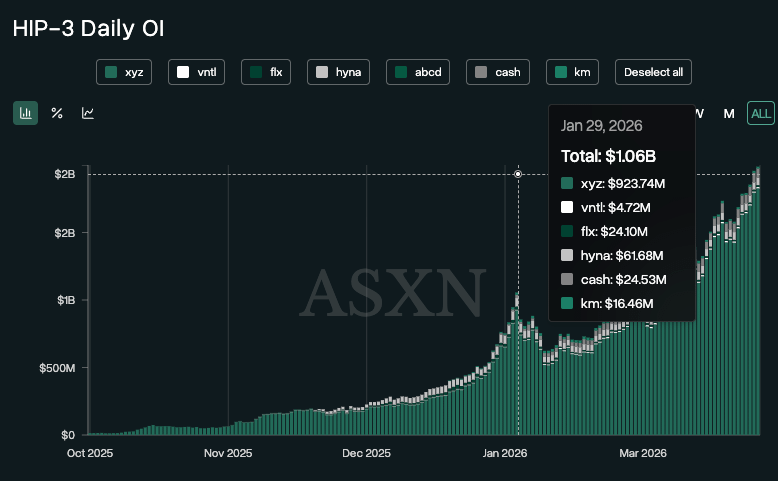
Daily OI of HIP-3
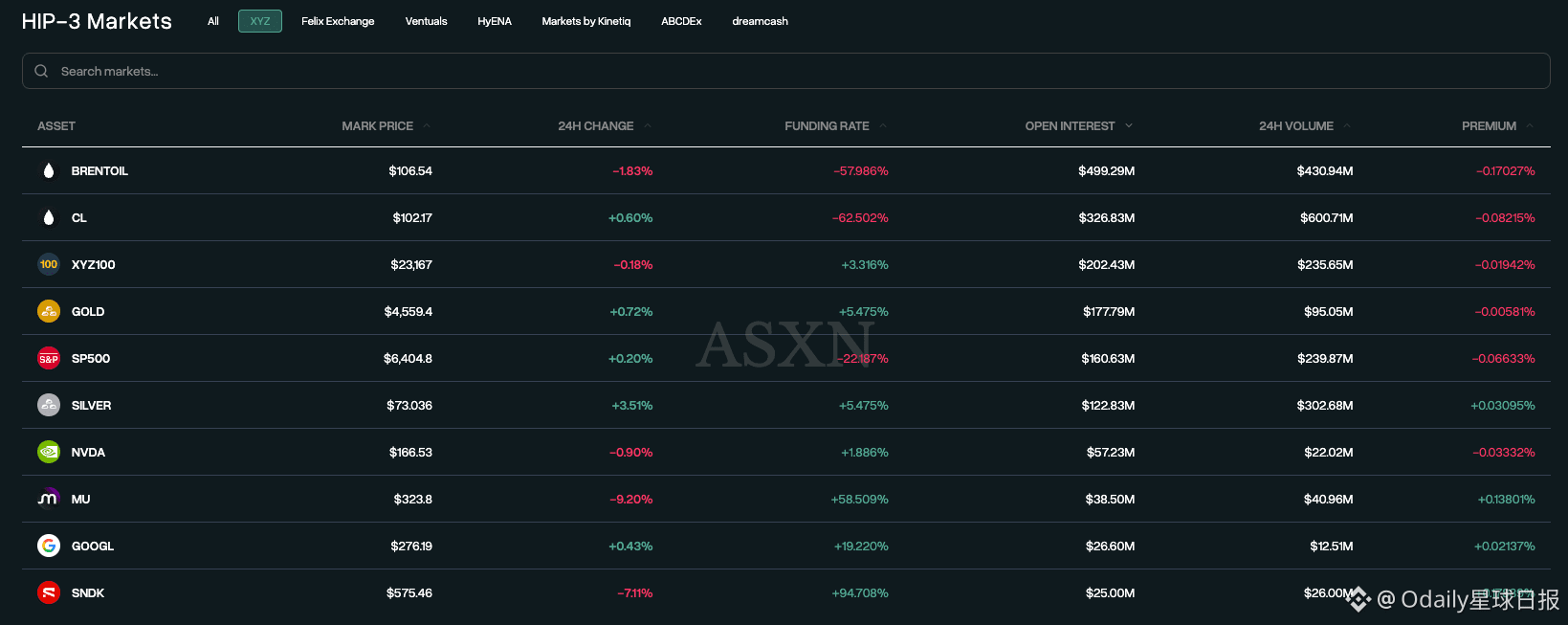
As shown in the figure above, HIP-3's OI is mainly contributed by trade.xyz, and regardless of whether calculated by OI holdings or market trading volume, the top 10 markets on trade.xyz are all traditional assets, with the first and second tracking contracts for crude oil, and the third tracking the Nasdaq 100 contract. Therefore, we can conclude that HIP-3 has become Hyperliquild's RWA trading market.
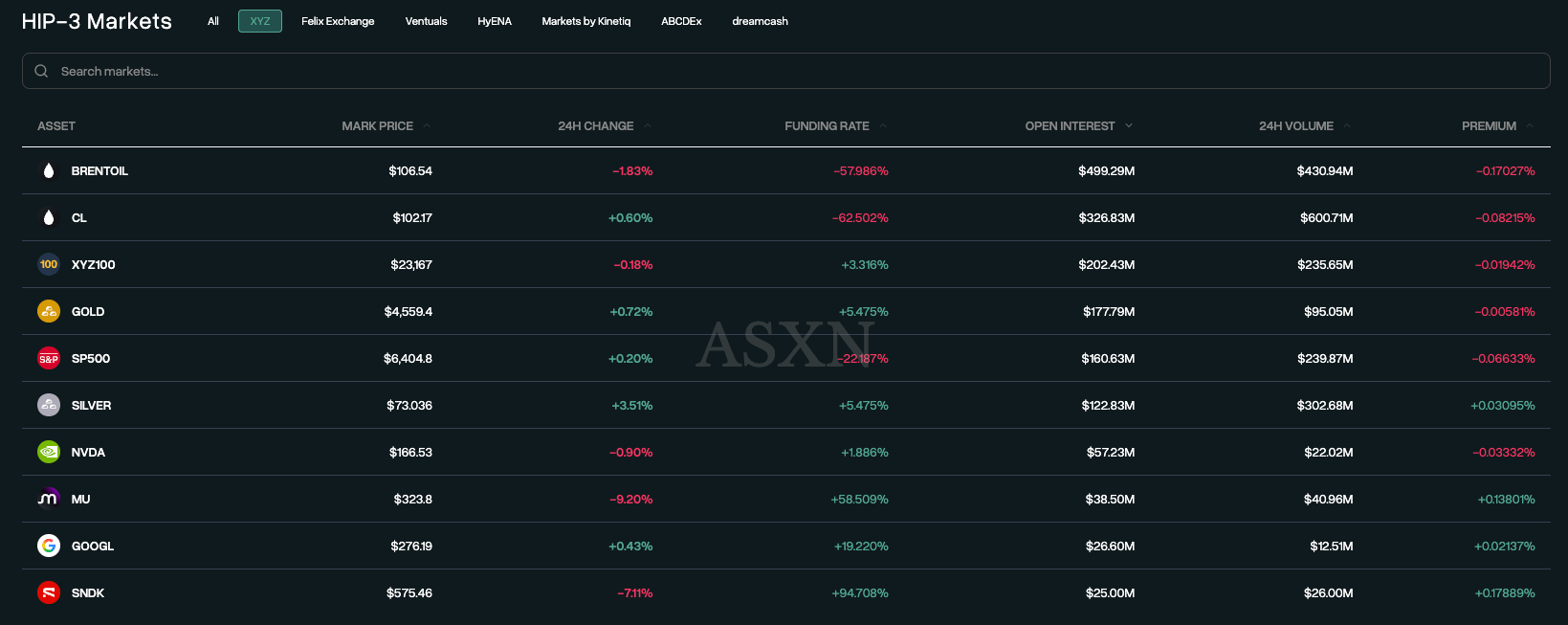
Top 10 markets on trade.xyz
By January 2026, in just three months, HIP-3's single-day OI could stabilize at hundreds of millions of dollars, enough to prove that HIP-3 is developing rapidly and gaining the attention of traditional commodity traders. However, for Hyperliquild, it still is not the main revenue and trading segment. For example, on January 29, HIP-3's OI for that day was $1.06 billion, while the total OI and trading volume of the Hyperliquild platform that day were $6.05 billion, with HIP-3 accounting for only 17%. Even HIP-3's OI for all markets on that day was less than that of BTC's OI.
HIP-3 is destined not to remain a supporting role on Hyperliquild forever; it is ready, just waiting for an opportunity.
The US-Iran conflict has become an important catalyst for the development of HIP-3.
On February 28, the catalyst appeared. That day, the US-Iran conflict broke out, and global financial markets began to tremble, especially as international oil prices continued to rise due to the war. However, the first day of the war fell on a weekend when traditional markets were closed (such as CME), and traders needing to adjust their positions and operations had to seek new tradable markets, making the HIP-3 market on Hyperliquild the preferred choice.
On January 6, trade.xyz launched contracts tracking WTI crude oil prices in the HIP-3 market, but the trading volume in the first two months was not large, averaging only a few million dollars, with a single-day peak exceeding $2000. However, after the outbreak of the US-Iran conflict, the trading volume of the crude oil contracts launched by trade.xyz quickly exceeded $100 million in a single day. On March 5, trade.xyz followed up with contracts tracking Brent crude oil prices, and on March 23, the single-day trading volume of these two crude oil contracts reached a total of $2.38 billion, while on the same day, the trading volume of ETH on Hyperliquild was only $1.51 billion.
Increasing the trading volume of crude oil contracts is only the superficial effect of this catalyst, while in essence, the geopolitical tensions in the Middle East for over a month have propelled the RWA/commodity contract market led by HIP-3 to become the new core narrative of Hyperliquild.
After the outbreak of the US-Iran conflict, HIP-3's OI continued to rise, breaking $1 billion again on March 1, and then continuously setting new highs. By March 31, HIP-3's OI had reached $2 billion, with a monthly increase of over 100%. HIP-3's OI has surpassed the OI of mainstream coins like BTC, with the OI of BTC contracts on Hyperliquild on March 31 being $1.8 billion and the OI of ETH contracts being $1.19 billion. In terms of total OI proportion, HIP-3 has accounted for over 50%, equivalent to contributing half of the platform's activity.
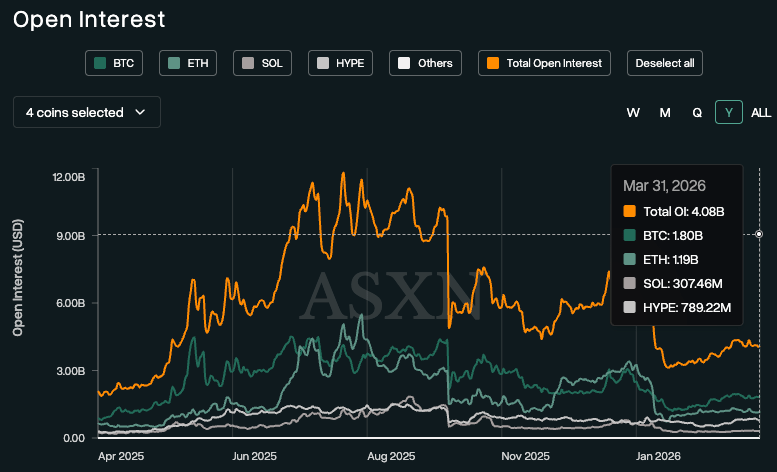
Hyperliquild's new value support
In the context of a sluggish crypto market, HIP-3 has found new value support for Hyperliquild. Hyperliquild has made a glamorous turnaround, transforming from a single-function Prep DEX that only trades crypto assets to an on-chain exchange that also trades RWA assets and extends its reach into traditional finance.
Compared to traditional trading markets, Hyperliquild has several obvious advantages, such as 24/7 uninterrupted trading and support for higher leverage. While these advantages are also possessed by many exchanges and DEXs from a market competition perspective, Hyperliquild's market advantages still lead the pack.
Taking silver contracts as an example, as of now, the 24-hour trading volume of the XAG/USDT contract on Binance is $1.864 billion, while the 24-hour trading volume of the silver contract in the HIP-3 market is approximately $300 million, only 16% of Binance's volume. On the surface, the gap between the two seems vast, but considering the user base, the conclusion will be different.
Binance is the largest CEX globally, with over 300 million users, while Hyperliquild is the most well-known DEX, but it has only 1.18 million users, which is 0.39% of Binance's user base. At the same time, official data shows that HIP-3 has only accumulated 2.42 million independent traders. With such a disparity in users, the silver contracts on Hyperliquild can still achieve over a hundred million in trading volume, proving that the RWA traders on Hyperliquild are primarily whales and professional traders/institutions.
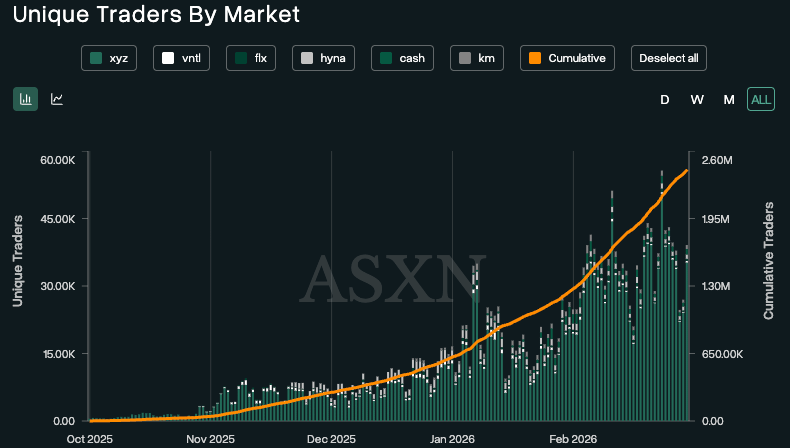
Otherwise, merely having millions of users cannot create billions of dollars in trading volume (Odaily Note: On February 9, Hyperliquild's silver contracts reached a peak of $4 billion in a single day). These users are one of Hyperliquild's most valuable moats; they are not just general traffic users, but rather a group of whales and professional traders with large capital volumes, high trading frequency, and extreme sensitivity to volatility, with the “output efficiency” of each user being sufficient to make up for the lack of total user numbers.
Moreover, compared to centralized exchanges, Hyperliquild's appeal to traditional financial traders is becoming increasingly strong.
The core reason is that Hyperliquild is a DEX with strong privacy and no KYC, providing a high-quality user experience and deep liquidity, along with an established brand image that increases traders' trust in Hyperliquild. This is particularly enticing for traditional financial traders, especially those dealing in commodities, macro, and event-driven players.
These traders are not unable to trade on CME, brokers, or CEX but are unwilling to expose their position intentions, trading rhythms, and capital paths to platforms, brokers, or regulatory interfaces. The KYC, risk control stratification, and account review mechanisms of CEX essentially increase visibility; what Hyperliquild offers is a faster, less scrutinized trading entry, without cumbersome account opening, waiting for approval, or the risk of centralized platforms tightening permissions at any time, yet still being able to access sufficient liquidity and a mature trading experience.
On March 18, S&P Dow Jones Indices authorized the S&P 500 index to trade.xyz, allowing it to issue the S&P500/USDC contract market on Hyperliquid. The choice of Hyperliquid and trade.xyz by S&P is undoubtedly seeing its huge trading volume and user advantages, but the most important thing it brings to Hyperliquid is compliance recognition.
For traditional traders who were originally hesitant due to compliance concerns, this is a strong shot in the arm, dispelling worries like “Can we do it? How much can we do? How long can we do it?” If even the S&P has authorized it directly, what is there to worry about Hyperliquid or trade.xyz running away?
In summary, the US-Iran conflict has revealed the potential of Hyperliquid in the RWA trading market, and with the growth in trading volume and the establishment of user trust, Hyperliquid will no longer be just a temporary substitute during traditional financial market closures like CME, but will become an important participant in the traditional financial market, helping traders better discover prices for traditional assets and even seize pricing power in traditional financial markets.
This is one of the core reasons why investors have a long-term positive outlook on HYPE over the past month and into the future.
It is worth mentioning that Hyperliquid's newly proposed HIP-4 (Odaily Note: similar to Polymarket, allows players to trade event outcomes on Hyperliquid) may create a new growth flywheel for Hyperliquid. HIP-3 enables Hyperliquid to trade traditional assets, while HIP-4 could enable Hyperliquild to trade everything.
Related Reading
A detailed 10,000-word explanation of Hyperliquid HIP-4: Borrowing from prediction markets and options trading to encroach on traditional finance