

A few years ago, I personally led a cross-border energy infrastructure negotiation involving multiple stakeholders. Despite a strong willingness to cooperate at the commercial level, we ultimately became stuck at a critical guarantee stage due to the lack of a neutral, transparent, and tamper-proof performance record mechanism. That experience made me deeply realize that in today's increasingly intense geopolitical game, traditional centralized trust mechanisms have become the biggest bottleneck hindering global efficient collaboration. We urgently need a new trust protocol based on mathematical axioms that can transcend sovereign boundaries.
It is precisely based on a deep reflection on this reality pain point that I began to closely follow the technological evolution path of @SignOfficial . Rather than saying it is building an ordinary blockchain network, it is more accurate to say it is reshaping the digital underlying logic of global geopolitics. By deeply analyzing its technical architecture, I found that the core value of SignOfficial lies in quantifying and atomizing the abstract concept of "trust." In the traditional SWIFT system or letter of credit system, the establishment of trust relies on a lengthy chain of intermediaries, whereas SignOfficial compresses the verification process to milliseconds through zero-knowledge proofs and distributed consensus algorithms, achieving a technological leap across generations. This qualitative change in efficiency has revolutionary significance for high-frequency global trade settlements.
In this intricately designed ecosystem, $SIGN tokens are not only a medium for the flow of value but also a core element for maintaining network security and stability. From a data-driven perspective, the trade default rate due to geopolitical risks has increased by about 15% over the past five years. Against this backdrop, this economic model offers a highly forward-looking solution. It utilizes smart contracts to automatically execute terms, eliminating subjective space for defaults, and is essentially building a "de-trust" operating system for the global digital economy, allowing participants with different ideologies to engage in fair competition under the same set of rules. This mechanism design effectively reduces transaction costs and enhances execution efficiency.
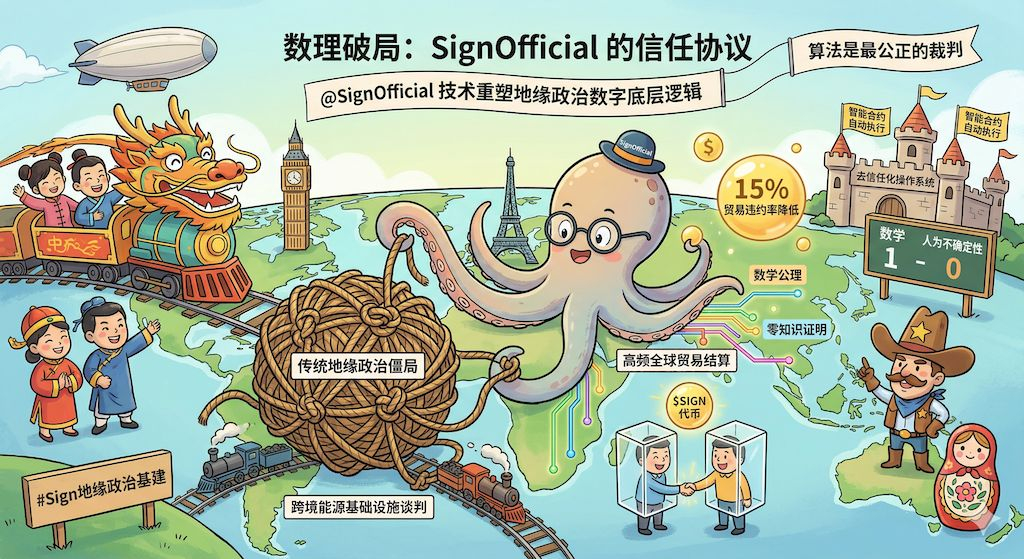
From a macro trend analysis, the world is experiencing a profound structural shift from "unipolar hegemony" to "multi-centered collaboration." #Sign地缘政治基建 is not just a technical label; it represents a new political philosophical practice. It leverages the certainty of code to hedge against human uncertainty, which is the key to the realization of Web3 infrastructure. Future geopolitical competition will not merely be a struggle for territory or resources but also a contest for dominance over digital infrastructure. SignOfficial makes mathematics a common language for humanity, turning algorithms into the most just judges. This is not only a victory for technology but also an attempt by human rationality to establish order in chaos.