

In observing the evolution of the global digital landscape, I can't help but think of the rise and fall of the Silk Road in history, which was not only a trade route but also a boundary for the competition of civilizations. Today, the internet is facing a serious risk of 'balkanization', with the global network splitting into incompatible islands. In this complex and turbulent context, @SignOfficial appears to have rebuilt a modern version of the 'commercial treaty' on the digital wasteland. This is not just a technological iteration, but a redefinition of digital sovereignty, attempting to establish a new order in a divided network and reshape the boundaries of the digital world.
#Sign地缘政治基建 The core of this grand narrative lies in using cryptographic means to detach and code 'trust' from centralized entities. Combining my past in-depth analysis of blockchain protocols, this is similar to upgrading the traditional passport visa system to an automated protocol based on zero-knowledge proofs. From a technical perspective, by integrating decentralized identity (DID), this protocol ensures data sovereignty belongs to the user while completing complex compliance verification without disclosing privacy. This mechanism provides a highly forward-looking balanced solution for Web3 infrastructure in an increasingly stringent regulatory environment and a complex landscape of data privacy regulations.
Data indicates that as the digitalization process accelerates, the security of cross-border data flows has become a key indicator of national competitiveness. Within this framework, $SIGN tokens play a crucial role as 'infrastructure fuel.' It goes beyond mere value storage to become the lifeblood that sustains the operation of this decentralized network. Through specific staking mechanisms, the node network maintains high-intensity defenses, preventing any single entity from tampering with historical records. This economic model cleverly integrates national security logic with DeFi incentives, creating a positive feedback loop that ensures the long-term stability and censorship resistance of the system.
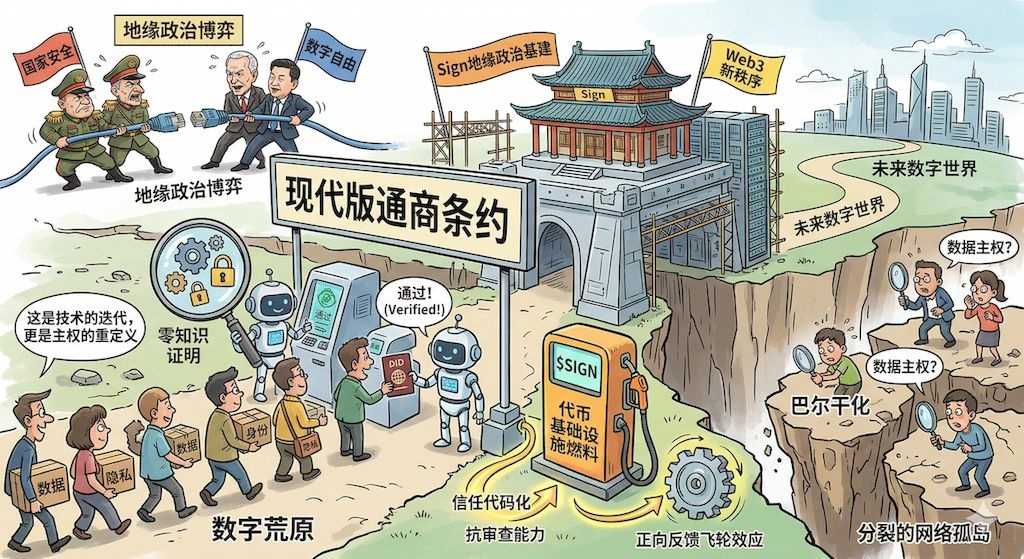
From a macro perspective, we are witnessing a deep integration of the sovereignty of the physical world and the freedom of the digital world. Future geopolitical games will no longer be limited to land, sea, and air, but will occur between hash values and public and private keys. For investors and technology observers, understanding this layer of 'infrastructure' is more important than merely focusing on price fluctuations. This is not just a technological innovation, but a strategic choice about establishing citizenship in the digital age. We are transitioning from passive internet users to active digital citizens, taking control of the future.