

In the past year, a shocking news emerged in the crypto circle: The Saxony authorities in Germany urgently liquidated about 50000 Bitcoins and disposed of them in euros.
Someone immediately calculated the figure of 'earned tens of billions of dollars',
Some people lament, 'If this batch of Bitcoin hadn't been sold, how much would it be worth now?' - What is the truth?
This article will restore the entire process of this event: official announcement, timing of sale, market logic, reasons for selling, missed profits, institutional constraints, and future insights.
I hope to provide you with a deep report that combines data and thought.

Incident restoration: Who, when, and how to sell?
1. Cause of the incident: Asset freeze in the film piracy case.
In early 2024, Saxony, Germany, froze a large amount of Bitcoin assets while investigating the Movie2K piracy website case. Subsequently, the authorities initiated judicial proceedings, and the assets were eventually disposed of by the court.
2. Urgent liquidation: Rapid sales over three weeks from June to July.
According to reports from the Saxony public security and judicial departments (consistent with media reports), Germany sold assets in batches from June 19 to July 12, 2024.
Total amount sold: 49,858 BTC (this number is widely reported by the media).
Proceeds from the sale (official): approximately €2,639,683,413.92 (approximately 2.64 billion euros).
The media converted the dollar amount to about $2.8B, with an average selling price of about $57,900 per BTC.
Note: The official term for this is 'emergency sale'—according to Section 111p of the German Criminal Procedure Code, if assets are likely to depreciate by ≥10% during judicial proceedings, they can be liquidated.
3. Market environment and price background.
During that sale window, the price of Bitcoin experienced downward pressure from early June to mid-July 2024, dropping from ~$67,000 to around ~$55,000 (with fluctuations in the range).
The sale operation itself is considered to have a short-term impact on the market, and the media once referred to it as a 'pin' or 'selling pressure source'.

Germany 'made how much money / missed how much?'
Here is the detailed arithmetic:
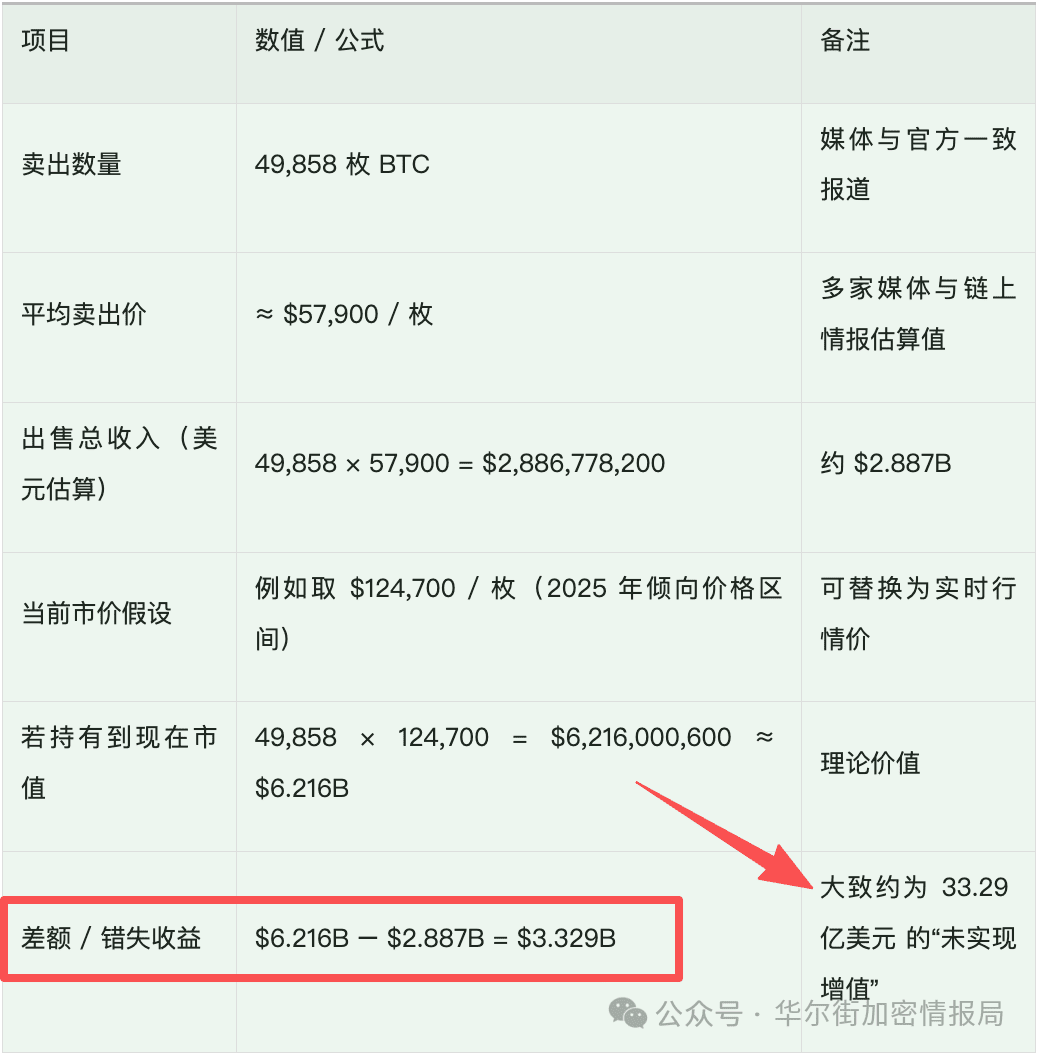
Conclusion: Germany exchanged about 49,858 Bitcoins for about $2.887B, whereas if held until the current market price, its theoretical market value would be about $6.216B, with a missed gain of about $3.33B.
Of course, these numbers are based on estimates (average selling price, current market value assumptions), but the magnitude and relative relationships are very persuasive.

Why did Germany choose to sell? The institutional logic behind it.
This operation seems to 'earn' little but 'misses' greatly, so why did Germany undertake such an operation?
First, legal procedures and risk control mechanisms.
The German judicial system supports the 'emergency liquidation' mechanism. If an asset is held for a long time during unresolved judicial proceedings and may depreciate beyond a certain percentage, the prosecution can initiate liquidation procedures. This is their legal basis for initiating action, as reported by the media.
If not liquidated, continued declines in asset prices will expose the court and the state to greater risks.
Second, asset conversion, custody, and usage restrictions.
The funds obtained from the sale are held by the court or relevant judicial departments (such as the Leipzig District Court) rather than immediately entering the national treasury.
Because it is a criminal case involving property disposal, high-risk market operations cannot be arbitrarily invested, and conservative disposal must be followed.
Third, concerns about market impact and batch arbitrage.
Germany has clearly adopted a 'gentle sale/batch sale' strategy to minimize the impact on the market (instead of a drastic sell-off), according to official statements, 'entrusted to banks to sell in a fair and gentle manner'.
Selling in batches can also disperse the impact and avoid a dramatic one-time drop.
'Sold too early' vs 'Legal limitations': Should it be criticized?
'Sold too early'
If Germany could have held until now, theoretically, it could have gained an additional $3.3 billion in appreciation. This means there is a huge opportunity cost in capital terms. Under the trend of cryptocurrency being viewed as 'long-term digital gold' or 'national allocated assets', this sale is considered a typical case of 'missing future gains'.
'Legal restrictions'
Germany's actions are not for profit but to fulfill judicial responsibilities and avoid the risk of asset depreciation. If judicial authorities allow assets to depreciate sharply due to waiting, it will lead to public opinion questioning and accountability risks. In many countries, judicial institutions do not have the capacity or authorization to 'hold high-volatility digital assets for a long time'.
If this operation is purely driven by risk control and legal constraints, then criticizing 'sold too early' has ethical limitations.
However, if the future judicial system allows for more flexible disposal strategies (such as hedging mechanisms, periodic release mechanisms, etc.), that would be a better path.

Conclusion
Germany's sudden sale of nearly 50,000 Bitcoins appeared to the market at the time to be a massive sell-off; however, viewed in hindsight, it may become a classic case of 'missing tens of billions in appreciation'.
But remember, this is not a simple 'buy-sell correctness' comparison, but a complex game of law, procedures, risks, and capital. From this, we see:
The unavoidable nature of institutional constraints in national-level asset disposal.
The amplification effect of opportunity cost in extremely volatile assets.
How do transparent supervision and public opinion influence judicial asset disposal strategies?
The next time you hear 'how much BTC a certain country sold and how much money they made', don't rush to envy or criticize.
We must first restore: how the law is, how the system is, what the timing is, and what the process is.
Finally: Many views in this article represent my personal understanding and judgment of the market and do not constitute advice for your investment.