
"Tools won't make you money, but using the wrong tools will definitely make you lose money."
Most people collect 100 indicators, but in the end, they still lose in the same way: tool piling without a system.
I break down my trading tools into three layers, like peeling an onion, from the outside to the inside:
🔹 First layer: Perception layer (see what the market is saying)
❌ Common misconception: Open the trading software and first look at whether the price has risen.
✅ Correct posture: First, look at the market sentiment thermometer.
My portfolio:
• Funding rate + long/short ratio → Determine extreme short-term sentiment
• Net inflow/outflow of exchanges → Look at the movements of big players
• Options Put/Call ratio → Institutions' hedging intentions
📊 Practical Screenshot Example:
[Funding rate suddenly positive + Big players depositing] = Short-term bullish but beware of corrections
[Negative funding rate + Big players withdrawing] = Possible rebound opportunity amid panic
🎯 Tip: When these three align, the signal's reliability increases by 50%; in case of conflict, observe first.
🔹 Layer Two: Decision Layer (Tell me whether I should take action)
❌ Common Misconceptions: Buy on a golden cross, sell on a death cross, getting slapped in a choppy market.
✅ Correct Posture: Use structure confirmation instead of signal triggers.
My core tools:
• Volume distribution chart (Volume Profile) → Find real support/resistance
• Market structure highs and lows (HH/HL/LH/LL) → Determine whether the trend is broken
• Volatility channel (ATR) → Dynamically set stop-losses, avoiding getting washed out by noise
💡 Key Mindset:
"Signal" indicates that there may be an opportunity,
"Structure" tells you whether the opportunity is valid.
📌 Case Study:
Yesterday, SUI broke through the previous high, and many people chased after it.
But looking at the volume distribution: the breakout point is just in a low volume area, with a dense transaction area above at $1.8.
→ High probability of a false breakout; wait for a pullback confirmation before entering, and indeed today there was a pullback.
🔹 Layer Three: Execution Layer (Turning plans into results)
❌ Common Misconceptions: Manual ordering, changing strategies as emotions rise.
✅ Correct Posture: Write discipline as code.
My execution checklist:
✅ Must ask 3 questions before opening a position:
1. What is the maximum loss for this trade? (Calculate loss first, then think about profit)
2. If I am wrong, what signal proves I am wrong? (Set stop-loss logic in advance)
3. If I am right, what signal lets me add to my position/take profit? (Conditions for letting profits run)
✅ Use conditional orders instead of market orders:
• Breakout order: Triggered only when both price and volume confirm
• Stop-loss order: Use ATR for dynamic calculations, not a fixed percentage
• Take-profit order: Place orders in batches to avoid "selling too early" anxiety
✅ Review template (3 minutes each day):
• How many planned trades did you execute today?
• Which trade is an emotional trade? Why?
• Does the tool combination have any failure signals?
🎁 Easter Egg: "Chemical Reaction" case of the three layers of tools
Situation: BTC has been choppy for 3 weeks, direction unclear.
The value of tools is not in "many", but in "linkage".
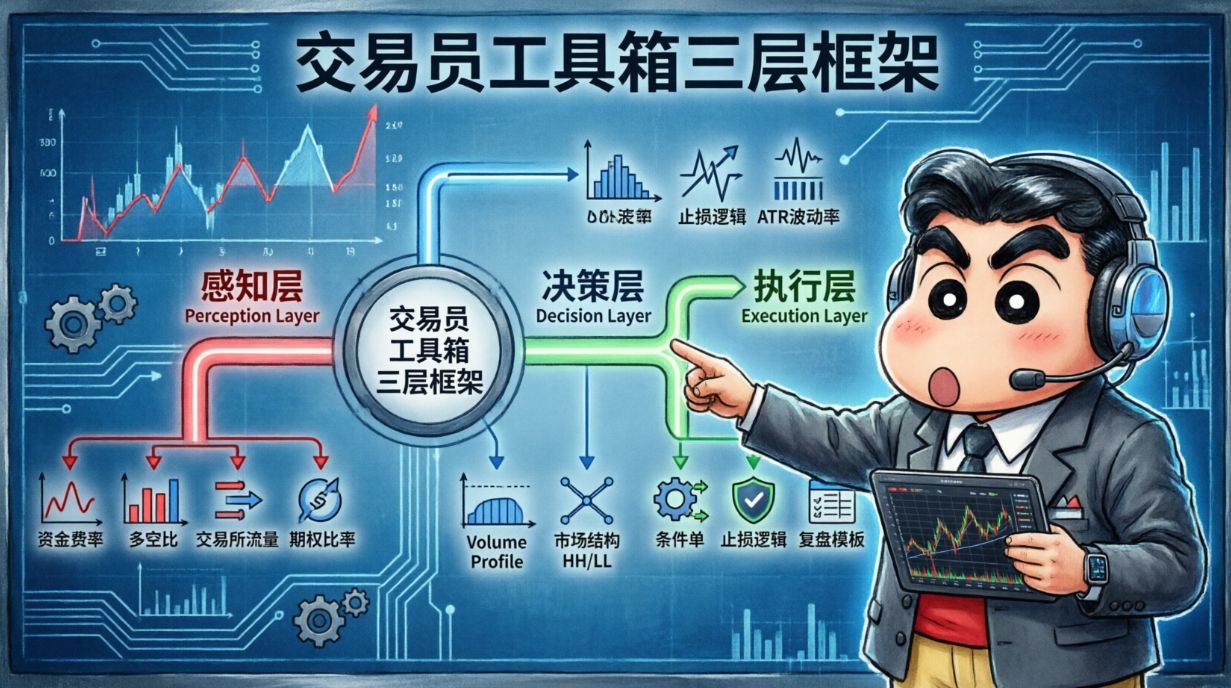
👦 Crayon Shin-chan Easter Egg: Wearing trader headphones, holding a notebook, looking serious—"Tools must be used correctly; otherwise, even Shin-chan loses money!"
📌 Lastly, let me say this
"Beginners look for the Holy Grail, while veterans build systems."
You don't need 100 tools; you only need:
3 perception indicators (understanding emotions)
2 decision frameworks (confirming structure)
1 set of execution discipline (controlling your hands)
Tools are lifeless; combinations are alive.
Which layer in your toolbox is the weakest? Let’s discuss in the comments below👇