


Key Points
From this guide, you will learn how to protect your Binance account, including how to use early warnings to prevent mistakes before money is transferred.
We will discuss the most common fraud and account takeover tactics today, two major security threats in the field of digital finance today.
Finally, you will see simple yet impactful setups that you can enable in just a few minutes – biometrics, passkey, and Anti-Spoofing Code – to build a multi-layered protection that remains effective as crime becomes more sophisticated.
Currently, most security incidents in the digital finance sector fall into two groups: scams, where you are tricked into authorizing a money transfer, and account takeover, where bad actors attempt to gain access to transfer your money without your consent. Read on to understand the common signs of these two types of attacks, important early warnings to disrupt them, and simple account setups to add multiple layers of protection.
Scams and account takeover: How are they different?
A scam is a criminal scheme designed to deceive a person into voluntarily sending money to the scammer or intentionally granting access that allows for a money transfer. This form relies on building trust through deception and then exploiting that trust. Simply put, the criminal "persuades" the victim to send them money.
Account takeover (ATO) attacks are efforts by bad actors to gain access through malicious means (e.g., installing malware) without the user’s knowledge or consent and ultimately transfer money that the victim did not actively approve the transaction. This is akin to breaking into a safe using technical measures and stealing money. However, ATO attacks often begin with fraudulent communication, through which criminals seek to obtain account login information or secretly install malware to "break into" the victim’s account.
Types of scams to be aware of
Scams often rely on urgency and panic to pressure you into clicking, scanning, or sharing before you can verify the source. Here are some common tactics we are recording and you should be wary of.
Impersonation and fake support
Impersonation remains one of the most persistent tactics of criminals. This form includes tools such as spoofed SMS messages, fake support phone numbers, legitimate-looking websites, and social media accounts that attackers use to impersonate Binance representatives. The goal is to replace the channel you trust with one controlled by the scammer, then guide you to take a risky action.
In 2026, scammers may even impersonate the support department and pressure users to install screen-sharing applications. Once they have access to your screen, they will guide you to withdraw money step by step or directly take control and initiate withdrawal orders right on your device.
Impersonation and on-chain fraud
On-chain impersonation and fraud rely on getting you to interact with the wrong platform or asset or send money to the wrong destination. Common examples include fake tokens, fraudulent airdrops, fake platforms, and scam projects.
Investment scams
Investment scams may look like legitimate earning opportunities but the goal is to get you to send money to a wallet or platform controlled by the scammer. The offers often include guaranteed profits, VIP tiers, or limited-time bonuses to create a sense of urgency along with well-crafted websites featuring fake endorsements and screenshots of withdrawals to build credibility.
When you deposit money, the scam will switch to drain mode. Withdrawals are often blocked with unreasonable "taxes," "gas fees," or "unlock fees," and you may be pressured to deposit more to "restore" your account. In many cases, the displayed profits are fabricated and the platform will disappear once it has harvested enough money.
Ponzi schemes disguised as jobs or tasks
Ponzi schemes disguised as job or task platforms promise stable high returns for completing simple actions or recruiting others. In reality, payouts come from the money of new participants rather than actual profits. When recruitment slows down, the scheme collapses and late participants suffer losses.
Common account takeover tactics
Account takeover often exploits urgency and confusion to pressure you into clicking, scanning, or sharing before you can verify the source, aiming to compromise your account. Here are some common tactics to be cautious of.
Phishing attacks
Phishing attacks remain one of the most common ways that scammers target cryptocurrency users because they rely on urgency, pressure, and misplaced trust. We will analyze three common phishing attack patterns, but the tactics do not stand still. Scammers continually refine their scripts as users become more cautious. The best defense is to always be skeptical of unexpected messages, verify the source through official channels, and slow down before you click, scan, or share anything.
Phishing messages and fake support links: Scammers impersonating "Binance support" on Telegram or via email create a sense of urgency and send a "verification" or "reset" link leading to a spoofed website designed to steal your login information or 2FA code.
Apple ID phishing attack: The attacker sends fake Apple alerts via SMS to steal your Apple ID, then exploits access to your synchronized iCloud password, Face ID, or passkey to break into your linked accounts including Binance and attempts to execute unauthorized withdrawal orders.
Malware via email attachments: Convincing emails (often accompanied by ZIP files or attachments) can automatically install malware on your device as soon as you open them. Initially, you may not notice anything, but the malware can silently steal data, take over your account or wallet operations, or weaken your device's security settings by combining psychological manipulation techniques with technical exploitation aimed at draining your funds.
Face and QR code scams
Don't let yourself be scammed and deceived. Scammers may impersonate support or Binance personnel and ask you to send a face video for "verification" or send a QR code disguised as a reward or final update that gives them immediate access to your account.
Early warning from Binance
Binance may send early warnings if you are about to transfer money to an address related to fraudulent activity. Do not ignore these warnings. Pause to double-check the address and consider whether you are being pressured to send money, especially if someone claims to be a Binance employee or customer support.
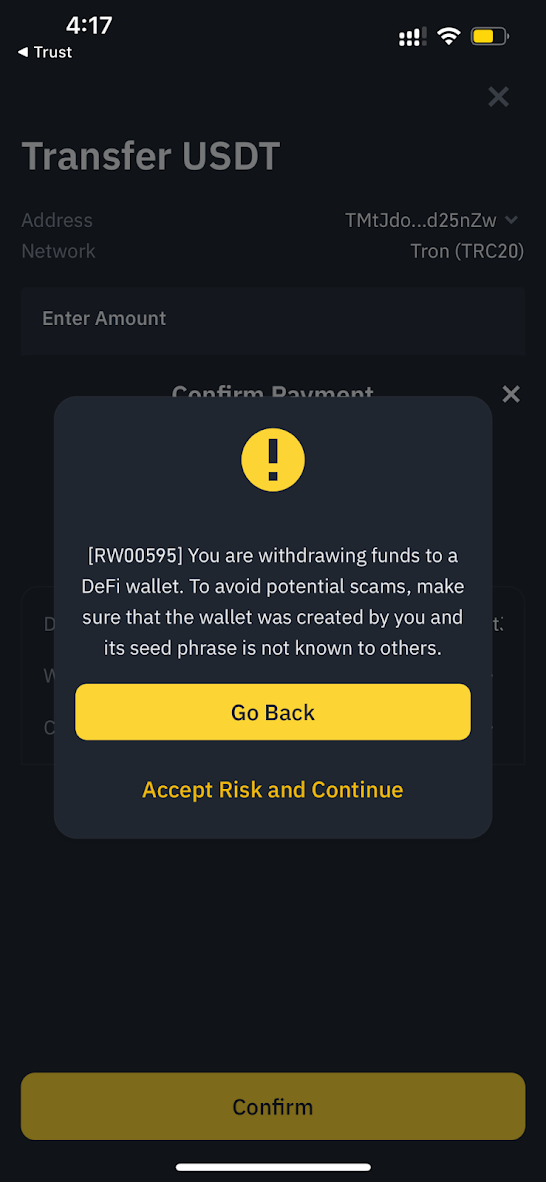
Early warning on mobile devices
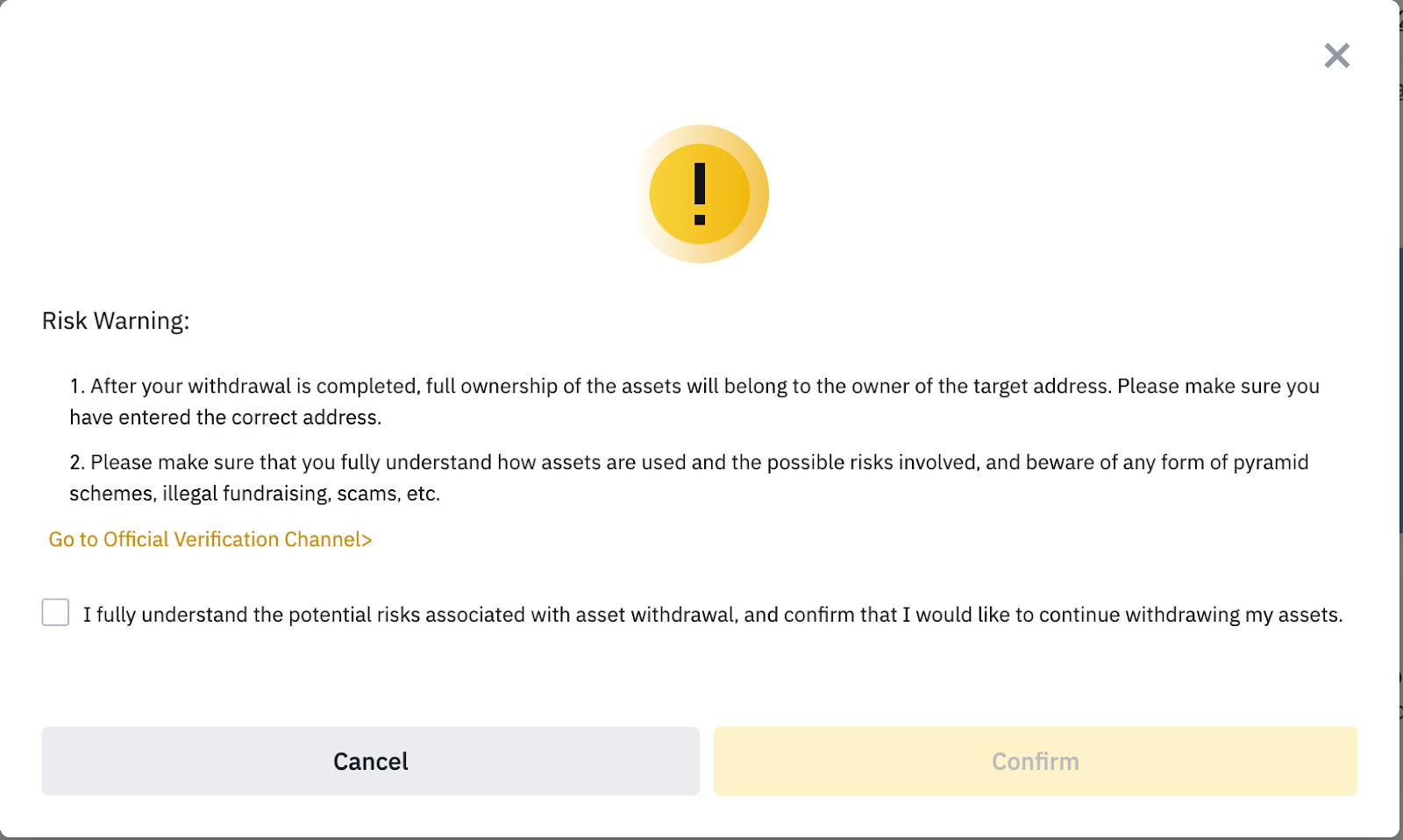
Early warning on computers
When risk signals are high, Binance may temporarily suspend withdrawals on the account. This is the final layer of defense, used as an emergency stop measure in urgent situations to prevent the account from being drained while we verify what is happening. Withdrawals will only be restored after a security check and confirmation from the account owner.
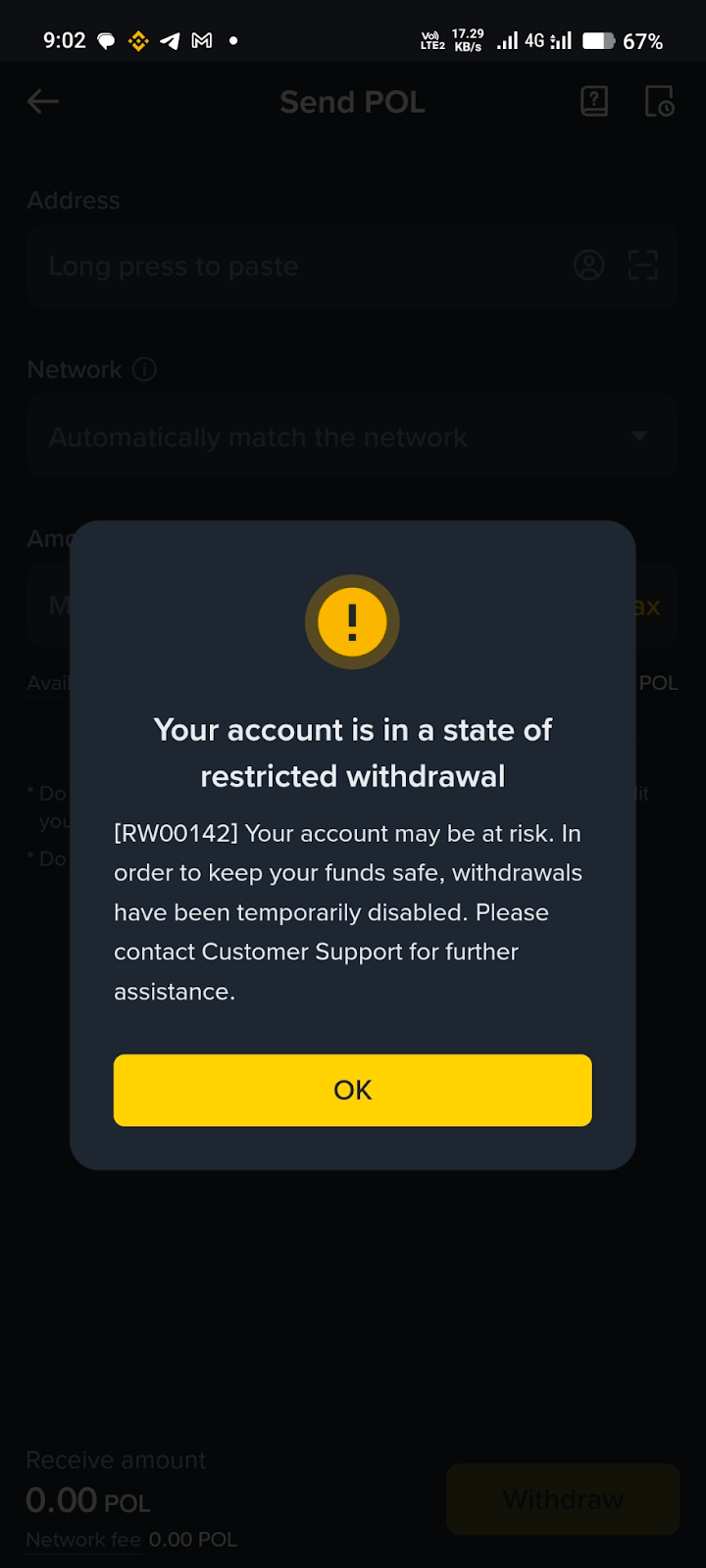
Block withdrawals on mobile devices
Simple setup to protect yourself
A strong security setup is one of the most effective ways to prevent account takeover before it starts. Here are three updated ways to protect your account in 2026.
Biometrics: Use face or fingerprint verification to add a strong device-based layer that is harder to compromise than passwords or one-time codes.
Passkey: Add passwordless authentication based on cryptographic verification stored on your device, reducing the risk of spoofing attacks and SIM swap attacks while also making login simpler on supported devices.
Anti-spoofing code: Set up an 8-character code that appears in Binance's official emails and notifications so you can quickly identify phishing messages.
In 2026, relying on just one security measure is often not enough as scams are becoming increasingly complex. That’s why biometrics, passkeys, and anti-spoofing codes work best when combined, providing you with layered protection.
Security tip: Verify first, keep learning
Also remember to keep all account activities, security checks, and support conversations within the Binance app or on Binance’s official website. If a message asks you to call a phone number, switch to another app, or click on a strange link, consider it suspicious. When in doubt, use Binance Verify to verify links, emails, and contacts and follow Binance Risk Sniper on Square, Binance Academy, along with our security blog series for ongoing updates on scams and prevention tips.
Summary
If you haven't recently reviewed your account security settings, take a few minutes to set up biometrics, enable passkeys when possible, and add anti-spoofing codes. These measures help protect your account even if you receive a convincing message or click on something you shouldn't. Scams evolve rapidly, but staying updated through our security resources can help you recognize early signs of fraudulent behavior and account takeover attempts while avoiding costly mistakes.
Read more
Please note: There may be differences between the original English content and any translated versions (these versions may be generated by AI). Please refer to the original English version for the most accurate information in case of discrepancies.