


Author: Yokiiiya
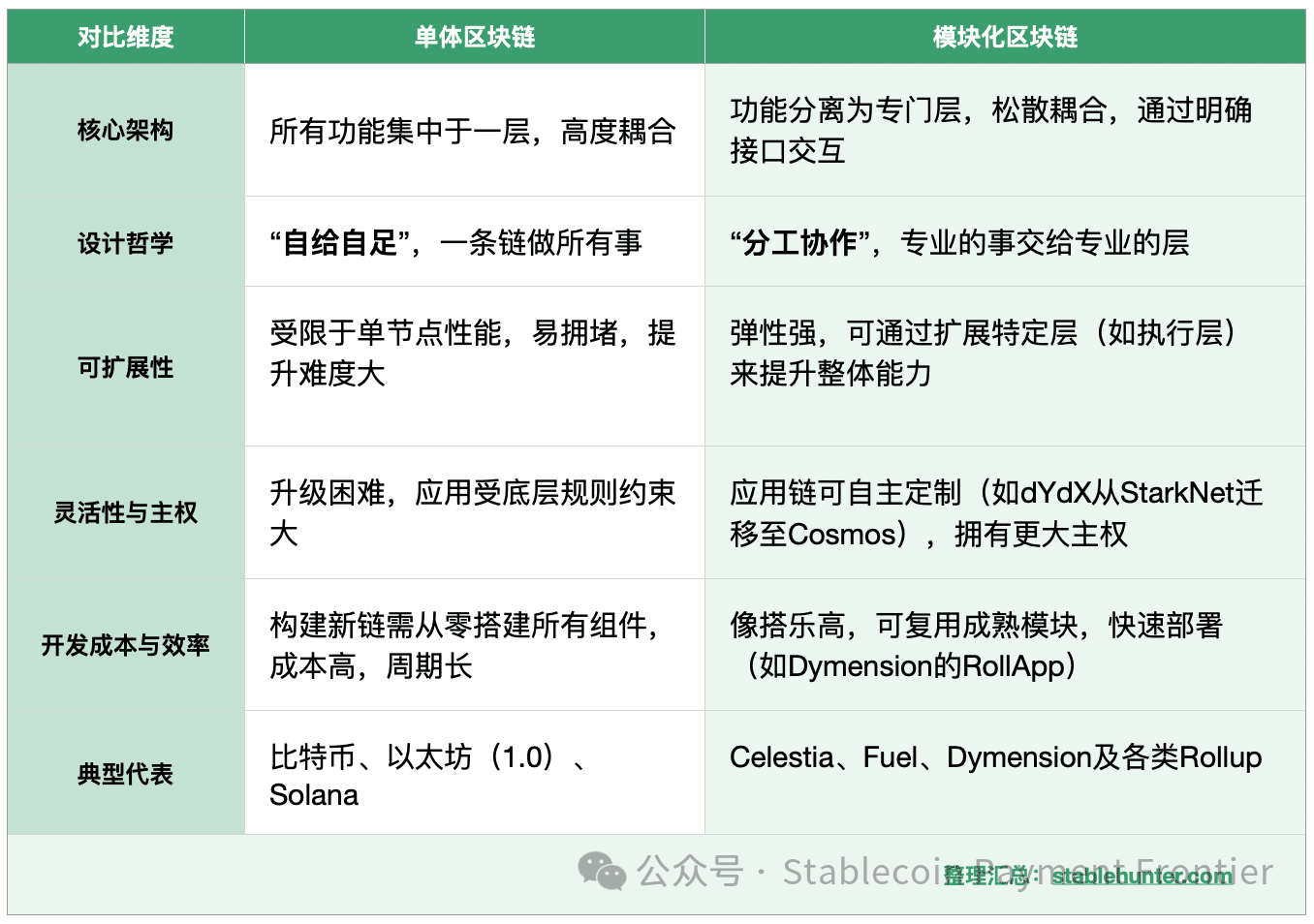
Modularization is the core trend in the evolution of blockchains today, and it is essential to clarify its inevitability—how the limitations of monolithic blockchains naturally lead to modular solutions. It is necessary to highlight the advantages brought by 'division of labor' through comparative structures, such as how the separation of the DA layer (like Celestia) and the execution layer (various L2s) solves the 'impossible triangle' problem.

1. Core Idea: Why is modularization necessary?
Traditional blockchains (like early Ethereum and Bitcoin) are monolithic blockchains. They function like a standalone workshop, managing all production processes:
Execution: Handles transactions and smart contract operations.
Consensus: Determines which block is valid and orders them.
Data Availability: Ensures that all transaction data is publicly available so that anyone can verify the state.
Settlement: Finalizes transaction results and resolves disputes.
The problem is: this 'small workshop' has limited capabilities. When all the work is placed on it, it encounters the well-known 'blockchain impossible triangle'—struggling to balance decentralization, security, and scalability.
The solution for modular blockchain is to split these four core functions and have different, specialized “factories” responsible for them. Through division of labor and collaboration, the overall efficient operation of the system is achieved.
Two, Detailed Explanation of 'Layering' in Modular Blockchain
Modular design decouples core functions, allowing each layer to focus on what it does best:
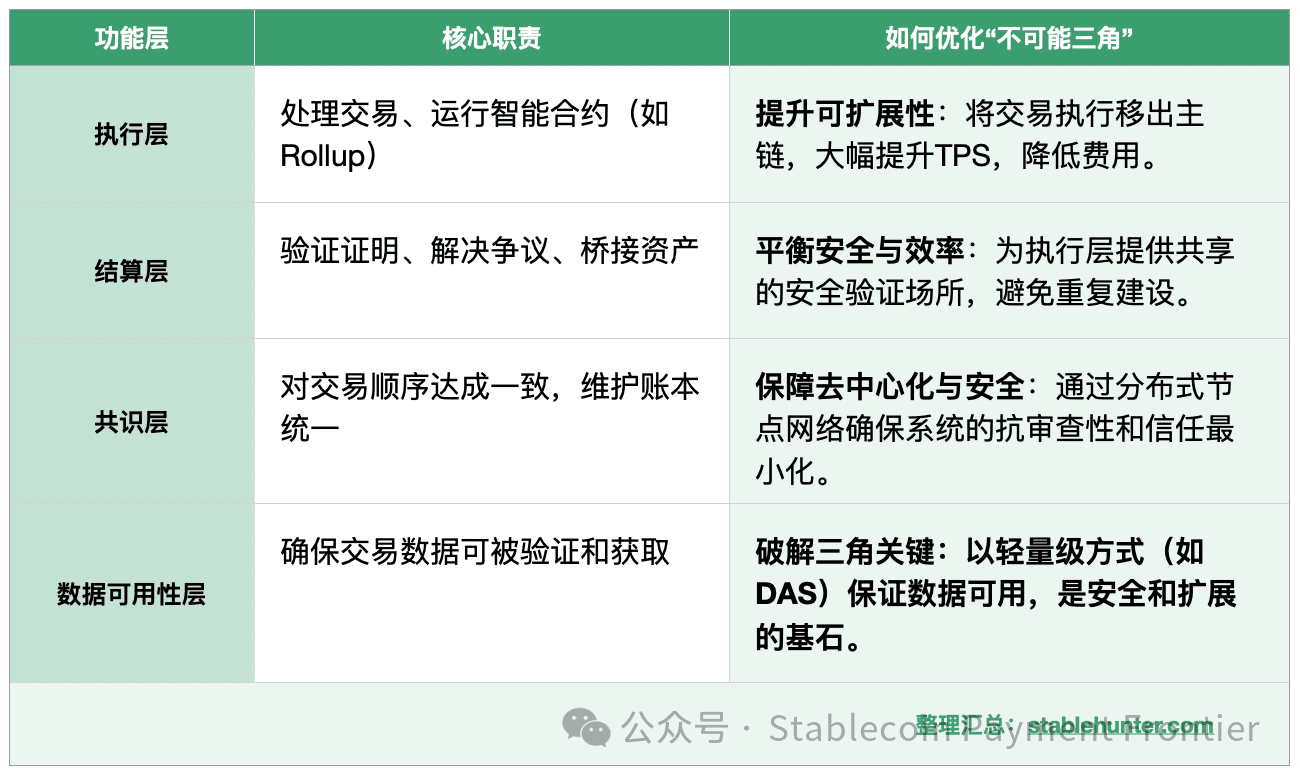
Execution Layer: Specifically handles transactions and runs smart contracts, serving as the interface for direct user interaction.
Settlement Layer: Provides transaction finality, verifies proofs, resolves disputes, and acts as a bridge between different execution layers.
Consensus Layer: Reaches agreement on the order and validity of transactions through a network of nodes, maintaining the consistency of the ledger.
Data Availability Layer: Ensures that transaction data is fully published and available for verification and download, serving as an important cornerstone of security.
Three, How Modularity Breaks the 'Impossible Triangle'
Modular architecture allows for the separation of functions, enabling independent optimization of each layer, providing a path to break the 'impossible triangle.' For example, the execution layer can pursue high-speed processing, while the consensus and data availability layers focus on security and decentralization.
Modular blockchain decouples the four core functions of traditional monolithic blockchains—execution, settlement, consensus, and data availability (DA)—allowing each layer to focus on what it does best, thereby providing feasibility for breaking the 'impossible triangle.' The table below can help you quickly grasp how each layer optimizes for the 'impossible triangle':
Celestia is a typical example, focusing on the data availability layer. By using technologies such as Data Availability Sampling (DAS), it significantly enhances scalability while ensuring decentralization and security. Rollups (such as Arbitrum, zkSync) are a successful practice of the modular concept, moving transaction execution off-chain (execution layer) and ultimately anchoring data to safer underlying chains (consensus and data availability layers), thus inheriting the underlying security while achieving high performance.
Four, Rational View of Modularity
Although the prospects for modular design are broad, it also needs to be viewed rationally:
'Breaking' is about optimizing balance, not an ultimate solution: modular blockchain tends to be a more refined art of trade-offs. It does not aim for one chain to achieve perfection in all three aspects simultaneously, but rather through architectural adjustments, allows the entire system to achieve higher scalability while maintaining acceptable levels of security and decentralization. The core lies in specialization and collaboration.
The new architecture brings new challenges: this decoupling also introduces new complexity issues. For example, the security of communication between layers is crucial. At the same time, the overall complexity of the system increases, raising the understanding threshold for developers and users. Currently, there is still room for improvement in the degree of decentralization of some components in the modular stack (such as the sorter).
Modular blockchains decouple core functions, allowing specialized layers to do specialized work, opening a practical path for blockchain scalability, bringing us closer to the optimization balance of the 'impossible triangle.' Of course, this is an ongoing evolution rather than a one-time revolution.