
Last week, I talked with a friend about RWA on-chain assetization and mentioned the recent news about a mainstream privacy mixer being classified by the judiciary. The sense of helplessness and reflection almost overflowed the screen. I have always wondered why, in this world that advocates decentralization, we still have to guess the boundaries of regulation like seeking a confession from a deity?
Watching countless developers tread carefully because the 'privacy code' itself is regarded as a criminal tool is infuriating due to this power imbalance. This is not just a lag in the law; it is fundamentally due to the lack of a transparent 'game cost' for privacy technology—when privacy becomes a 'black box' that cannot be self-evident to the system, redundant rules become the only means to strangle innovation.
This dilemma of "having to run naked for the sake of innocence" is the ultimate proposition that Midnight ($NIGHT) attempts to dissolve through the mechanism of NIGHT assetization. I dissected its logic and found its design to be extremely counterintuitive.
Typical privacy tokens pursue absolute concealment and nullity, but Midnight exhibits an unusual restraint.
It transforms the "right to privacy proof" into an asset, turning the originally ethereal credit into a visible resource. The core of this restraint lies in: it does not seek to destroy regulation, but rather establishes a priceable buffer between user sovereignty and external audits through assetization. It makes privacy no longer a blind spot in law, but a digital asset that can be verified through algorithms and requires payment of "computational or token costs" to obtain.
I tend to estimate the survival probability of a system in the real world from the cost side:
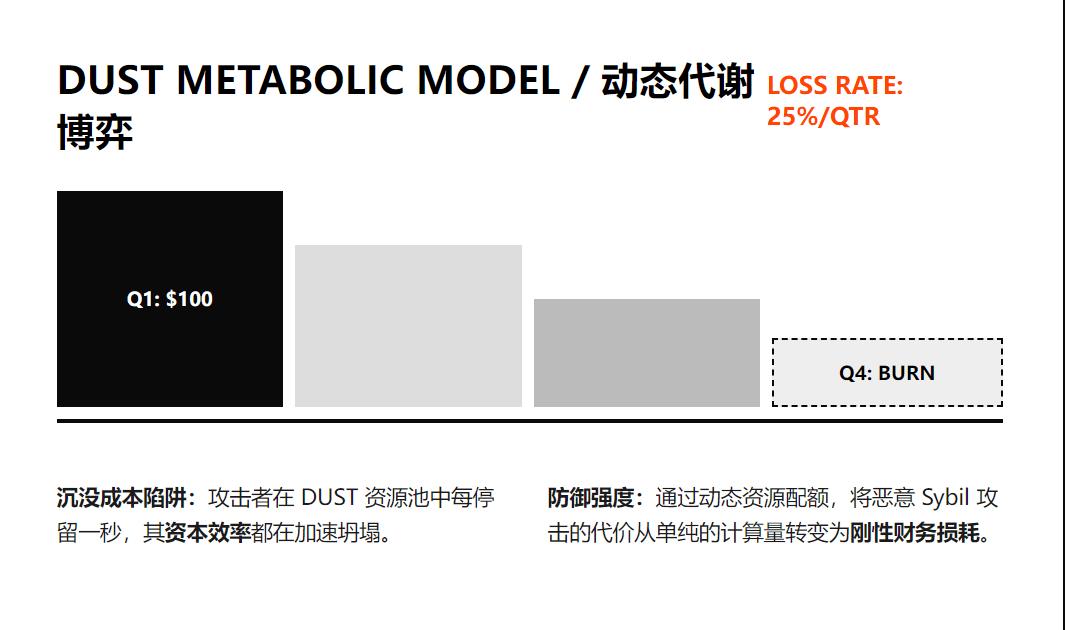
Game account: The capital trap of Sybil attackers. Under the assetization framework of $NIGHT , if someone tries to pollute the credit pool by faking 10,000 false privacy identities, they must face the physical limitations of DUST resource quotas. Assuming the resource threshold for generating a single identity is 100 dollars, due to DUST's dynamic metabolism attributes, if the attacker cannot complete arbitrage in a very short time, their capital loss rate will be fixed at over 25% per quarter. This sunk cost ensures the attacker is financially doomed to fail.
Ecological account: Talent premium and market dividends. This is a valuation difference that determines the ceiling:
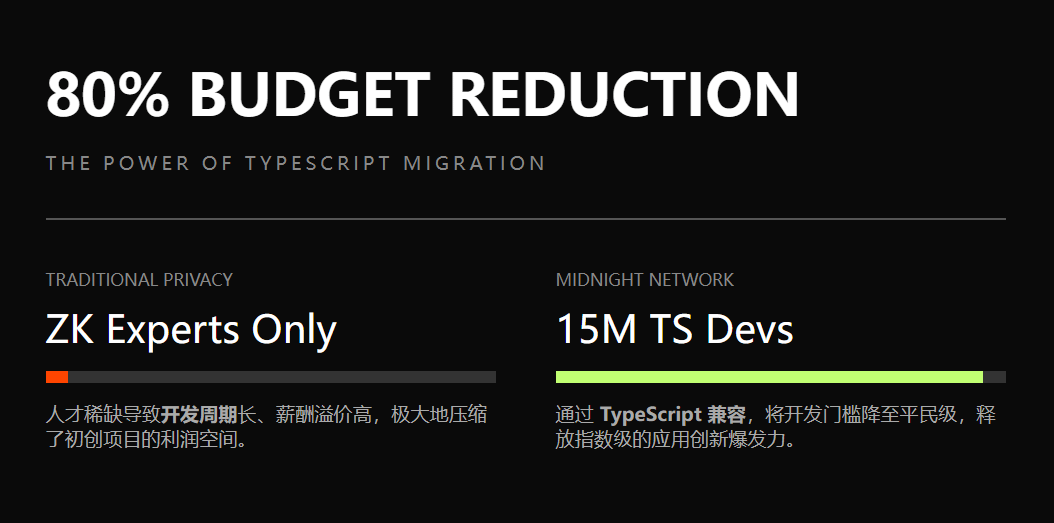
Scarcity tax: The R&D monthly salary of global native ZK experts (a very small number) is usually 4 times that of ordinary developers, and the development cycle is extremely long.
Popularization dividend: Midnight directly leveraged the global 15 million TS developers through the migration compatible with TypeScript.
Valuation difference: This disparity in developer density means that the application deployment budget can be directly reduced by about 80%, greatly enhancing the capital efficiency of projects.
When "privacy" is no longer a target of the law but becomes a digital asset protected by algorithms and priced by capital, Web3 can be said to have truly shifted from defense to offense. If a protocol allows you to complete cross-border compliance audits by paying a small amount of $N$NIGHT without handing over your private key, do you think banks would refuse you because they cannot "fully control you"?
Interactive voting: What do you think is the biggest obstacle to the large-scale commercialization of privacy technology?
A. The "one-size-fits-all" policy of regulatory agencies
B. Severe shortage of developer talent
C. The collective lack of user privacy awareness
D. Excessively high transaction friction in technology implementation