
Last week, I met a friend who works in the financial risk control field. When he talked about the prevailing 'in-depth background checks' in the industry, his tone of obviousness led me into deep reflection. To apply for a mid-level position, candidates are required to authorize the retrieval of personal credit reports, social security bases, and even every large expenditure record from the past five years.
I have always been puzzled as to why, in order to prove a simple 'compliance' or 'credit value', we must complete a thorough 'digital striptease' in front of institutions? This sense of oppressive power imbalance fills me with great helplessness and anger: under the current rules, the rule-makers tend to excessively demand data to mitigate their minimal risks, while the rule enforcers (ordinary people) must pay an extremely high price for privacy.
This logic redundancy of 'incomplete disclosure means no proof' is essentially the technical inertia of centralized credit. I reviewed the white paper of Midnight ($NIGHT), and its assetization of NIGHT and selective disclosure mechanism are designed to be extremely counterintuitive.
Traditional blockchain compliance often leads to two extremes: either a completely public 'full disclosure' or a completely hidden 'full concealment' to avoid regulation. However, Midnight exhibits an unusual restraint. It transforms NIGHT into an asset with compliance semantics through ZK (zero-knowledge proof), and its essence lies not in making you 'hide deeper', but in enabling you to achieve 'precise proof'.
This mechanism allows you to provide an immutable conclusion proof to the verifier through a smart contract without handing over the complete transaction flow (raw data). It curbs institutions' greed for redundant data, forcibly drawing a red line on the technical level for the boundary of power: you can verify my credit, but you have no right to pry into my life.
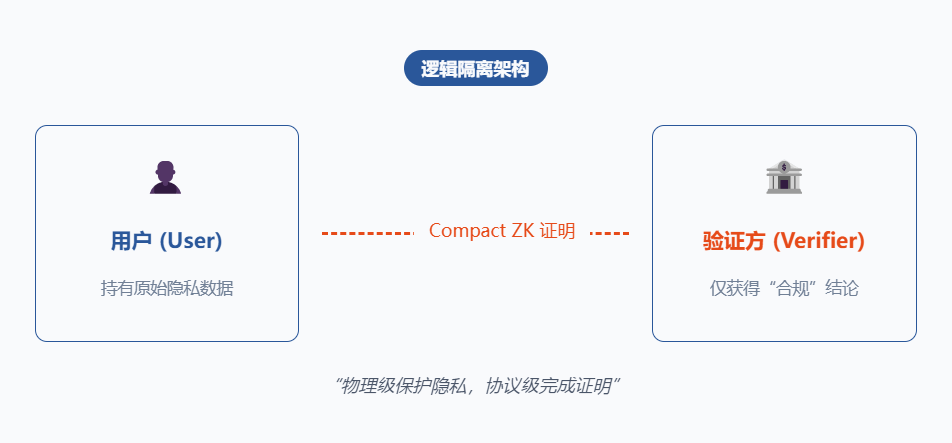
From the perspective of a business architect, this shift in technical paradigm directly reconstructs the underlying formula for profit distribution:
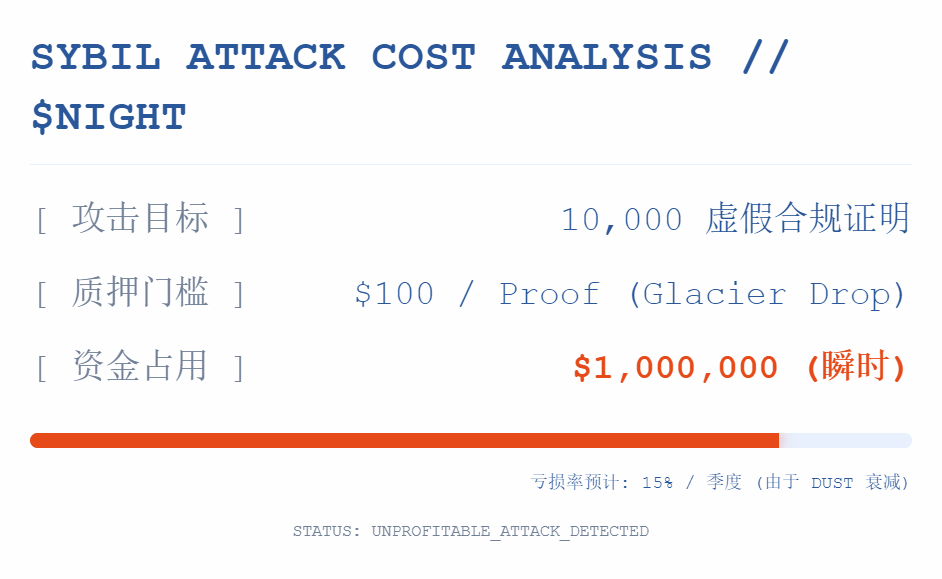
Game account: data forgery and attack costs. In the Midnight ecosystem, if a black market organization wants to massively forge compliance proofs through a Sybil attack (witch attack) to pollute the credit pool, they must hold and consume DUST through Glacier Drop or similar mechanisms. Assuming the staking threshold for each compliance proof is $100, when an attacker attempts to simulate 10,000 fake identities, their instantaneous capital occupation will reach $1 million. Due to the dynamic metabolism attribute of DUST, the opportunity cost and depreciation rate of these funds during the attack cycle will lead to an increase in the attacker's loss rate of about 15% each quarter. This physical defense based on 'sunk costs' makes malicious gaming unprofitable.
Ecological account: a dimensionality reduction strike of technology landing. This is a harsher comparison:
ZK cryptography expert: The global stock is extremely limited, and a single person's annual salary is usually above $300,000, with a research and development cycle measured in 'years'.
TypeScript developer: There are tens of millions globally. Midnight allows them to write compliance logic directly in TS.
Market valuation: This means that when companies build privacy-compliant applications, the R&D budget will drop from millions of dollars to hundreds of thousands, and the market valuation will gain significant certainty premiums due to the increased speed of landing.
Asset sovereignty, compliance certainty, and developer density constitute the true moat of Midnight.
When 'data ownership' is no longer an empty legal concept but a power boundary rigidly constrained by code, we truly have the chips to negotiate with giants. What Midnight is doing is redeeming our privacy from the institutions' balance sheets back to personal wallets.
If there is a technology that allows you to apply for a mortgage without having to hand over all transaction records, would you be willing to learn to use a new wallet for this dignity?
Feel free to share your similar experiences, and let's dissect the interests behind these rules in the comments section.