


Why XRP "Doesn't Make Sense" Until You Understand This One Concept
The Invisible Problem of Slow Money
Information flies around the world in milliseconds, but international money still crawls through analog and fragmented circuits. With geopolitical tensions boiling and the DXY (Dollar Index) weakening under the weight of de-dollarization, the global financial system creaks. In this chaos, XRP is poorly understood as mere retail speculation. In fact, it is the backbone of a new banking paradigm — not a volatile asset, but infrastructure where institutional capital truly resides. Forget the crypto bubble; the value of XRP arises from solving the pains of a system that is slowly collapsing.
Integration, Not Revolution
Unlike BTC, the digital gold dreaming of knocking down fiat currencies, or Ethereum with its decentralized utopia, XRP doesn't want to be your bank. It integrates with the existing system, turbocharging banks with unprecedented efficiency. In a world of fractured economies, it acts as a neutral bridge. Helping the system instead of waging war against it is the winding path — full of regulatory hurdles — but the only one that scales to trillions in volume. "XRP doesn't steal the bank's throne," as an old sarcastic banker would say. "It just makes the king run faster."

Goodbye to Dead Capital
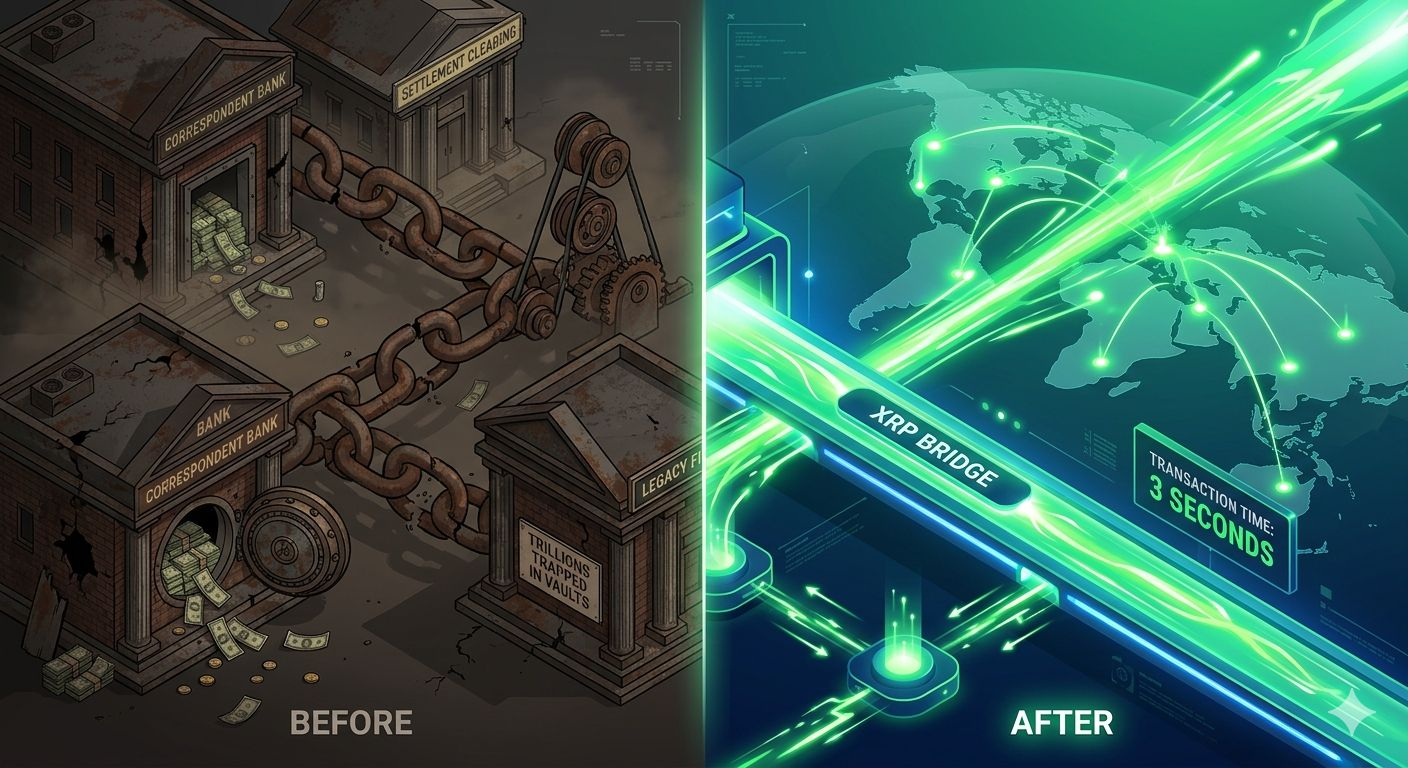
International transfers via correspondent banking are an archaic relic: from Brazil to Japan, the real jumps through intermediaries, bleeding spreads with each jump. Worse: trillions in 'dead capital' sit idle in Nostro/Vostro accounts, ensuring phantom liquidity. The XRPL puts an end to this via On-Demand Liquidity (ODL).
Settlement in 3 seconds, not days.
End of spreads: real turns into XRP, XRP turns into yen, no pit stops.
Freedom: banks redeem idle treasury.
It's the end of the silent hemorrhage that enriches custodians and impoverishes the rest.
The Legal Victory of 2025
The war with the SEC, since 2020, ended in August 2025 with a settlement that cleared the runway. XRP is not a security — tied to company profits — but a commodity, like gold or oil: value dictated by the market, not by an entity.

Institutions can now custody it without fear, accelerating adoption.
ISO 20022, The Language of the Big Players
The financial world is migrating to ISO 20022, the unified language of banking data. RippleNet already speaks fluently — without translators or hacks, unlike rivals. That's why Santander and SBI Holdings (Japan) are already on board, years ahead in the cross-border race.
Silent Cycles, Like Amazon in 2000
The XRP chart is well-behaved: consolidations from 2018-2020 and 2022-2025 scream institutional accumulation, not memecoin hype. It resembles Amazon during the dot-com bubble — underestimated but with unbeatable infrastructure that dominated decades later. Risk? Volatility reigns. Patience is the antidote for those who see beyond the short term.
The Responsive Money Has Arrived
CBDCs and 24/7 markets make XRP inevitable. We are moving from static money to programmable liquidity. The question isn't if it changes, but: are you jumping on the speed of information, or resisting the inevitable?
It's just an exercise in futurology — nothing to take seriously. Think from other angles, step outside the box and explore the unexpected.