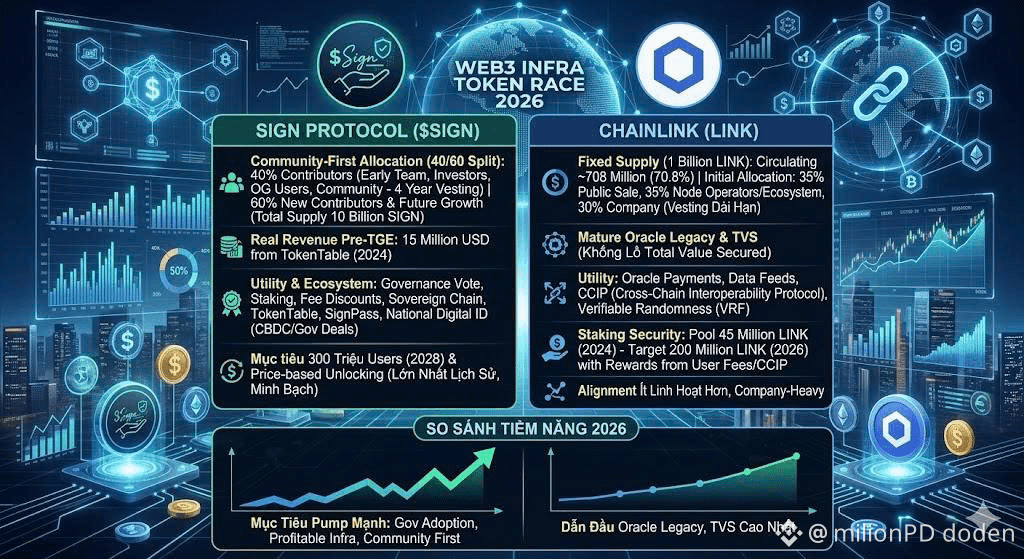
Comparison between $SIGN of Sign Protocol and LINK of Chainlink
Today I bring a deep comparison between SIGN of Sign Protocol and LINK of Chainlink, the two leading infra tokens in Web3. With a total supply of 10 billion SIGN, an allocation of 40% for contributors over the past 4 years (early team, investors, OG users, community) and 60% for new contributors along with future growth, SIGN is distinctly designed with a community-first approach: utility serves as the backbone of the entire ecosystem (protocol, app, TokenTable, SignPass, Sovereign Chain), allowing for earning, staking, spending, governance voting, fee discounts, and supporting government deals for CBDC/digital ID. Combined with a real revenue of 15 million USD from TokenTable in 2024 before TGE, along with price-based unlocking through the largest distribution tool in history, SIGN is not only transparent but also scales to a national level with the goal of onboarding 300 million users by 2028, presenting a profitable infra narrative with extremely strong sovereign adoption post-bear.
In contrast, LINK has a capped supply of 1 billion, with approximately 708 million (70.8%) currently circulating, an initial allocation of 35% for public sale, 35% for node operators/ecosystem rewards, 30% for the company focusing on oracle payments, staking security (pool of 45 million, targeting 200 million by 2026 with rewards from CCIP/Data Feeds/user fees), and collateral against slashing. LINK has matured with a huge TVS, but long-term vesting and a company-heavy structure make alignment less flexible than SIGN.
I see SIGN excelling with a 40/60 split in community with real revenue pre-launch and TokenTable integration, while LINK leads in oracle legacy; by 2026, when government adoption explodes, SIGN has the potential to pump stronger thanks to a solid foundation. What do you think about this race? Please comment your opinion!
#signdigitalsovereigninfra $SIGN @SignOfficial
Today I bring a deep comparison between SIGN of Sign Protocol and LINK of Chainlink, the two leading infra tokens in Web3. With a total supply of 10 billion SIGN, an allocation of 40% for contributors over the past 4 years (early team, investors, OG users, community) and 60% for new contributors along with future growth, SIGN is distinctly designed with a community-first approach: utility serves as the backbone of the entire ecosystem (protocol, app, TokenTable, SignPass, Sovereign Chain), allowing for earning, staking, spending, governance voting, fee discounts, and supporting government deals for CBDC/digital ID. Combined with a real revenue of 15 million USD from TokenTable in 2024 before TGE, along with price-based unlocking through the largest distribution tool in history, SIGN is not only transparent but also scales to a national level with the goal of onboarding 300 million users by 2028, presenting a profitable infra narrative with extremely strong sovereign adoption post-bear.
In contrast, LINK has a capped supply of 1 billion, with approximately 708 million (70.8%) currently circulating, an initial allocation of 35% for public sale, 35% for node operators/ecosystem rewards, 30% for the company focusing on oracle payments, staking security (pool of 45 million, targeting 200 million by 2026 with rewards from CCIP/Data Feeds/user fees), and collateral against slashing. LINK has matured with a huge TVS, but long-term vesting and a company-heavy structure make alignment less flexible than SIGN.
I see SIGN excelling with a 40/60 split in community with real revenue pre-launch and TokenTable integration, while LINK leads in oracle legacy; by 2026, when government adoption explodes, SIGN has the potential to pump stronger thanks to a solid foundation. What do you think about this race? Please comment your opinion!
#signdigitalsovereigninfra $SIGN @SignOfficial