
A couple of days ago, I was drinking with friends and talking about blockchain. He asked me a question: With such amazing privacy coin technology, why are big institutions so afraid to touch it?
I was taken aback for a moment. Thinking about it, it's true. Monero and Zcash are well-established brands, the technology is undeniable, but when mentioned, everyone's first reaction is 'Is this thing used for bad purposes?' Regulators are watching, institutions are avoiding it, and in the end, it can only brush its presence in dark web legends.
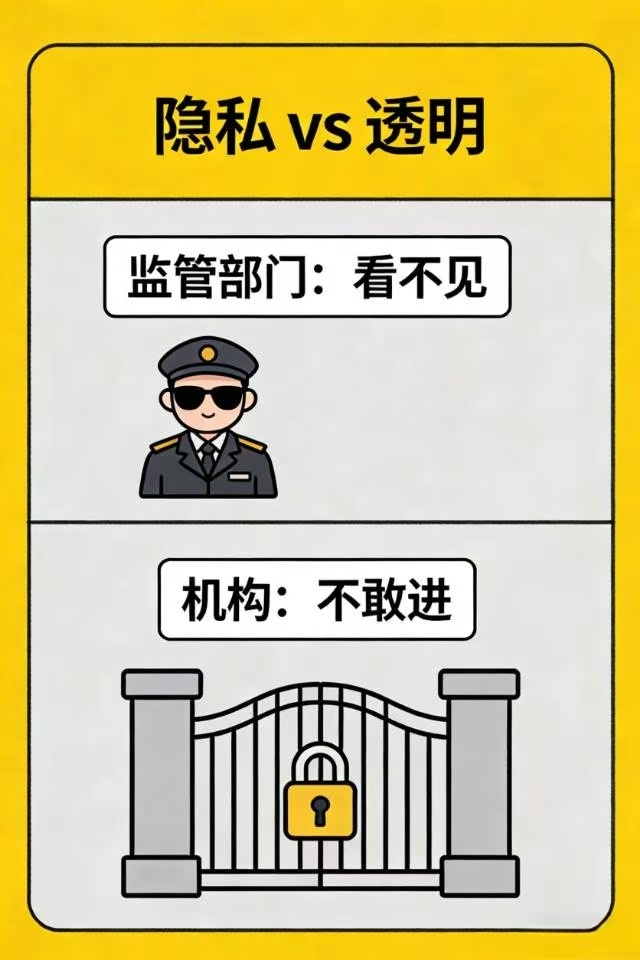
Where is the problem? I think they have turned privacy into a 'black box'—once you enter, you can't see anything, not even passing compliance reviews.

Recently, I noticed the Midnight project and found that it addresses a very practical issue: should privacy be hidden or only shown to those who need to see it?
The idea of 'selective disclosure' resonates with me.
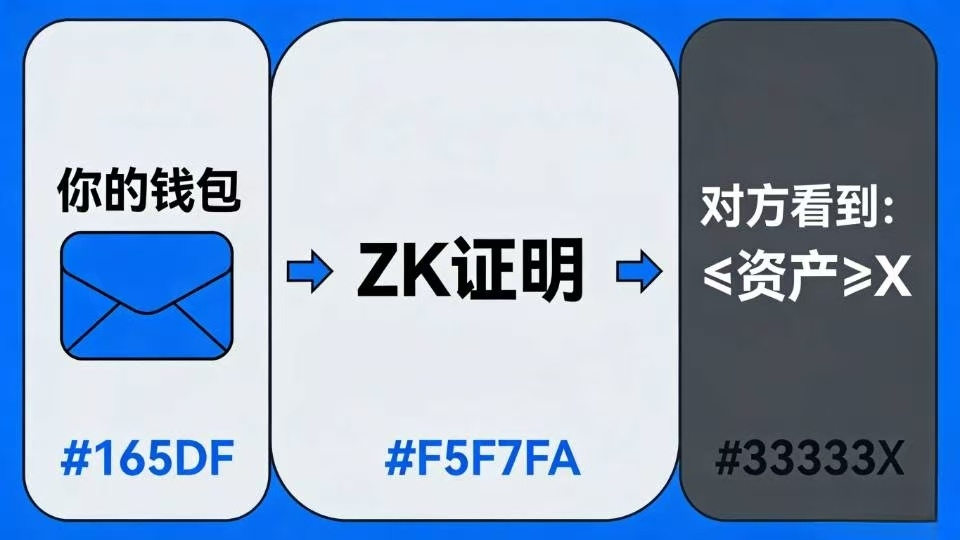
Midnight created a 'dual-state ledger,' which essentially has two layers: one is public and as transparent as a regular blockchain; the other is private, with data stored in your hands and encrypted. They are connected by zero-knowledge proofs.
What does it mean? Let me give you an example. You want to prove 'I have money' but don't want others to know how much is in your account. With this system, you can generate a proof that tells others 'my assets are greater than a certain amount,' but they won't see the specific number, transaction history, or balance.
Fahmi Syed (Chairman of the Midnight Foundation) said a very insightful thing: 'Private data should not be stored on the blockchain.' The data is yours; if others want to use it, you have to agree. The platform cannot just take it.
This is like the reverse logic of the current internet. Nowadays, you use free services, and the platform sells your data. Midnight's idea is: the data is still in your hands; you can 'open a door' for others to verify a fact when you need it, and then close it when done.
Why are large institutions starting to enter the market?
A few days ago, I saw the news that MoneyGram joined Midnight's node operation. Also, names like Worldpay, Bullish, Google Cloud, and Vodafone.
Worldpay processes $3.7 trillion in transactions annually, covering 6 million merchants. Bullish wants to do proof of reserves on Midnight — proving 'I have money to compensate you' without having to make the wallet address and transaction history completely public.
Isn't this what institutions want? Compliance, auditability, while protecting commercial secrets.
Think about it, if a bank made all transactions public on the chain, competitors would see all your assets — who would dare to go on-chain? But being completely opaque won't work for regulation either. Midnight provides this balance — using mathematical proofs to replace trust instead of gambling on the integrity of others.
I think the design of DUST is quite clever.
There's an interesting detail. Midnight uses a dual-token model: NIGHT and DUST.
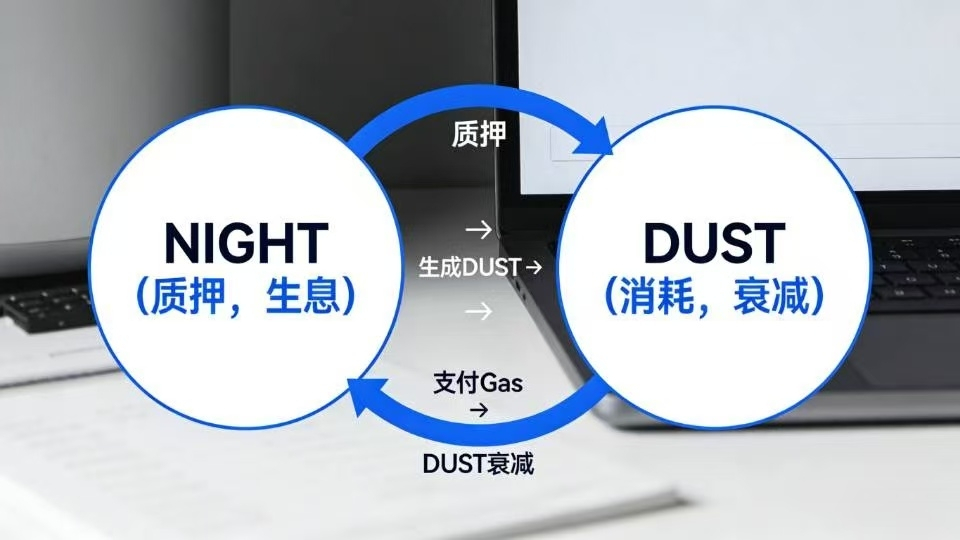
NIGHT is an investment asset, and DUST is the 'fuel' used for Gas. The key point is that DUST cannot be transferred; holding NIGHT automatically generates DUST, and unused DUST will decay within 7 days.
What problem does this design solve? Think about today's public chains: when ETH rises, Gas fees also increase, and when Gas increases, the network gets congested, leading to a poor experience. After separating NIGHT and DUST, no matter how much NIGHT rises, the cost of DUST remains stable, preventing the situation of 'when the price rises, you can't afford to use the chain.'
The CTO of the Midnight Foundation quoted: 'You bought a Samsung phone; you don’t need to use Samsung stock to pay for it, right?' — investment is investment, consumption is consumption; this logic is indeed sound.
Let me say two more things.
Returning to the initial question: privacy is not about hiding; it's about only showing it to those who need to see it. Midnight is making the idea of 'selective disclosure' a reality, turning privacy into a tool for compliance rather than an enemy of compliance.
At the end of March, the mainnet will go live. It's hard to say whether it will work out, but at least the direction is right — using cryptography instead of trust and ensuring compliance with privacy protection. I've long given up hope for the money I lost, but if in the future remittances, buying coins, and renting can be replaced by mathematical proofs instead of relying on personal integrity, it will be worth it.