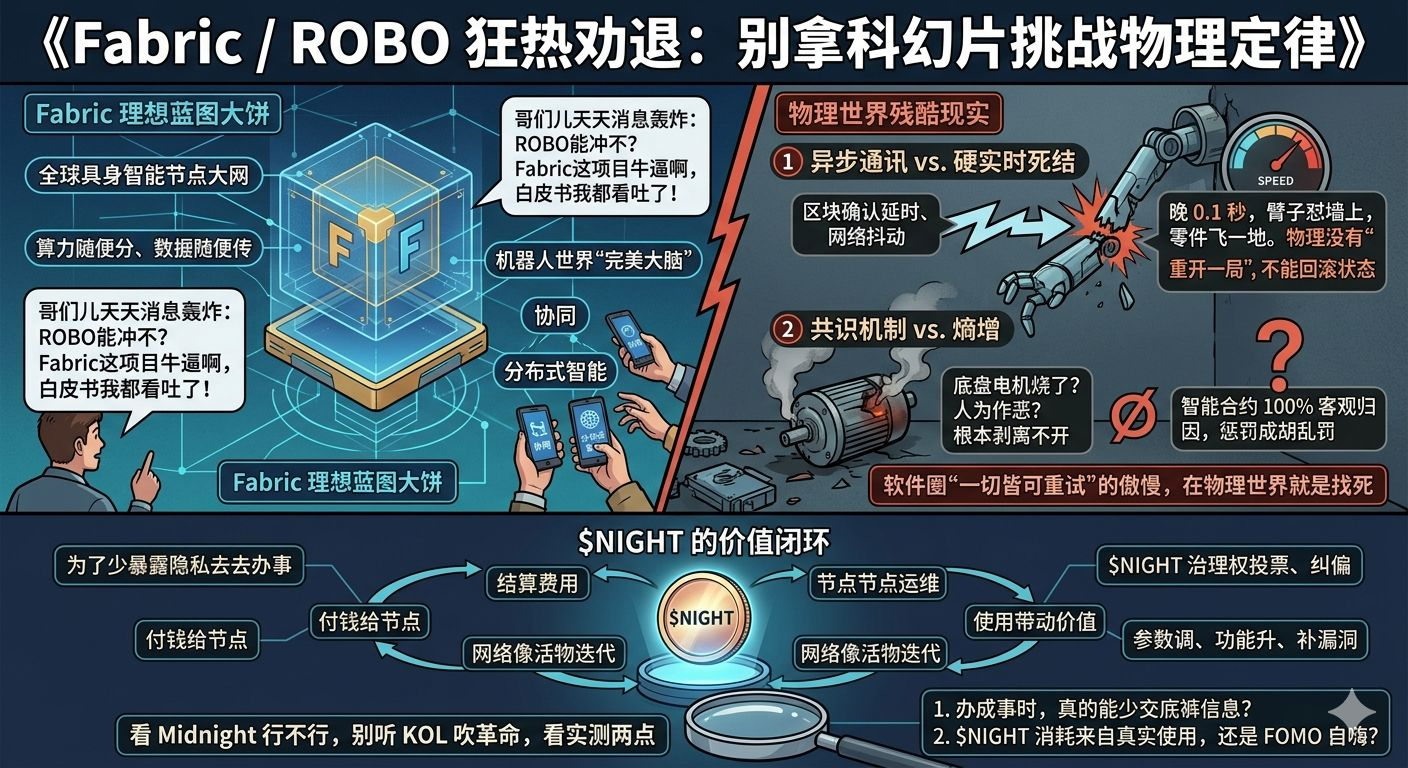
Recently, my group of buddies has started to surround me again, bombarding me with messages every day: “Bro, can ROBO make it? This Fabric project is amazing, I've even vomited from reading the white paper!” It makes my head hurt.
I have to admit a truth: when I first saw the Fabric white paper, I was indeed shocked. That engineering aesthetics is quite impressive. The vision proposed by Fabric Foundation sounds like something out of a sci-fi movie: a super modular cross-chain network, coupled with a decentralized state machine, where global embodied intelligent nodes (those moving robots) are connected into a big web through cryptographic consensus, computing power can be distributed freely, data can be transmitted freely, and value can be settled freely. Wow, in an ideal state, it is the 'perfect brain' of the robot world, so exciting. But the problem is, buddy, I'm not just a pure coder; I've really rolled around in the hardware pit for a few years. The arrogance of the software community's mantra of 'everything can be retried' is simply suicidal in the physical world. Right now, the cryptocurrency community's frenzy over Fabric and ROBO, I can only watch with cold eyes, extremely pessimistic, and absolutely refuse to touch it.
Why so pessimistic? Because physical laws don’t cater to your feelings. The thing that drives me the craziest is the deadlock between asynchronous communication and real-time hard realities. Those cryptocurrency traders shout 'collaboration' and 'distributed intelligence' every day, but do you understand that the force control feedback and real-time obstacle avoidance of robotic arms must be completed within milliseconds? Delay by 0.1 seconds, and the arm could slam directly into the wall, with parts flying everywhere. Fabric's cross-chain state synchronization relies on block confirmations. This inherently comes with network delays and asynchronous jitter. On-chain, if a transaction takes a few seconds, it can be redone; but in reality, $ROBO

If you wait for the on-chain signaling to squeeze for half a day before hitting the brakes, what awaits is a physical collision and a blur of aluminum alloy fragments. The blockchain can roll back states, but can broken decelerators and smashed sensors be rolled back? No. The physical world does not have the option of 'restarting.'
Another thing that makes me roll my eyes is using consensus mechanisms to manage the entropy increase of the physical world; it’s purely wishful thinking. The Fabric ecosystem loves to boast about its Slash mechanism, claiming it can punish nodes for wrongdoing. In pure digital DeFi, this can work — if someone acts maliciously, just slash their stake and that’s it. But applied to ROBO, it’s simply a large comedy. Imagine this: a robot fails its task. Was it because the chassis motor overheated? Or because the visual lens fogged up? Or was there some node deliberately causing trouble? How could existing smart contracts possibly provide 100% objective and controversy-free attribution on-chain? Natural hardware failures and human malice are fundamentally intertwined. If attribution is impossible, punishment becomes chaotic. The economic security assumption collapses from its roots.
So my current attitude towards ROBO can be summed up in four words: extremely cautious. This doesn't mean that the direction of Fabric is completely hopeless. In the long run, for robots to truly become 'economic entities,' on-chain identity, payment, and coordination infrastructures must indeed be developed. But at present, this narrative is far from reality. The technical debt hasn’t been paid off, the gap between physical and on-chain interfaces hasn’t been bridged, and yet you dare to rally everyone to go all in? That’s not investment; it’s a giveaway.
My buddies are still asking, 'Should we get on board?' I keep replying the same thing: let’s talk once Fabric actually resolves these underlying issues. Until then, I’d rather continue to be a spectator. The crypto world lacks nothing but stories; what it lacks is the step to turn those stories into reality. The real world is harsh; it doesn’t care how beautifully you write your white paper, nor does it care how great your K-line looks. It only recognizes physical laws, only acknowledges millisecond-level responses, and only cares if broken parts can be repaired.
So, brothers, #ROBO with this wave of excitement, pursue it however you like. I’ll put on my safety helmet and eat melons on the sidelines. When the day comes that it can really allow robots to live on-chain like humans, I’ll consider whether to take out my pocket money to play.