

I saw a teacher say that high-end talent in the cryptocurrency circle is leaving.
Based on my personal experience, it may or may not be true.
When we discuss high-end talent, we first need to define what high-end talent means.
Stanford, Ivy League, Tsinghua, Peking University, and top programs at National University of Singapore are considered high-end talent. Or is it just about getting those diplomas?
AI requires high-end talent with cutting-edge academic research results and supporting skills to work in the industry. The same goes for commercial space (like SpaceX or Rocket Labs), so those directly related to these cutting-edge research capabilities are the must-have 'high-end talent'.
As for those not in these fields, I believe that even if you are from these schools, you would still not be relevant. If you switch to another person to do it, it wouldn’t be too far off, fully unnecessary conditions.
But what is the situation in the cryptocurrency sector? There isn’t much that belongs to 'rocket science' (maybe some cryptography?), it belongs to a broad financial industry, finance is a game played by people, and the high-end talents in this industry are required to 'understand human nature', to grasp human nature, and to develop systems and products that exploit human nature; payment, stablecoins, RWA, if you insist on not considering these as part of the cryptocurrency sector, the requirements are still the same.
So if you are in the 'high-end' category in terms of education, but you are not in the cutting-edge of AI and industry-academia-research, then I’m sorry, I would prefer someone who has been in sales for ten years or even been a dealer for ten years; nothing else matters, just human connections.
As for the employment population in the cryptocurrency sector:
This overlooks a large number of employment populations in the cryptocurrency sector that cannot be discovered on Twitter.
Let's not talk about the present, let's talk about 2019. Can a bear market last longer than 2019? Other than Binance's ICO, there hasn't even been a decent narrative (which is not the same as the current lack of narrative heat).
And not to mention Europe and America, let's talk directly about Asia.
First, there are various small wallet/cloud exchange development companies that specialize in undertaking various funding projects encapsulated into mall and online earning APPs, but in essence, they are all variations of crypto wallets.
A small team of 5-8 people in Shenzhen, Hangzhou, Chengdu, there are at least thousands of such teams, not to mention the main outsourcing destinations like Hanoi, Ho Chi Minh City, and India. These teams are still thriving to this day.
Next is related to mining machines, which the old cryptocurrency sector understands well.
Then there are various ground promotion/BD/exchanges, these people basically need to accept rotations doing several projects in a year, but the number is enormous. A small project requires at least 4 or 5 people, and these are not only required to take the points but also need to pay upfront.
For larger projects, small team leaders or region-level service center operators need to subsidize, basically at least ten people or more.
The least known but most numerous are the channel businesses, which involve various paths of currency exchange. The exact number of practitioners cannot be verified, but let me put it this way: the hotels in the Luohu Port area (like Sunshine Hotel, Baijin) are full of various people engaged in channel work all year round, as well as some countries.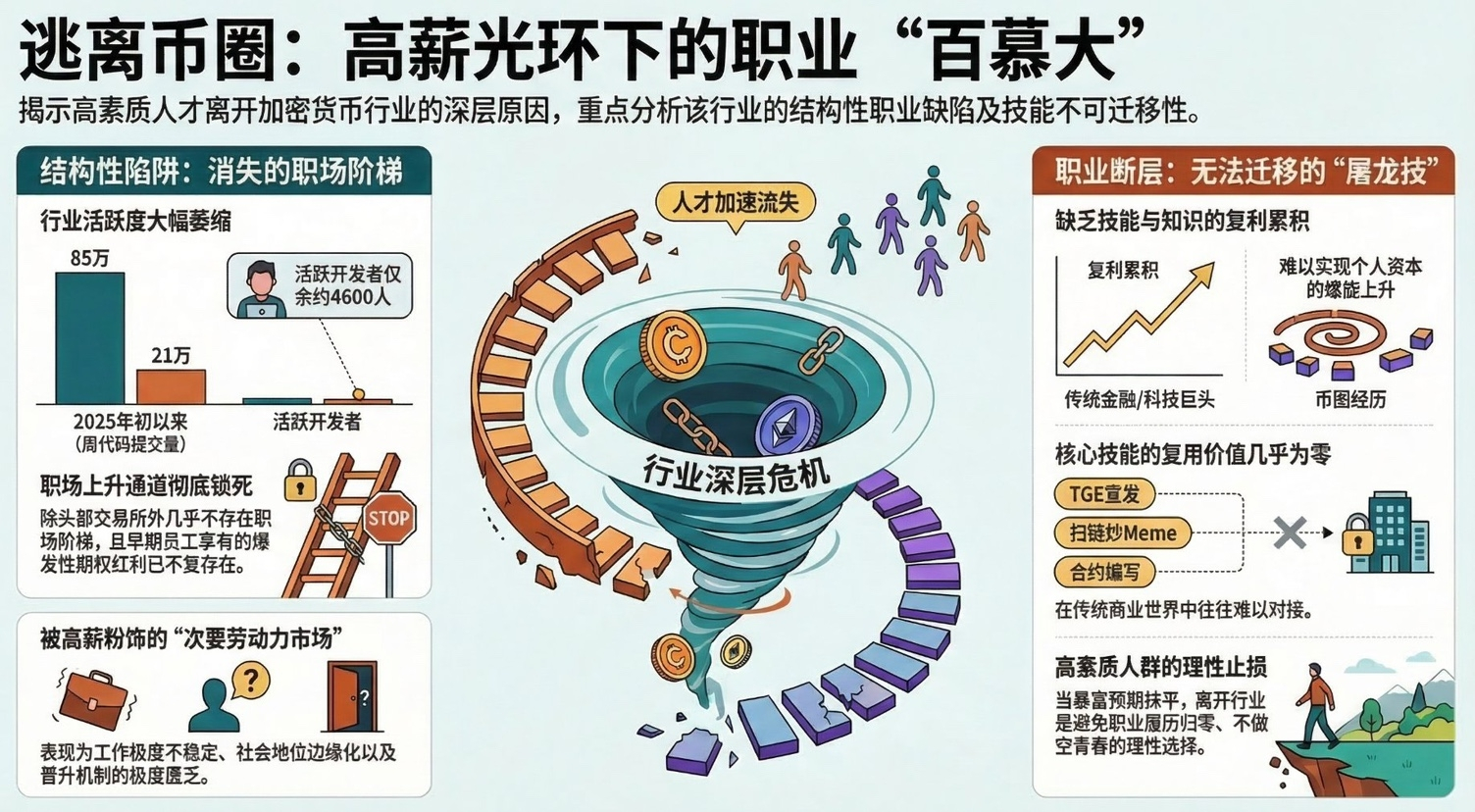 Violent agencies come out to scam extra money and are fully booked.
This does not include some peripheral fields, such as media, communities, and conferences.
So I say, there are only those who have been eliminated by the cryptocurrency sector, and no one truly leaves it, just like the gambling industry over the centuries.
Because the cryptocurrency sector is driven by human nature rather than technology; people can actively give up certain technologies and models, but cannot give up their own humanity.
Industries driven by technology have strong explosive power, while those driven by human nature possess strong vitality.