


Many people, upon hearing ZK (zero-knowledge proof), immediately think: hide everything, the more anonymous the better. But Midnight does not take this path; it is more like doing something 'down to earth'—making privacy something you can adjust yourself.
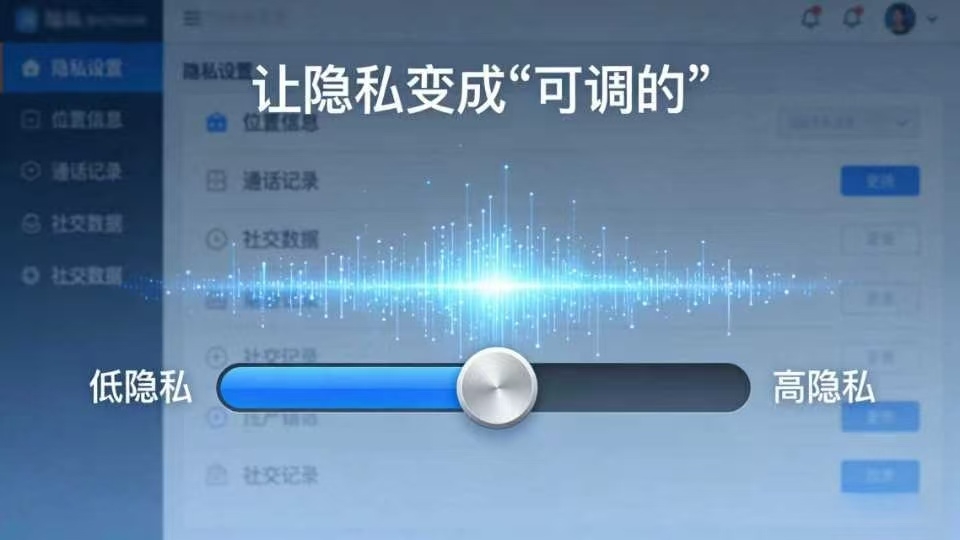
What does it mean? You can think of Midnight as a 'blockchain with a privacy switch.' Previous chains were either completely transparent, where everything could be seen, or completely hidden, where nothing could be seen. Midnight offers you a middle option: you can decide for yourself which information to hide and which information can be shared with others when needed.
For example, if you are doing on-chain lending. Normally, others can either see all your assets or see nothing. But on Midnight, you can simply prove one thing: 'I have enough collateral,' but you don't need to disclose how much or where it is. If regulation or auditing requires it, you can choose to display the relevant information.
This is what it means by 'controllable privacy.' It's not a one-size-fits-all approach; it's like adjusting the volume, you can set it to whatever level you want.
This way of playing is actually very friendly to many real-world scenarios. For example, RWA (real-world assets on-chain), institutions doing DeFi, even medical data, identity systems; these things cannot be completely public, but they also cannot be completely black box. Midnight just happens to be in the middle—protecting privacy while being able to 'clarify' when needed.
Of course, this design is not without cost. For example, proving it is generated by your own device; if the phone is not very good, it may lag a bit. Additionally, development becomes more complex and is not as intuitive as ordinary smart contracts; a small mistake could lead to problematic logic.
Moreover, the biggest problem right now is actually not technology, but that the ecosystem has not yet developed. There isn't an application that makes people feel they 'must use' it as soon as it comes out, so many things are still in the realm of imagination.
But from a broader perspective, this model is quite interesting. Because future regulation will only become stricter—complete transparency is unrealistic, and complete anonymity is also hard to maintain in the long term. Therefore, a solution that allows 'what should be hidden to be hidden, and what can be said to be said' has a better chance of surviving.
So Midnight is essentially not pursuing the ultimate privacy, but rather addressing a more realistic question: how can privacy truly be utilized?
When many people hear ZK (zero-knowledge proof), their first reaction is to hide everything, the more anonymous the better. But Midnight is not going down that path; it is more like doing something 'down to earth'—making privacy something that can be adjusted by oneself.
What does it mean? You can understand Midnight as a 'blockchain with a privacy switch.' Previous chains were either completely transparent, where everything could be seen, or completely hidden, where nothing could be seen. Midnight gives you a middle option: you can decide for yourself which information to hide and which information to share with others when needed.
For example, if you are doing on-chain lending. Normally, others can either see all your assets or see nothing. But on Midnight, you can simply prove one thing: 'I have enough collateral,' but you don't need to disclose how much or where it is. If regulation or auditing requires it, you can choose to display the relevant information.
This is what it means by 'controllable privacy.' It's not a one-size-fits-all approach; it's like adjusting the volume, you can set it to whatever level you want.
This way of playing is actually very friendly to many real-world scenarios. For example, RWA (real-world assets on-chain), institutions doing DeFi, even medical data, identity systems; these things cannot be completely public, but they also cannot be completely black box. Midnight just happens to be in the middle—protecting privacy while being able to 'clarify' when needed.
Of course, this design is not without cost. For example, proving it is generated by your own device; if the phone is not very good, it may lag a bit. Additionally, development becomes more complex and is not as intuitive as ordinary smart contracts; a small mistake could lead to problematic logic.
Moreover, the biggest problem right now is actually not technology, but that the ecosystem has not yet developed. There isn't an application that makes people feel they 'must use' it as soon as it comes out, so many things are still in the realm of imagination.
But from a broader perspective, this model is quite interesting. Because future regulation will only become stricter—complete transparency is unrealistic, and complete anonymity is also hard to maintain in the long term. Therefore, a solution that allows 'what should be hidden to be hidden, and what can be said to be said' has a better chance of surviving.
So Midnight is essentially not pursuing the ultimate privacy, but rather addressing a more realistic question: how can privacy truly be utilized?