


Article source: Foresight News
Written by: ChandlerZ, Foresight News
On March 16, OpenSea co-founder and CEO Devin Finzer tweeted that the OpenSea Foundation has decided to postpone the SEA token issuance event originally scheduled for March 30. In October 2025, Finzer first announced that SEA would be launched in Q1 2026, and now Q1 is about to end with the new timeline still undetermined.
Finzer attributed the delay to the current harsh environment of the crypto market and emphasized that "SEA is only launched once," stating that the foundation chooses to wait until everything is ready rather than rush to meet the original date.
Refund or retain rewards, users must choose one
For users who participated in the Wave 3 to Wave 6 reward activities after the Q1 schedule was announced, OpenSea has proposed a set of optional compensation plans.
The core logic is a refund in exchange for treasure rewards, where users can apply for a refund of the transaction fees charged by the platform during these rounds of activities. However, if a refund is chosen, the corresponding treasure rewards from that wave will be removed from the account. If users choose not to refund, the treasure rights already held will remain unchanged, and the foundation promises to take these rights into serious consideration at the TGE, with this part of the rights independent of the historical activity distribution quotas.
This design responds to the community's dissatisfaction with the reward mechanism. Previously, Wave 1 distributed a prize pool of $12.2 million, including NFTs and tokens, but community feedback shows that obtaining higher-tier treasure chests requires extremely high trading volume, and the reward distribution is highly random, criticized as indirectly encouraging wash trading. OpenSea had therefore suspended the new XP reward system.
60 days of zero fees and product roadmap
In addition to the refund plan, OpenSea announced the implementation of a 60-day zero-fee policy starting March 31. The zero-fee period covers the platform's own token trading fees, and a new fee structure will be launched after the expiration, with Finzer stating that the rates will be more competitive for high-frequency trading users.
On the product side, the event originally scheduled for March 30 has been canceled, but the team will hold another event focused on product updates in the coming months. OpenSea's OS2 platform officially exited Beta in May 2025 and currently supports cross-chain token trading on 22 chains. The mobile application has entered a closed testing phase, with an AI trading assistance tool named OpenSea Intelligence built in. The perpetual contract trading feature is also on the roadmap.
The NFT industry has come to a standstill, and OpenSea chooses to wait again
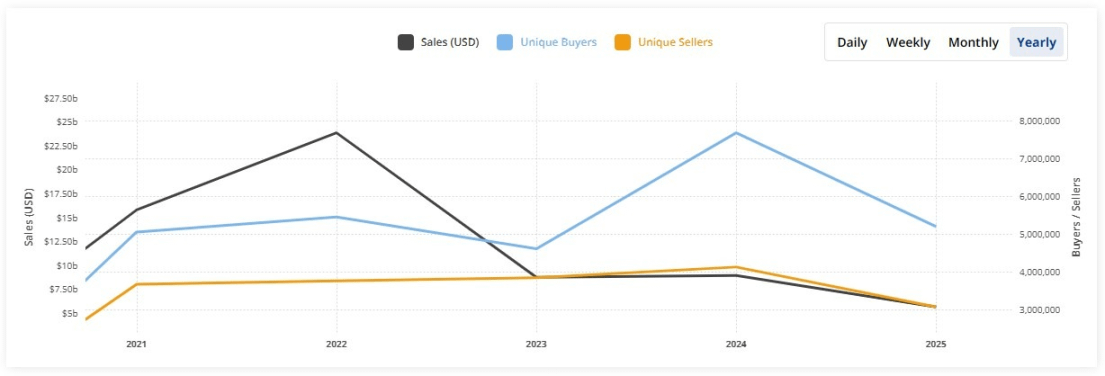
Behind the delay in token issuance is a shrinking industry environment. Data from CryptoSlam shows that NFT sales for the entire year of 2025 will be $5.63 billion, down 37% from $8.9 billion in 2024. Meanwhile, the supply side has expanded to 1.34 billion units, dropping from $124 to $96. By the end of 2025, the total market value of NFTs is expected to be about $2.4 billion.
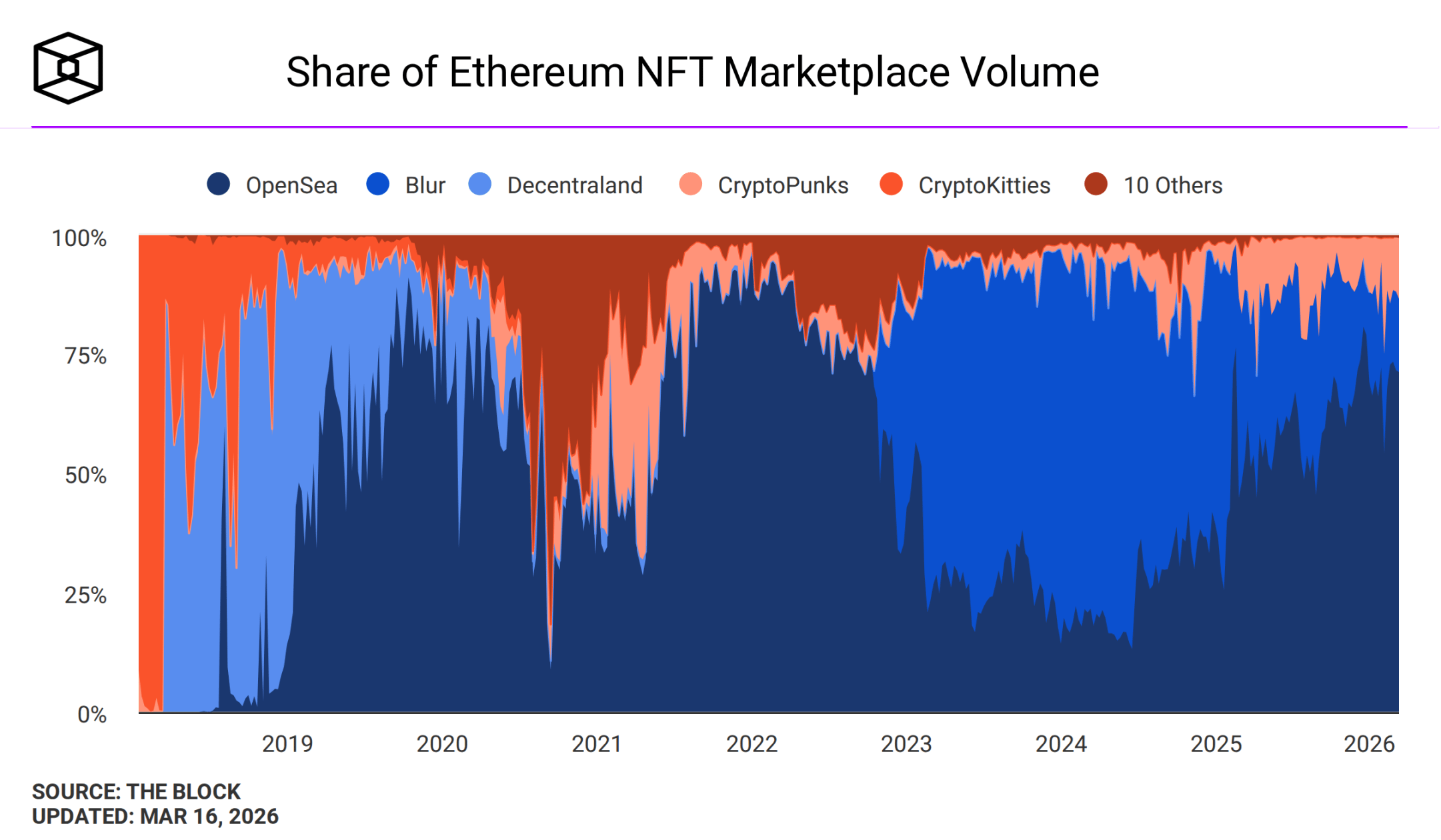
In this context, OpenSea's market share has actually increased, but the underlying numbers are no longer driven by NFTs. According to data from The Block, OpenSea currently holds about 71% of the Ethereum NFT trading market share. After the announcement of the SEA token, the market share has continued to rise, but out of the $2.6 billion monthly trading volume in October 2025, over 90% came from token trading, while NFT trading volume remains weak.
In May 2025, after OS2 exited the Beta version, OpenSea's monthly active users rose to 467,000, the highest since 2023, but as the entire market cooled down, the trading enthusiasm in the NFT market has significantly diminished.
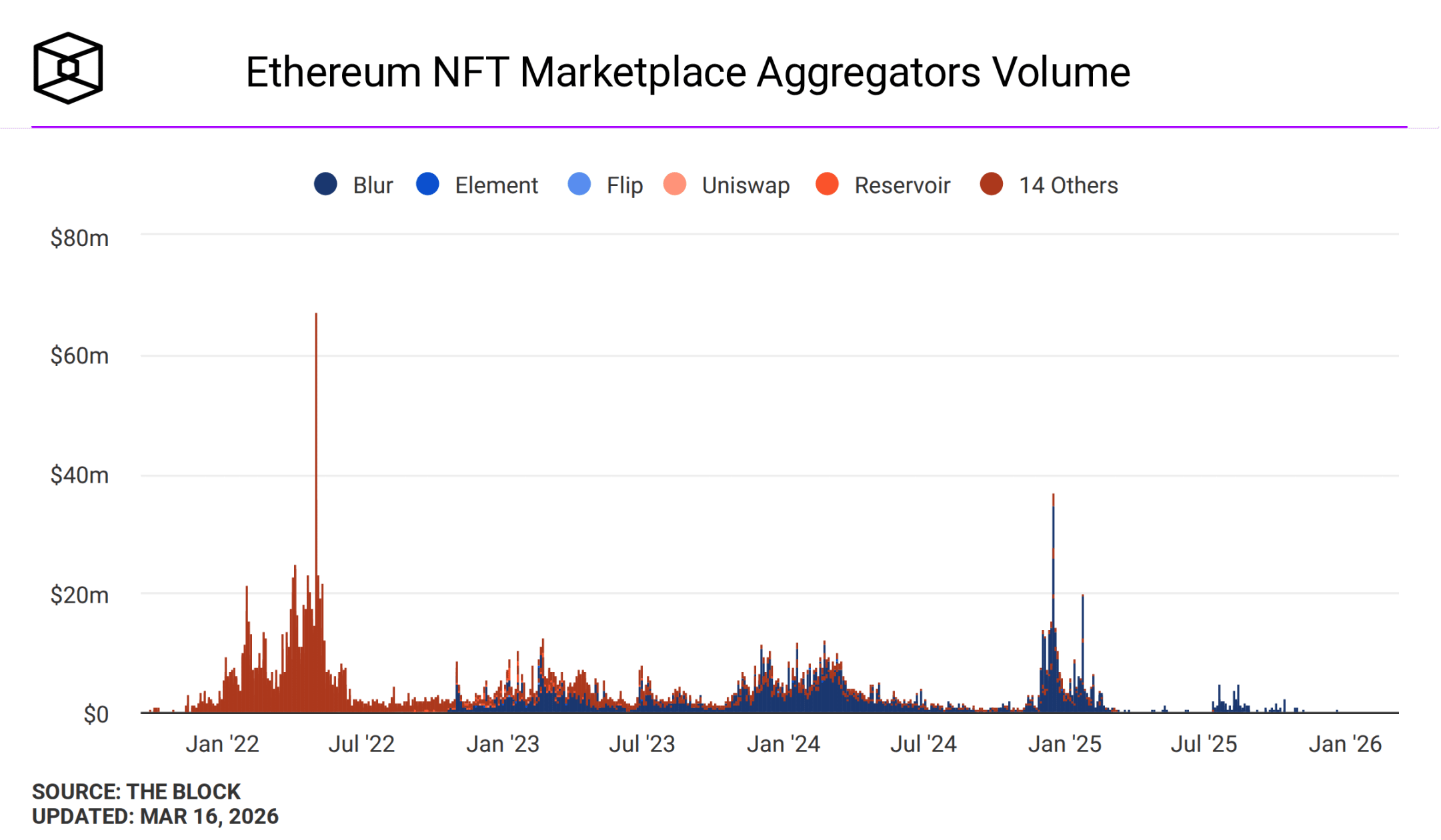
This also explains why OpenSea is eager to transform. Perpetual contracts, cross-chain token trading, and mobile applications are all seeking new traffic sources beyond NFTs. The SEA token was originally the climax of this transformation narrative, but its delay has left the momentum of the transformation in limbo.
50% of the token supply is promised to be allocated to the community, and after the launch, 50% of platform revenue will be used to buy back SEA, allowing users to stake SEA to support specific collectibles or token projects. This token economic model, when announced in October 2025, had driven a surge in trading volume, but its current delay might consume the community expectations built at that time.
Finzer mentioned at the end of the tweet that the last announcement timing was 'too early', creating unnecessary uncertainty. He promised that the next time the foundation sets a new timeline, it will be 'thoughtful and very specific'. Before that, how much confidence the community has in SEA may depend on whether the 60 days of zero fees can bring substantial user retention growth.