In the world of investment, there is a cruel mathematical formula that everyone entering should memorize:
Buying ETH at 10000, if it drops by 10%, it needs to rise by 11% to break even; if it drops by 30%, it needs to rise by 43% to break even; if it drops by 50%, it needs to rise by 100% to break even. Conversely, if it rises by 10%, it only needs to drop by 9% to return to the starting point, while a rise of 100% only requires a drop of 50% to lose all gains.
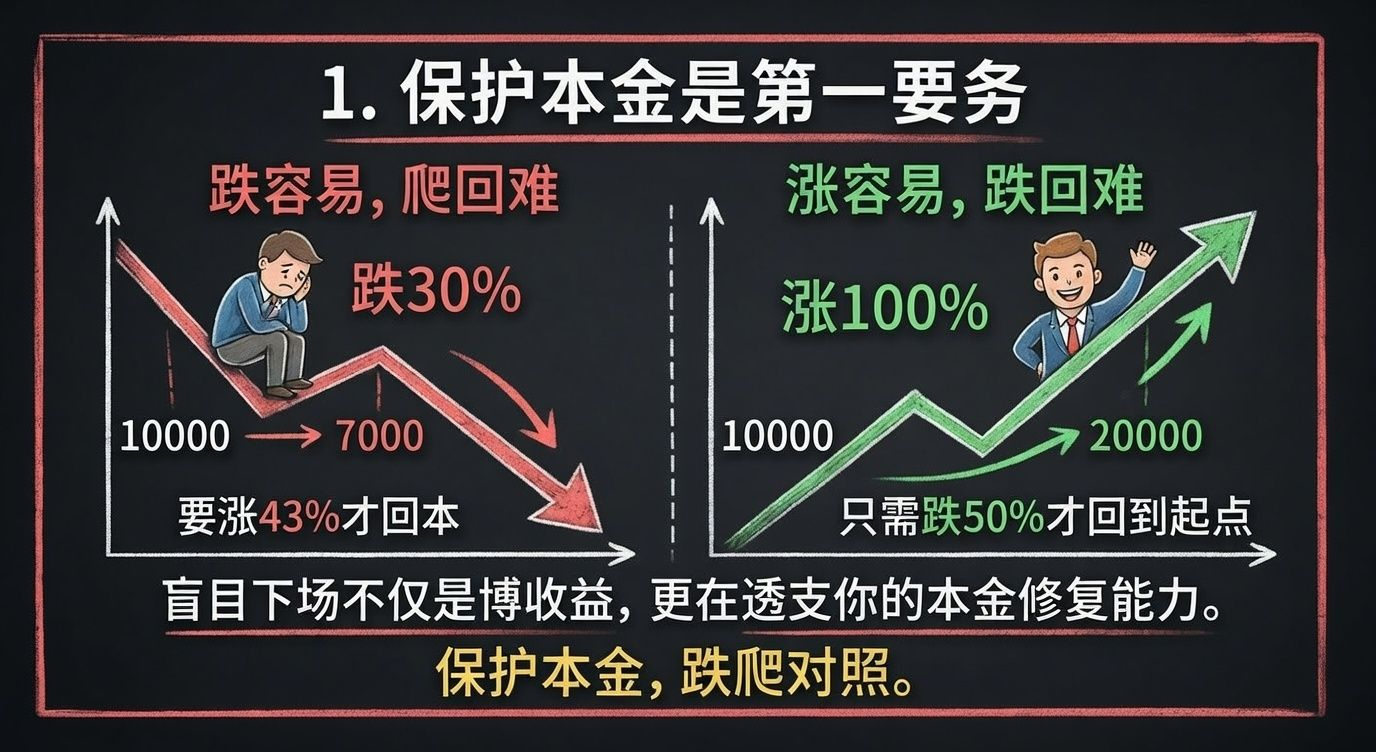
Protecting the principal is the primary responsibility of investment, because it is easy to fall but difficult to climb back. This mathematical asymmetry tells us that when you cannot see the underlying logic of a project, blindly entering is not only about betting on profits but also about overextending your ability to recover your principal.
With this clarity, let's take another look at the recent hot topic of $ROBO .
A 20 million financing AI project, why does it remind me of the internet bubble 20 years ago?
Last night while scrolling Twitter, I saw ROBO dropped again. I remembered those friends who went all in in early March, and now they're playing dead. To be honest, I almost jumped in too. After all, with Pantera Capital and Cb Ventures leading a 20 million investment for Binance's rapid launch, that configuration is quite luxurious, right? The AI + robot concept sounds like the ticket to the next era.
But if you calculate the 'break-even formula' from earlier, you'll find that from the ATH (all-time high) of 0.06 to now 0.04, a drop of 34% means that someone entering now will need a rise of over 50% to break even.
77.7% of the tokens are still locked; what do you think they are waiting for?
I looked at the token distribution of ROBO and laughed. Investors got 24.3%, the team and advisors 20%, and the foundation reserve 18%. That adds up to over 60%, all with a 12-month cliff + 36 months of linear unlocking.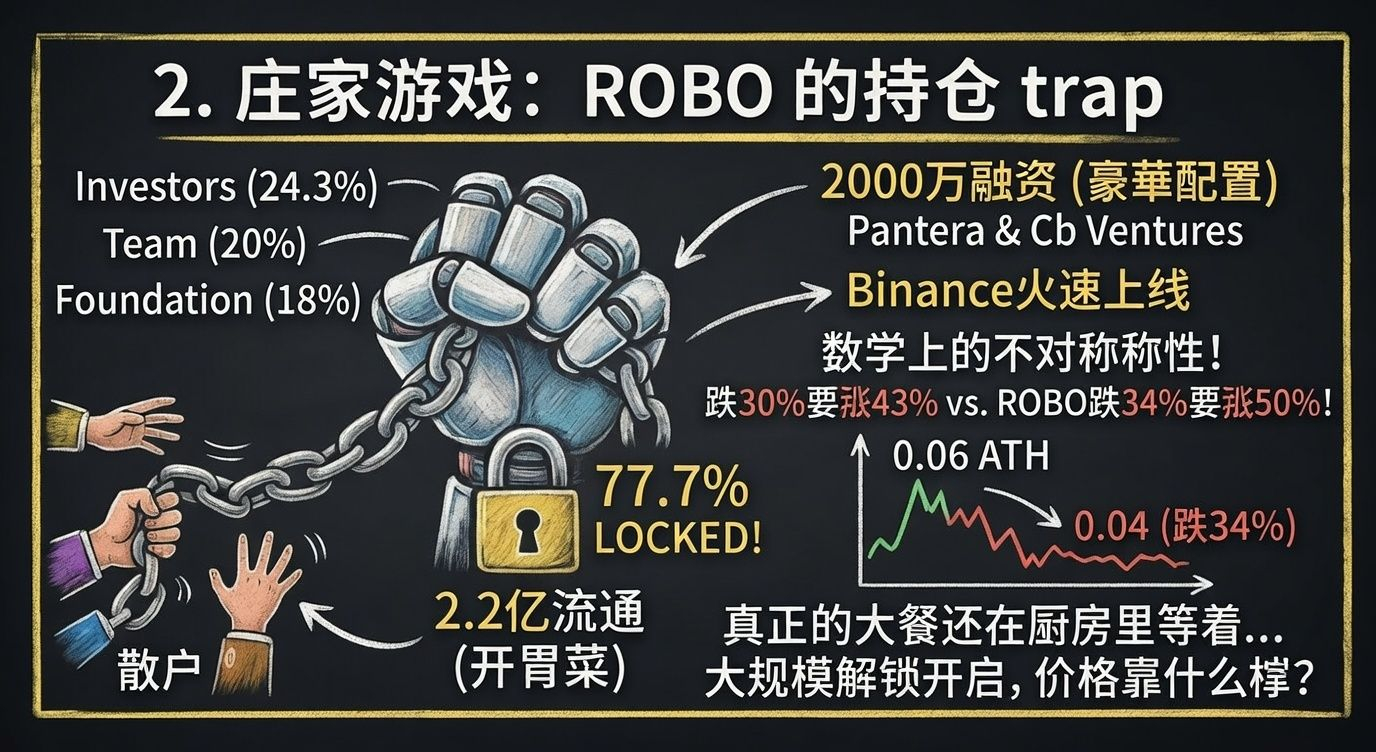
In other words, the 220 million tokens circulating in the market now are just the appetizers. The real feast is still waiting in the kitchen. It's like a restaurant where there’s a long line outside, but the kitchen has prepared ten times the dishes. When large-scale unlocking begins, do you think the price can be supported by that nebulous 'robot economy'?
What's more interesting is that 20% of the protocol's revenue will be used to buy back ROBO. The question arises, what protocol revenue is there now? The robot economy is still in the PPT stage; where does the buyback come from?
Robots going on-chain to make money sounds beautiful, but what’s the reality?
The vision of Fabric Protocol is indeed appealing: to give robots on-chain identities and enable autonomous trading, forming a 'robot economy'.
It sounds like a cryptographic version of (me, robot).
But the problem is that even the most basic infrastructure hasn't been set up yet. The white paper states that the core components will be deployed in Q1, and the incentive mechanisms will only start in Q2.
What we are buying now is essentially a token for an infrastructure that hasn't started operations yet.
Just like buying a stock of a website back in 2000 that claimed to disrupt retail, only to find out they hadn't even finished the shopping cart feature.
What makes me most uneasy is this timing.
On March 12th, Fabric just announced a collaboration with Virtuals Protocol. Virtuals has over 18,000 AI agents and more than 400M on-chain transaction volume, which sounds impressive.
But have you noticed that such 'strong alliances' announcements often appear when token prices need to be boosted?
From ATH's 0.06 down to now 0.04, a drop of 34%. Just right for some good news to stabilize the morale.
Moreover, Virtuals is set to launch the 'Robotics Track' in Base Batches 03, isn't the timing just too coincidental?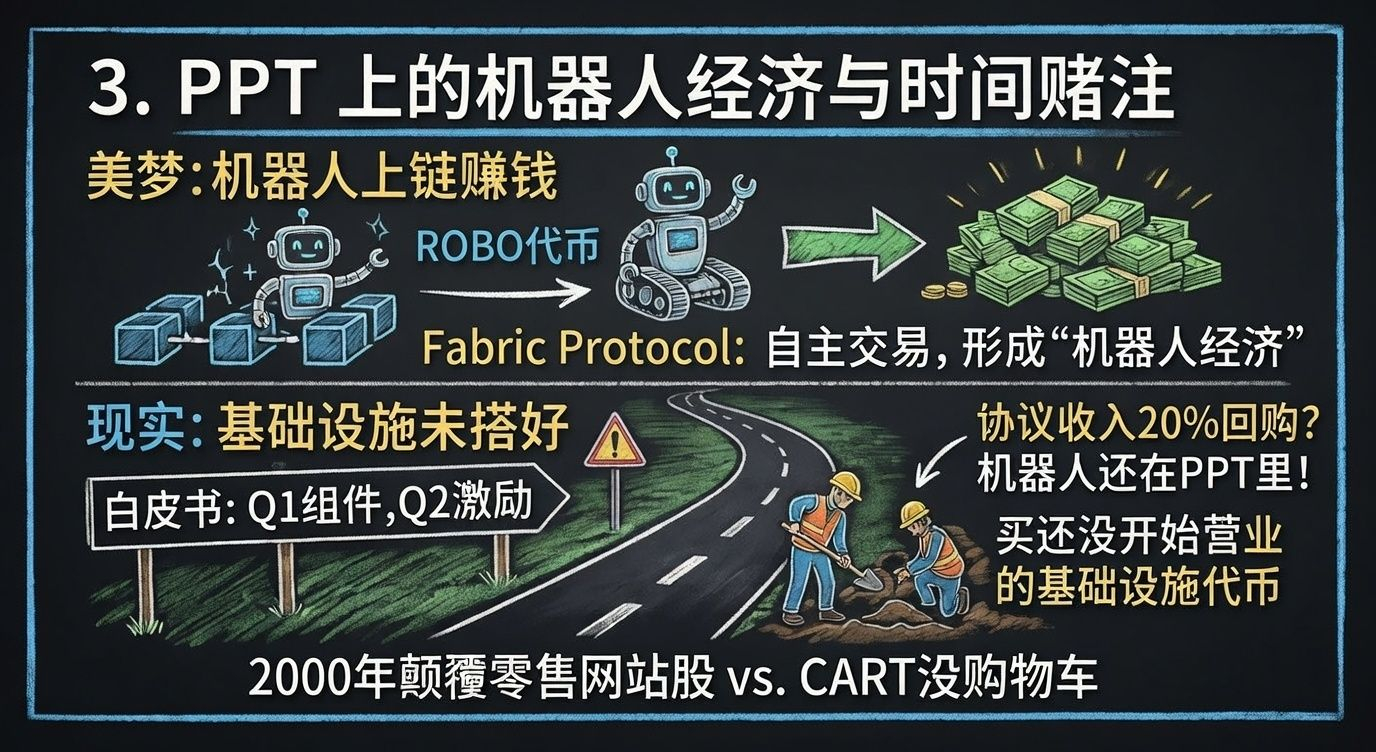
I'm not being pessimistic, but I'm pondering a question.
AI is indeed the future, and robots will indeed change the world. But is that really the same thing as the value of the ROBO token?
Just as the internet really changed the world back in the day, 99% of internet companies have died.
Fabric Foundation claims to be a non-profit organization, aiming to benefit all of humanity with smart machines. This sounds great, but where do the interests of token holders rank in this grand narrative?
What really makes me alert is this familiar smell.
Luxurious investment firms, grand technological visions, complex token economics, and that classic line, 'We are building the future'.
Isn't this just a repeat of the DeFi Summer of 2021?
At that time, many projects claimed they would reconstruct finance, and what happened? Most became speculative tools, with real innovations being few and far between.
Now it's changed to AI + robots, but the script remains the same.
But I’m not completely pessimistic.
To be honest, if Fabric can actually deliver, it would indeed be disruptive. Allowing robots to trade autonomously and form an economic closed loop presents a huge imaginative space.
Moreover, 20 million in financing is not a small sum; Pantera and Coinbase are not just random investors. They must have seen something we haven't.
The key is the time window.
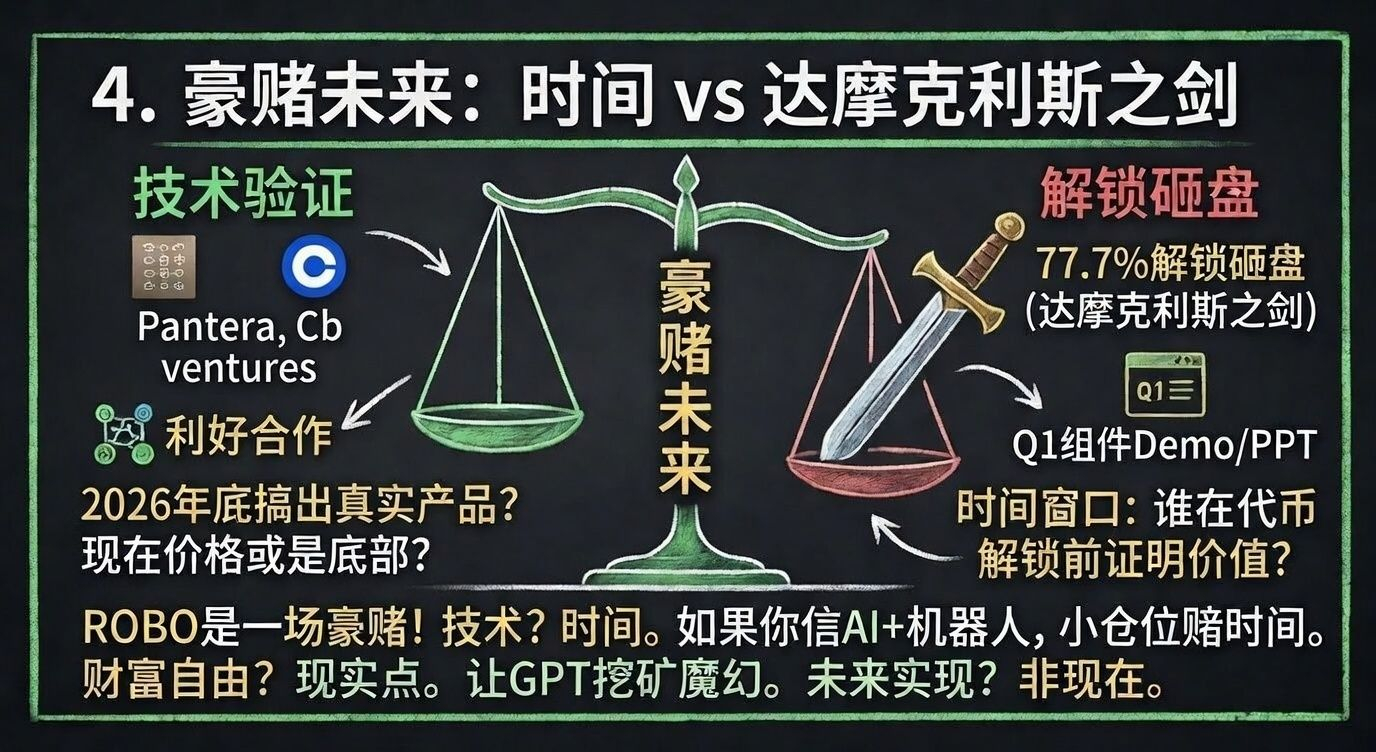
If they can produce a truly usable product by the end of 2026 and prove that the robot economy is not a castle in the air, then the current price might indeed be the bottom.
But if by then it's still just a demo and a PPT, then the 77.7% unlock will be the sword of Damocles hanging over our heads.
My conclusion is very simple.
ROBO is now just a gamble.
What we are betting on is not the technology, but time.
Betting that Fabric can prove its value before token unlock occurs on a large scale.
If you believe AI + robots are the next big trend and are willing to take high risks, you can try a small position.
But if you expect ROBO to grant you financial freedom, I suggest you return to reality.
After all, getting robots to make money on-chain sounds just as magical as having GPT mine.
Maybe the future will really come to fruition, but it’s definitely not now.