


What is USDT (Tether)? How is it pegged to the US dollar?
USDT (Tether) is a cryptocurrency stablecoin pegged to the US dollar, issued by Tether Limited since 2014. Initially based on the Bitcoin blockchain's Omni protocol, it now supports multiple mainstream chains such as Ethereum, Tron, and Solana. For each USDT issued, it is theoretically backed by a reserve equivalent to one US dollar.
Tether claims that its reserve assets include cash, short-term US Treasury bonds, and other liquid assets, which are regularly audited by third parties (such as BDO) to publish reserve reports. This model of 'asset-backed + on-chain issuance' has made USDT the largest stablecoin by market capitalization, accounting for over sixty percent of the global stablecoin market (as of 2024).
Although large institutions can directly exchange or redeem USDT from Tether at a 1:1 rate, ordinary retail investors often purchase USDT through exchanges or over-the-counter channels at a price slightly higher than the dollar.
Overview of USDT characteristics
Value stability: Pegged to the USD, helping to combat cryptocurrency market volatility
Multi-chain deployment: Currently supports ETH, TRX, SOL, and other blockchains
Wide application: Commonly used in trading mediums, DeFi collateral, and cross-border payments
Is USDT legal?
USDT is not explicitly banned in most countries, and its legal status varies by region. According to the trends in cryptocurrency regulation for 2024, the following are the attitudes and regulatory statuses of major jurisdictions towards USDT:
Taiwan: Legal but must trade through compliant platforms
In Taiwan, USDT (Tether) is legal and can be transferred on the blockchain and traded on compliant cryptocurrency exchanges. According to Taiwan's legal regulations, USDT is considered a virtual asset and is subject to relevant financial regulations.
Virtual asset positioning: Taiwan's central bank and the Financial Supervisory Commission (FSC) recognize cryptocurrency as a type of 'virtual asset'; therefore, holding and trading USDT is not illegal as long as relevant legal regulations are followed.
Compliance service providers: In Taiwan, only companies registered with the FSC can legally provide USDT trading services, including trading platforms, exchanges, transfers, custodians, and underwriters, collectively referred to as 'virtual asset service providers,' with the most common being exchanges and cryptocurrency dealers. These service providers must comply with anti-money laundering laws and other relevant regulations.
Illegal risks: Although USDT itself is legal, due to its nature, criminals often use USDT to conduct illegal activities. Therefore, investors should remain vigilant when using USDT, choose compliant trading platforms, and avoid trading with unknown sources.
United States: Legal but facing regulatory challenges
The United States allows the circulation and trading of USDT and requires platforms to comply with KYC/AML standards set by FinCEN. Tether was fined a total of $41.5 million by the New York Attorney General (NYAG) and the CFTC in 2021 due to insufficient transparency of reserve assets. Tether subsequently promised to regularly publish audit reports verified by the accounting firm BDO.
China: Legal risks exist in trading.
The Chinese government has comprehensively banned ICOs and shut down virtual currency trading platforms since 2017. Although there is no explicit ban on holding USDT, all financial activities related to it (such as cross-border transfers and over-the-counter trading) may be considered illegal financial activities and are restricted by regulations such as the Anti-Telecom Fraud Law.
Hong Kong: Legal use under regulation
The Hong Kong Securities and Futures Commission (SFC) allows compliant platforms to provide stablecoin trading services, including USDT. After the implementation of the Virtual Asset Trading Platform Regulatory Ordinance (2023), all platforms must obtain SFC licensing and comply with AML/KYC requirements. Investors can buy and sell USDT through legally licensed exchanges.
USDT fraud? Analysis of common USDT fraud methods
Although USDT (Tether) itself is not a scam, it is issued by Tether Limited and is currently the largest USD stablecoin by market capitalization. However, due to its characteristics of 'value stability, global transferability, and high anonymity,' it often becomes the designated payment tool for fraud groups.
According to recent investigations by the Taiwan National Police Agency and the Criminal Investigation Bureau, cases of fraud involving USDT have continued to increase, with common methods as follows:
Investment fraud
Fraudsters impersonate cryptocurrency experts through LINE, Telegram, and other social media, persuading victims to exchange TWD for USDT and transfer it for investment. After the funds are sent, the other party loses contact. Such cases often involve overseas virtual asset platforms and are difficult to recover.
Romantic fraud
Using dating software to establish emotional relationships and then inducing the other party to purchase USDT investments, actually transferring their funds to a fraudulent platform. This type has been classified by the Criminal Investigation Bureau as a high-risk type of fraud case in 2023.
Fake USDT fraud
Some claim to hold a large amount of USDT and are willing to sell it at a low price, but the actual tokens provided may be counterfeit USDT 'homemade tokens,' with the same contract address and image but not issued by Tether. The contract address can be verified through Etherscan.
Fake trading platforms/phishing websites
Fraudsters impersonate legal trading platforms like Binance and Max Exchange, luring users to input their account information or directly deposit USDT, ultimately leading to account theft or fund transfers.
Why do fraud groups prefer USDT?
Compared to traditional bank transactions, USDT transfers on the blockchain are almost instantaneous, cross-border, do not require financial institution review, and most transactions are not real-name, making it difficult to trace the flow of funds and recover them.
What to do if you encounter a USDT scam? 3-step handling and prevention guide
If you suspect you are encountering a USDT (Tether) scam, you must stop trading immediately and preserve all evidence. Initiating a report and freezing process as soon as possible can significantly improve the chances of recovery. The following are specific response steps:
Step 1: Immediately stop losses and collect evidence
Stop trading and depositing: Cease all transfers related to the scam to avoid further losses.
Preserve cash flow and conversation records:
Including wallet address, transfer amount, TxHash (transaction ID)
Conversation records with fraudsters (LINE, Telegram, Email, social accounts)
Use on-chain tools to track funds: Use block explorers such as Etherscan or Tronscan to check fund flows and counterpart addresses.
Step 2: Report and contact relevant platforms
Report to the police: Provide complete evidence to the Taiwan police (165 Anti-Fraud Hotline), or you can go to the police station to report.
Contact the exchange: If funds have entered an exchange (such as Binance, Max, Okx), please provide TxHash to request assistance in freezing suspicious accounts.
Legal consultation: It is recommended to cooperate with a lawyer for civil and criminal proceedings to seek civil compensation and criminal liability.
Step 3: Establish risk awareness and avoid repeated victimization
Refuse requests from unknown individuals for transfers: Do not easily trust online friends, romantic partners, or unknown investors asking to transfer USDT.
Verify the legality of the platform: Transactions should only be limited to compliant exchanges such as Binance, OKX, Max.
What is the difference between USDT and USDC?
USDT (Tether) and USDC are two major stablecoins that maintain a 1:1 value ratio with the USD, but there are slight differences in the following aspects.
Issuing institution and compliance
USDT is issued by Tether Limited, established in 2014. Although USDT has a high market capitalization and liquidity in the market, its transparency and compliance have been questioned, especially regarding asset reserve audits.
USDC is issued by the Centre Alliance, co-founded by Circle and Coinbase, launched in 2018. USDC emphasizes transparency and compliance, conducts regular asset audits, and adheres to U.S. money transmission laws, which has established a high level of trust among users and regulators.
Transparency and asset reserves
The asset reserves of USDT are more complex and have been criticized for insufficient transparency. Although Tether has begun to improve its transparency, it still faces questions about the integrity of its asset reserves.
USDC provides monthly disclosures of its asset reserves, outperforming USDT in terms of transparency. The asset reserves of USDC are mainly stored in regulated financial institutions, further enhancing the security of USDC.
Market acceptance and liquidity
USDT is one of the earliest stablecoins in the market, with a higher market share and trading volume, making USDT more common in exchanges and the cryptocurrency ecosystem. Many traders choose USDT for trading due to its higher liquidity.
Although USDC has a lower market share, its trading volume in the U.S. market is relatively high and is growing rapidly in international markets. For long-term holders who value compliance and transparency, USDC may be a safer choice.
Is USDT safe? What are the risks of buying USDT?
Although USDT (Tether) is designed as a stablecoin and theoretically should maintain a 1:1 peg to the USD, there are still several potential risks in practical operations and market dynamics. The following are three categories of safety concerns that should be particularly noted when investing in or holding USDT:
Insufficient reserve transparency
As mentioned earlier, USDT is a stablecoin issued by Tether, and there are still market participants questioning whether its reserves contain a large amount of commercial paper and non-high liquidity assets. If users redeem a large amount of USDT, whether Tether has enough USD reserves to deal with a run is still a significant variable.
Regulatory risk
The regulatory landscape for Tether USDT is still evolving globally. In most countries, there are no strict regulations restricting the trading of Tether USDT, while the United States has stricter regulatory norms for USDT. Therefore, if more stringent regulatory policies are enacted in the future, they may affect the market circulation of Tether USDT, causing investors to hesitate to use it.
Decoupling risk
Although the design goal of USDT is to stabilize at 1 USD, during extreme market conditions, such as severe volatility in the cryptocurrency market or increased regulatory risks, the price of USDT may temporarily fall below 1 USD. This decoupling phenomenon may cause users to suffer certain losses during exchange, but fortunately, to date, every decoupling event has recovered to a price of 1 USD in a short time.
What is the price of USDT?
The price of USDT is almost pegged to 1 USD, so the price is based on the current TWD/USD exchange rate plus a slight premium, which will be the cost of acquiring USDT.
How to buy USDT most cost-effectively?
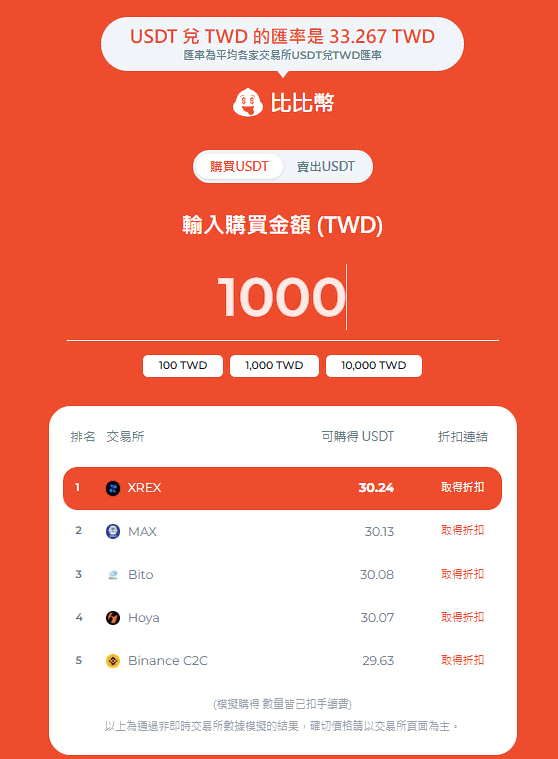
If you only look at the TWD exchange price for USDT, you can check the USDT price comparison website. Just input the amount of TWD you want to purchase, and the price comparison website will calculate the amount of USDT you will receive and list which exchange is the cheapest. However, it is still necessary to check if that exchange is indeed the cheapest before purchasing to avoid losses due to significant price swings in USDT at that exchange.
Source of information
The above price comparison is limited to TWD exchanges and C2C purchases of USDT; if you want to purchase USDT through wire transfer, you need to calculate the total amount to be purchased and how much will be deducted in fees. Is it cheaper compared to the two?
What are the transaction fees for buying USDT?
Each TWD exchange has different trading fees; HOYABIT charges a trading fee of 0.2% to 1.2%, while BitoPro charges 0.1% for makers and 0.2% for takers, all without using exchange discounts.
When purchasing USDT through Binance C2C, Binance does not charge transaction fees; however, the transfer fees during the transaction process must be borne by the buyer.
When purchasing USDT via Bitfinex wire transfer, a fee of 0.1% of the remittance amount will be charged by the platform (minimum charge of $60 USD/EUR)
Frequently Asked Questions
Does buying USDT require identity verification?
It is necessary to conduct identity verification on trading platforms to better prevent fraudulent activities, as accounts can be tracked, so do not avoid using TWD exchanges for purchases due to inconvenience.
Is Tether USDT a scam?
As long as it is used well, USDT is a tool for investors to avoid significant price fluctuations. However, it cannot be denied that many fraud groups prefer to receive USDT to avoid tracing. Therefore, when interacting with others, do not transfer USDT to others for operation just because you trust them.
How much is 1 USDT in TWD?
The value of 1 USDT equals 1 USD, and at the current market price, it is approximately 30 TWD.
How to exchange USDT back to TWD?
In addition to purchasing USDT with a credit card, funds can be transferred back to TWD through the original channels. TWD exchanges can convert USDT to TWD by selling USDT and then transferring TWD back to a linked bank account.
For detailed operational instructions, please refer to the cryptocurrency withdrawal - detailed steps for exchanging USDT for TWD!
How to transfer USDT across different exchanges?
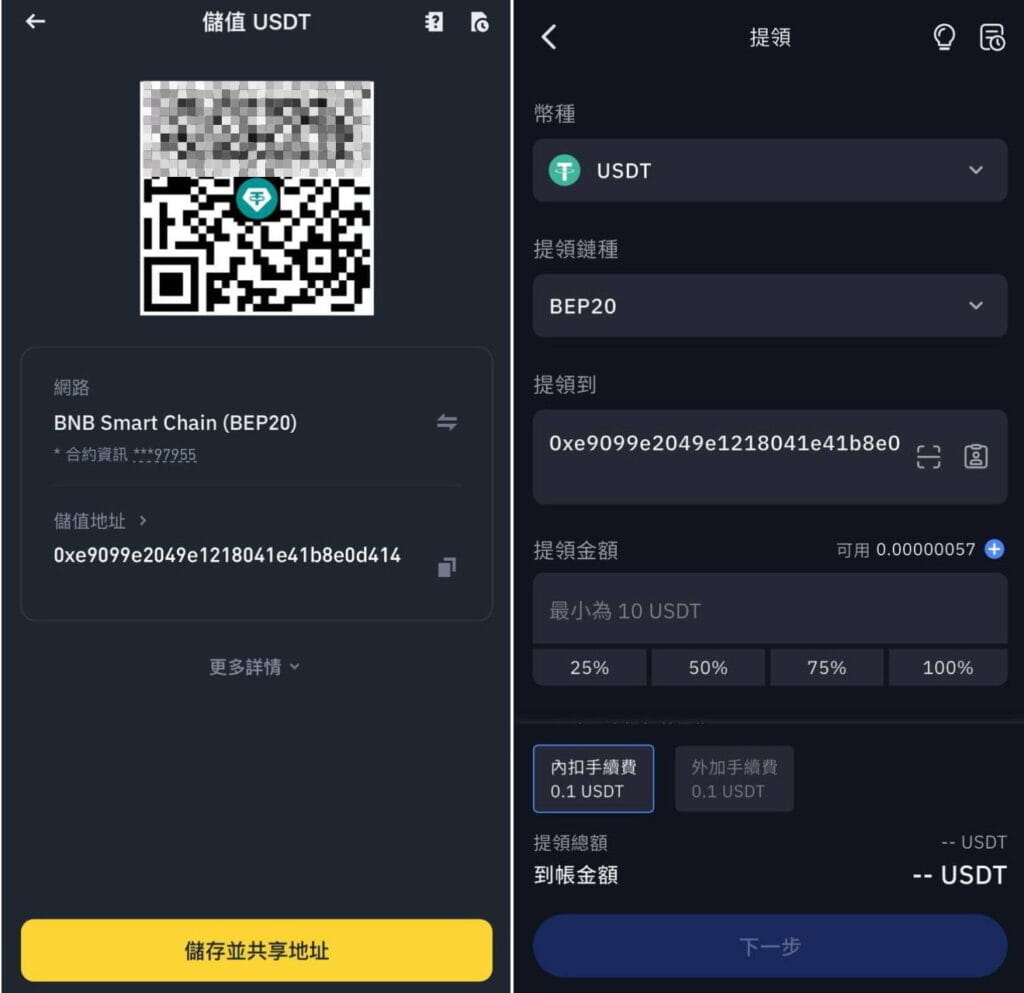
As an example of transferring USDT from the BitoPro TWD exchange to the Binance exchange
Open the BitoPro exchange and select 'Withdraw' USDT from the asset interface
Select the withdrawal chain type; for the cheapest option, choose BEP20
Open the Binance exchange and select 'Deposit' USDT from the funds interface
Select the deposit chain type as BEP20, and copy the deposit address to paste into the BitoPro exchange (be sure to check!)
Enter the amount of USDT to transfer
Conclusion
As one of the most liquid stablecoins globally, USDT (Tether USD) plays a core role in hedging and asset conversion in the cryptocurrency market through its 1:1 peg to the USD. Its high liquidity and instant on-chain transfer characteristics make it widely used in trading, DeFi, cross-border payments, and other scenarios.
However, the rapid popularization of USDT also brings potential risks, including reserve transparency disputes, regulatory uncertainties, and fraudulent abuses. According to statistics from the Criminal Investigation Bureau of Taiwan, recent years have seen a significant increase in investment and romantic fraud cases involving USDT. Investors should avoid private transactions and must trade through registered legal exchanges.
If paired with a compliant platform, completing KYC verification and strengthening risk awareness, USDT is still one of the most convenient and practical cryptocurrency stablecoin tools available.