

As a recognized necessary patch for Based Rollup, Preconfs has finally taken a key step towards standardization.
Written by: Web3 Farmer Frank
Why is Based Rollup, regarded as the 'orthodox' solution for Ethereum's scaling, always 'well-received but not executed'?
On one hand, it achieves the most thorough alignment of security and decentralization with the mainnet by returning the sorting rights to L1, but on the other hand, it has to endure a confirmation delay of up to 12 seconds, which almost discourages high-frequency trading and real-time financial scenarios.
Therefore, Preconfs was proposed as a necessary patch for Based Rollup, attempting to mitigate delays with sub-second transaction commitments, but for a long time, Preconfs has remained in a small-scale, non-standard exploratory stage, lacking a unified mechanism and stable returns, and has never truly scaled up.
Recently, Puffer Finance launched the Ethereum security infrastructure product 'UniFi AVS', which finally attempts to upgrade Preconfs from a temporary performance patch to reusable standardized infrastructure, providing sub-10ms confirmation speed and introducing institutionalized designs in security and economic incentives.
This article will analyze the core capabilities, technical pathways, and ecological impact of UniFi AVS from the perspective of industry observers and discuss whether it can truly become a key variable for Based Rollup—and even the broader Ethereum Rollup ecosystem.
1. UniFi AVS: Preconfs, No Longer Just 'Patching'
To understand the importance of this upgrade, one must first review the core logic of Based Rollup.
In the narrative of Ethereum's scalability, Based Rollup aligns completely with the mainnet in terms of security and decentralization by returning the ordering rights to L1 validators, but it also brings an inevitable trade-off—while inheriting the mainnet's security, it also introduces about 12 seconds of block confirmation delay.
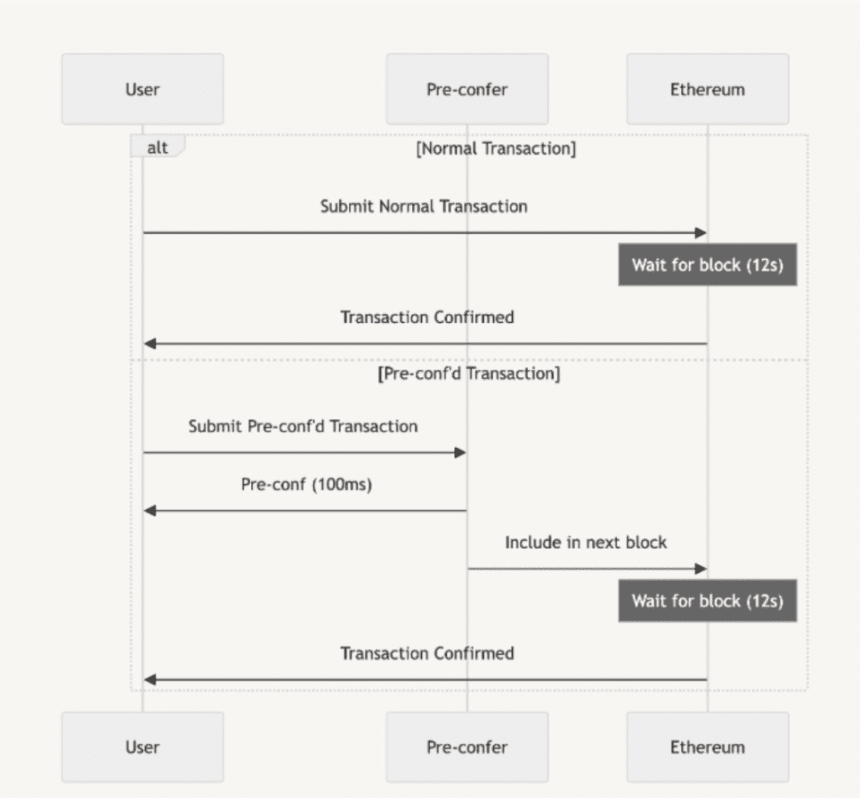 To this end, pre-confirmation (Preconfs) becomes a necessary patch for Based Rollup, responsible for providing users with trading execution promises in advance before the transaction is actually submitted to L1. It can be said that to fully unleash the potential of Based Rollup, it is essential to realize permissionless, neutral, and flexible pre-confirmation services.
However, for a considerable period, Preconfs remained more at the 'small workshop' stage (non-standardized, peer-to-peer solutions), usually run by a few nodes or project parties, lacking unified standards and stable revenue models. Once the nodes responsible for pre-confirmation went offline or acted maliciously, transactions could fail or even suffer MEV attacks, with serious deficiencies in reliability and sustainability.
The UniFi AVS launched by Puffer is a systematic solution proposed to this dilemma. It no longer treats Preconfs as temporary patches but upgrades them into callable infrastructure layers, with the core idea of reconstructing Preconfs into AWS-style standardized cloud services.
Specifically, UniFi AVS starts from three main lines, not only allowing Based Rollup to run faster but also providing sustainable revenue and institutional guarantees in security mechanisms.
In terms of performance, compressing transaction confirmation to sub-10ms provides a user experience comparable to Solana or even centralized exchanges;
In terms of economics, the profit-sharing mechanism at the protocol level allows Rollup to no longer 'work for L1' but to share revenue with validators and gateways;
In terms of security, relying on up to 13 billion dollars of Restaked ETH guarantees and slashing mechanisms transforms 'verbal promises' into 'cost-bearing contracts', forming institutionalized constraints;
For developers and Rollup projects, the emergence of UniFi AVS means they no longer need to design and maintain complex sorting and confirmation logic themselves, but can directly access a verified pre-confirmation infrastructure like calling AWS cloud services, plug-and-play, scalable on demand, putting more energy into product and user layers.
This modular design also gives Preconfs the potential for further productization and generating spillover effects—not only can Rollup project parties avoid reinventing the wheel, but in the future wallets, DApps, and upper-layer protocols can also access standardized APIs to uniformly enjoy the capabilities of 'instant confirmation + economic alignment + security guarantee,' truly turning 'speed and stability' into a public foundational service of the Ethereum ecosystem.
From this perspective, UniFi AVS allows Preconfs to transcend the positioning of a mere performance patch, instead standardizing performance, revenue, and security all at once, pushing it from an additional feature to the middleware infrastructure for Ethereum's scalability, paving a more sustainable path for the large-scale implementation of Based Rollup.
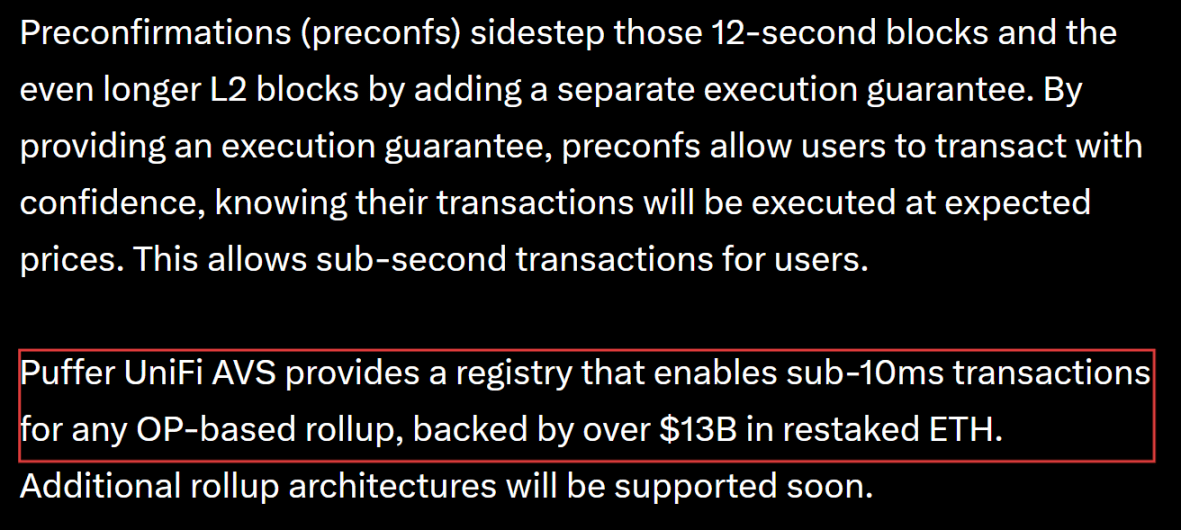
It is worth noting that Puffer also emphasizes that the applicability of UniFi AVS is not limited to Based Rollup; from a design perspective, its registry mechanism can also provide sub-10ms instant confirmation capabilities for any OP Stack Rollup, and plans to support more Rollup architectures in the future. In other words, it is positioned as a set of general pre-confirmation infrastructure with cross-architecture potential.
 Of course, whether all Rollups are willing to cede Sequencer revenue to AVS remains uncertain, and it can even be asserted that it would be difficult to achieve in the initial stages—after all, the sequencer issue is not merely technical but deeply intertwined with interest distribution.
In the L2 economic system, who will be responsible for dividing the cake, how much to allocate to whom, and how to distribute it?
Thus, Preconfs will ultimately evolve into a public standard for the entire Rollup ecosystem, primarily serving the Based path. This is not only a choice of technical route but also a game of business models and interest distribution, which will undoubtedly be a question that needs continuous observation in the coming years.
2. How Preconfs Are Reconstructed into Standardized Infrastructure?
Objectively speaking, since the concept of Rollup was proposed, Ethereum's scalability has not lacked concepts but rather the capability for engineering implementation.
After all, for a technology to evolve from a clever 'feature' to a robust 'infrastructure,' it generally needs to meet three core conditions: clear service commitments, reliable security guarantees, and sustainable economic models.
In other words, it moves from a technical concept to 'engineering' implementation, which is essential for scaling operations. Puffer's UniFi AVS concept is very much in line with this—reconstructing Preconfs from scattered small-scale attempts into reusable, scalable infrastructure with economic incentives.
In other words, how to ensure that Preconfs are no longer 'temporary commitments' from certain nodes but are designed as standardized network services.
1. Execution Preconfs: From 'Inclusion Guarantee' to 'Execution Guarantee'
The first step is to achieve an upgrade from Inclusion Preconfs to Execution Preconfs.
In the traditional Inclusion Preconfs model, users are only promised that transactions will be packed into blocks, but the state at the time of transaction execution cannot be guaranteed, so users may still encounter price slippage or even MEV front-running.
Execution Preconfs further upgrade to 'execution guarantees,' ensuring that transactions will be executed in the state at the time of user submission—once a user places an order, the state will be locked, and the transaction will only execute in that state; otherwise, it will not be valid.
For example, if you place an order to buy ETH, and the price is 4400 USDC:
In the Inclusion model, by the time of actual execution, the market price might have changed to 4410 USDC and still be executed, but the execution price is not what you expected at 4400;
If it is an Execution model, no matter how the market fluctuates, the system guarantees a trading price of 4400 USDC, and the transaction will only execute if this condition is met;
This transforms Preconfs from 'advance tickets' to 'deterministic transactions,' significantly enhancing user experience and providing stronger reliability for price-sensitive financial applications like DeFi, derivatives, and payments.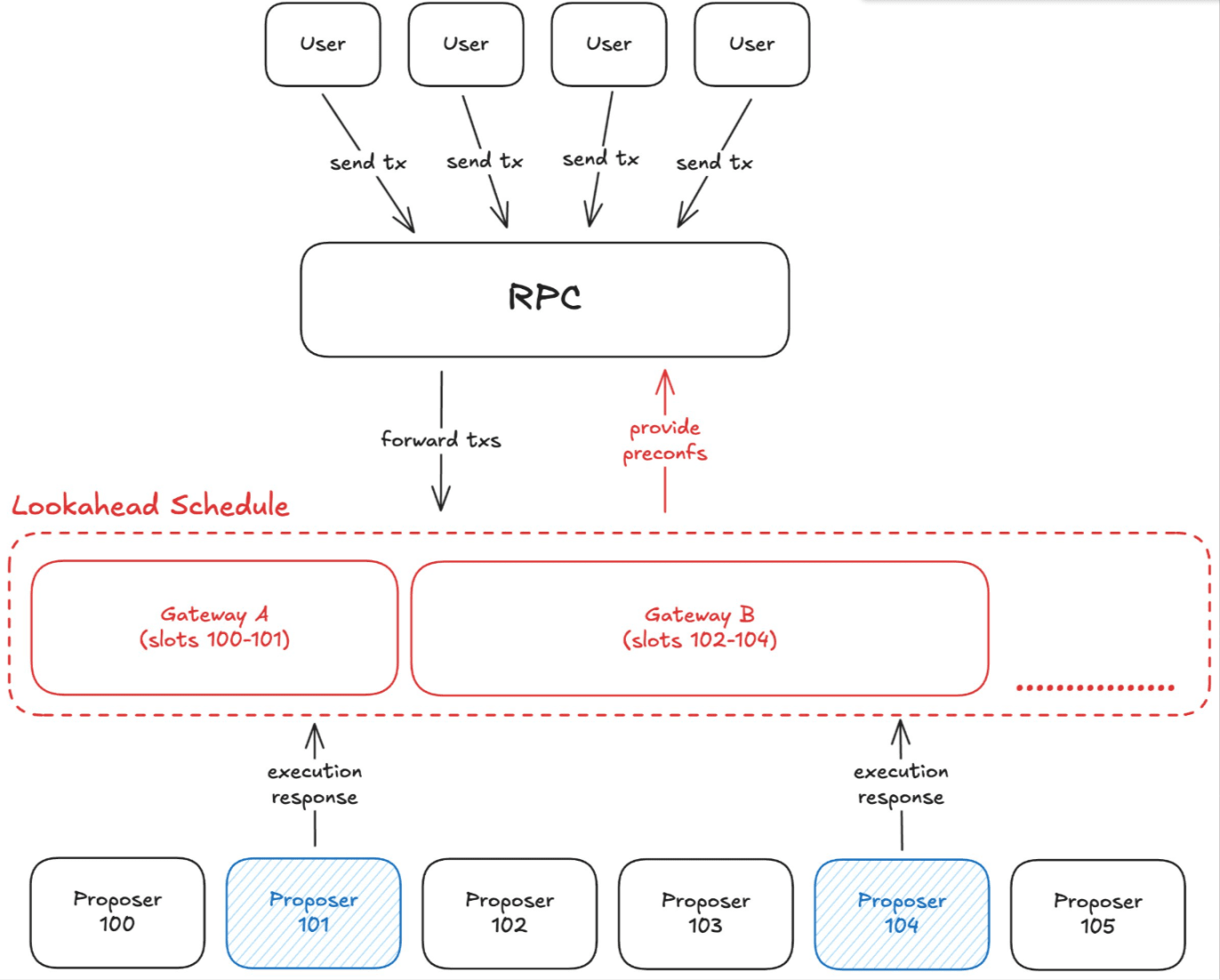 2. Gateway Architecture and Frags Technology: Delaying Compression to Below 10 Milliseconds
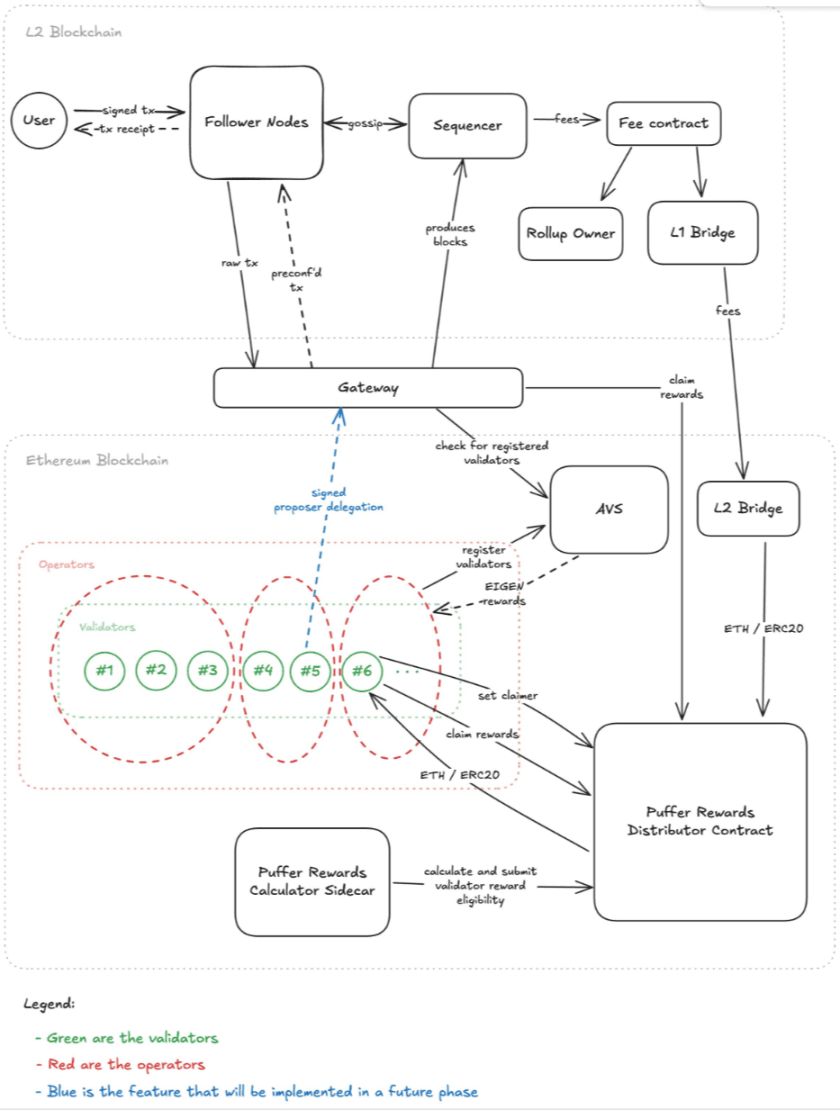
Puffer also introduces a Collateral-backed Gateway architecture (pioneered by the Gattaca team), allowing L1 proposers to delegate pre-confirmation execution rights to more specialized Gateways.
By leveraging frags (block fragments) technology and lookahead mechanisms, Gateways can process transactions in advance before official block production, shortening the window of state switching. Theoretically, under optimal configurations, transaction delays can be reduced to below 10 milliseconds (sub-10ms).
This brings about an experience for its users that theoretically can reach the level of high-performance public chains like Solana.
3. Restaked ETH Security Backing: Making Promises 'Costly'
In the past, Preconfs largely relied on nodes' 'voluntary compliance.' Once a node went offline or acted maliciously, users had almost no compensation mechanism.
The upgraded Puffer uses EigenLayer's restaking mechanism to ensure that each Gateway is backed by staked ETH from validators (phased implementation)—if the node becomes inactive, it may be penalized 1 ETH; if it maliciously extracts MEV or breaches its promises, it may trigger slashing at the level of 1000 ETH.
Unlike PoS penalties, the slashing of ETH from Preconf will compensate users who use the Preconf services, directly enhancing economic alignment and transforming the previously reliance on node reputation's soft commitments into hard commitments with clear slashing mechanisms, significantly enhancing institutionalized constraints.
At the same time, Puffer has established a Canonical Preconf Gateway Registry to ensure that all Gateways enter an orderly, public, and verifiable registration system.
 4. Programmable Profit Distribution: Institutionalized Multi-Party Value Allocation
Speed and security alone are not enough; for Preconfs to become infrastructure, they must also operate sustainably.
To this end, the upgraded UniFi AVS includes a Rewards Distributor, allowing flexible distribution of revenue among Rollup teams, Ethereum proposers, and Gateway providers, achieving programmable profit-sharing at the protocol level.
Rollup teams: Retain part of the transaction fees, no longer 'work for L1';
Ethereum proposers (validators): Earn additional income by providing Preconfs;
Gateway providers: Running the network to receive incentives, ensuring service stability;
Thus, revenue sharing is no longer a temporary agreement but is embedded in the protocol and automatically executed, forming a long-term closed loop of economic alignment among Rollup, validators, and Gateways.
This multidimensional mechanism design is key to transforming Preconfs from a single-point solution into a scalable and reliable public infrastructure.
3. The Beneficiary Landscape in Multi-Party Games
Any infrastructure upgrade is not just a technical evolution but also a redistribution of interests.
The uniqueness of UniFi AVS lies in its binding of performance, security, and economic incentives, allowing multiple ecosystem roles to find value within the same mechanism—from Rollup project parties to Ethereum validators, developers, and end users. It transforms Preconf from a patch into a sustainable modular service, enabling all participants to benefit from a stronger vessel.
First, naturally, are the Rollup project parties, who gain dual unlocks of performance and revenue.
In the past, Based Rollup was frequently criticized by the market for being 'slow and unprofitable', especially since the economic model almost entirely favored L1 validators. With the Execution Preconfs of UniFi AVS, Rollup can achieve sub-10ms confirmation speed in a plug-and-play manner, significantly enhancing user experience.
At the same time, the profit-sharing mechanism at the protocol layer allows Rollup teams to retain part of the economic gains without relying entirely on external subsidies, which represents a dual benefit of speed enhancement and revenue sharing for project parties.
Next are Ethereum validators / Restakers, who gain a new source of income.
Since L1 validators are the direct executors of Preconfs, by participating in UniFi AVS, validators can earn new Preconf service revenue in addition to traditional block rewards.
At the same time, Restaked ETH not only provides security backing but also increases the profit opportunities for validators, which in turn enhances the attractiveness of staking ETH, thereby strengthening the overall economic security of Ethereum, allowing validators to transition from merely running nodes to 'providing value-added services and obtaining additional income.'
Additionally, there are Gateway providers, whose roles have been institutionalized in this upgrade.
Puffer has established a Canonical Gateway Registry, making Gateways standardized nodes in the network rather than temporary roles. Once entrusted, Gateways can achieve pre-confirmation at levels below 10 milliseconds by running frags technology and lookahead mechanisms.
Their services are directly linked to economic incentives and are subject to slashing mechanisms, which means there are both benefits and costs, transforming Gateways from 'volunteers' into true infrastructure service providers.
At the same time, developers can enjoy lower thresholds and greater composability.
After all, in the past, developers wanting to achieve instant confirmation on Rollup often had to build complex mechanisms themselves, which was time-consuming and difficult to standardize, while the upgraded UniFi AVS, through modular APIs, allows developers to access instant confirmation capabilities like calling cloud services.
Whether for DEX, derivative protocols, or high-frequency GameFi applications, they can quickly enjoy the experience improvement brought by sub-10ms confirmations. This not only lowers infrastructure building costs but also reduces the risk of MEV theft, allowing developers to focus more on application layer innovations.
Finally, there are ordinary users, the most direct beneficiaries, who have experienced a smooth experience at the level of Solana or even close to centralized exchanges for the first time on Ethereum Rollup.
In terms of speed, transaction confirmation time has been shortened from 12 seconds to 10 milliseconds, providing an experience comparable to centralized exchanges;
In terms of determinism, Execution Preconfs guarantee price locking from the protocol commitment level, avoiding slippage and front-running;
In terms of security, Restaked ETH backing and slashing mechanisms make promises 'costly', allowing users to receive compensation in case of default;
From a higher level, the upgrade of Puffer UniFi AVS is not just a product evolution but a way to establish industry standards for Preconfs, transitioning from a patch upgrade to infrastructure, and even becoming a standardized middleware service for Ethereum.
This not only gives Based Rollup the potential to truly run fast, earn profit, and be secure but also strengthens Ethereum's long-term narrative as a Security Settlement Layer.
Final Note
Looking back at Ethereum's scaling process over the past five years, Rollup is undoubtedly the absolute mainline, but how to find a truly feasible balance among performance, economy, and security—this 'impossible triangle' has always remained unresolved.
Especially for Based Rollup, this 'orthodox scaling path' of Ethereum has been stuck at the last puzzle piece of large-scale commercialization. Therefore, objectively speaking, this Puffer upgrade with the launch of UniFi AVS can be seen as one of the highly feasible explorations to fill this gap.
The far-reaching significance lies in that it paints a clear potential 'endgame' for the future of modular blockchains: any emerging Rollup does not need to reinvent the wheel but can directly build on UniFi AVS, quickly achieving performance experiences comparable to Solana, security at the Ethereum mainnet level, and a self-consistent economic model.
However, whether it can ultimately become an industry consensus depends not only on the robustness and openness of its design but also on its ability to find the optimal balance point in the complex Rollup ecosystem and the games of multiple interests.
Therefore, for the industry, it serves as a key observation window to measure whether the Based Rollup narrative can truly mature in the next one to two years.