This morning, a 90-year-old company ceased operations. Work did not slow down, and production did not decrease, but it completely halted and sent a legal notice to every customer in its records saying: "We cannot fulfill your contract, we cannot guarantee delivery, and we cannot tell you when we will return to work again."
That company is "BAPCO" (Bahrain Petroleum Company), the only oil refinery in the entire Kingdom of Bahrain. It is a facility that has recently been upgraded with a cost of $7.3 billion to enhance its capacity to process 400,000 barrels of oil per day, and is designed to produce jet fuel and low-sulfur diesel that keep aircraft and trucks moving across Asia and Europe.
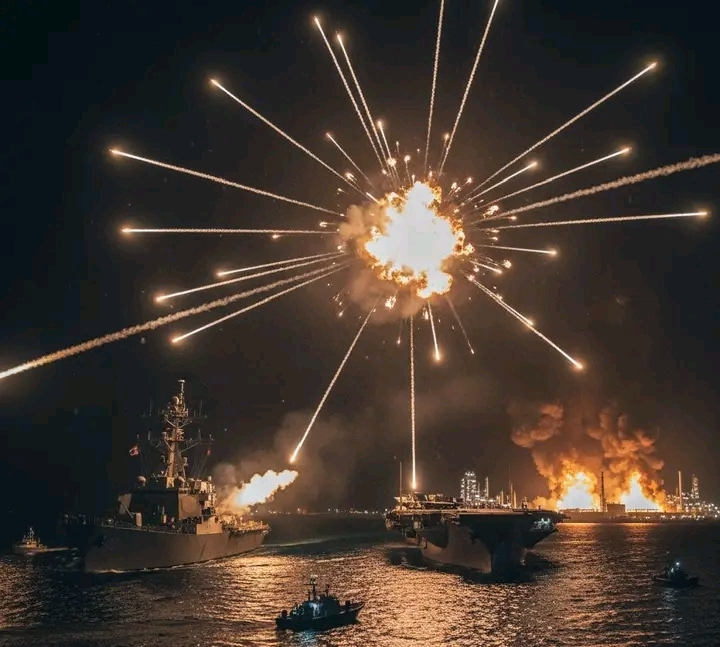
This morning, Iranian armed drones of the "Shahed" type were found by. The fire that broke out at the "Al-‘Umayr" facility lit up the skies over Manama for hours, and thick black smoke was seen from the highways across the island. Every emergency response unit in Bahrain was mobilized at the same time.
By the time the fires were contained, "Bapco" had already issued the legal document that sent shockwaves through global energy markets: "force majeure". Two words usually appear in contract law books, but in wartime they mean something much simpler: "We have been hit; we are shut down; and the world’s fuel supplies have become smaller."
"Bapco" is joining a growing list of Gulf energy giants that declared force majeure in the past ten days. QatarEnergy did it first by halting exports from the world’s largest LNG facility, removing 20% of global LNG from the market overnight. Kuwait followed by cutting production, and shut down the Ras Tanura refinery in Saudi Arabia (one of the largest refineries on the ground) after Iranian strikes.
And now, Bahrain’s only refinery—updated, new, and worth billions—is out of service. One by one, the energy infrastructure in the richest oil region on the planet is going dark. And the figure that captures what that means for every living person on Earth today is: Brent crude reached $119 per barrel this morning.
This is 60% higher than it was on the day this war began 10 days ago. 60% in 10 days; the largest sustained jump in oil prices in more than 50 years. This morning, Bloomberg confirmed that $6 trillion has been wiped from the value of global stock markets since February 28. 6 trillion has vanished—not from the market of one country, but from every market at the same time.
The Nikkei in Japan fell by 7%, South Korea’s Kospi by 8%, Germany’s DAX by nearly 3%, and the UK’s FTSE by 2%. Even Samsung, one of the world’s most valuable tech companies, saw its shares drop by 12%; because it needs power to run its factories, jet fuel to ship its products, and it needs a global supply chain that is functioning.
This morning, the global supply chain is not working normally. This is no longer a Middle East problem—it is a planetary economic emergency occurring in real time.
Iran’s message to the Gulf states today was not delivered through a diplomat or a press statement, but through the rising smoke from Bapco’s "Al-‘Umayr" facility. The message was specific and public: "If you can afford oil at $200 a barrel, stay with Trump. If you can’t, separate yourselves from this war." Iranian leadership said it directly: "Stand with America and bear the consequences in your energy infrastructure, or understand that the rules on your territory are why your refineries are burning."
This is the strategic logic Bahrain failed to account for correctly when, during this conflict, it became the first Gulf country to launch rockets directly at Iran. Media sources (such as "Manama Post" and Iran’s official TV) reported that the U.S. forces stationed in Bahrain—specifically at Al-Juffair base (the headquarters of the Fifth Fleet)—were the ones that launched rockets toward Iranian targets (such as a water desalination plant on Qeshm Island). That decision by one of the smallest and most vulnerable countries in the region opened a door that has not been closed since. Iran’s response was a systematic targeting of Bahrain’s most important economic assets.
Qatar’s Energy Minister Saad Al-Kaabi said in an interview with the "Financial Times," highlighting what every energy analyst underscored: "We expect that any energy source in the Gulf that has not yet declared force majeure will do so in the next few days if this continues." He expected oil to reach $150 and warned that all regional producers may be forced to shut down production entirely.
The G7 responded by announcing discussions to release oil reserves through the International Energy Agency, to pump around 400 million barrels into global markets. But the accounting problem is as follows: 400 million barrels sounds huge until you do the calculations; based on current global consumption, this amount provides coverage for only between 10 and 12 days. After that, the reserve runs out and the core problem remains: the Strait of Hormuz is closed, Gulf production stops, and refineries burn.
Meanwhile, "Majtaba Khamenei," Iran’s new Supreme Leader chosen yesterday (the son of the man whom America killed to start this war), inherited a country whose Revolutionary Guards operate with full independence; their arms factories are still running, their drones and ballistic missiles are still being deployed—and their strategic goal is now stated clearly: to push oil to $200 per barrel as a mechanism to make America’s continuation of this war impossible economically and politically at home.
Trump’s response to oil reaching $114 came via social media, where he said prices would fall quickly once "Iran is destroyed," and he described those concerned about rising prices as "fools." But the gap between $1.85 and $4 per gallon of gasoline is not just an abstract figure; it is a cost every American household and business is suffering from.
Today, March 9, 2026—the tenth day of this war—something was passed and the shape of the next phase of the conflict changed. The war began as "a military confrontation between three 'countries'" and today it has become a global economic "crisis" with a confirmed cost of $6 trillion—and it is still rising.
For 50 years, the global economy has been built on the assumption that Gulf oil would flow reliably through the Strait of Hormuz forever. That assumption is being destroyed now with every announcement of "force majeure."
Iran said outright that it will target any American or Israeli ship attempting to cross. The new top leader is not in a negotiating mood. And when French President Macron asked Iranian President Pezeshkian to stop the strikes, the response was a question: "Did you condemn America when it killed 170 children in a school? Did Europe stand up? Did anyone say a word of accountability?" Nobody had a good answer.
The Swiss government stated officially that the U.S.-Israeli strikes on Iran constitute a violation of international law, urged the Pope to stop the bombs, warned China against the spread of the fires of war, and confirmed Russia’s active assistance to Iran.
The "Bapco" fire is still being contained on the island of "Sitra" in Bahrain as you read this text. 90 years of operations, $1 billion in upgrades, and 400,000 barrels per day of capacity—all now out of service. The new Iranian leader is watching it all from Tehran; he has not requested a ceasefire, has not changed his stance, and his goal is to get oil to $200.
The world has between 10 and 12 days of emergency reserve coverage once the G7 releases its oil stocks. After that, the accounts run out.. and the fires of "Al-‘Umayr" are still burning.