


Written by: Luke, Mars Finance
Introduction: Seeking the essence beneath the clamor
On September 22, 2025, the crypto market experienced a celebration belonging to the Bitcoin ecosystem. As the price of Bitcoin stabilized above $114,000, a strong influx of capital surged into its emerging Layer 2 ecosystem, among which a protocol token named Hemi saw a rise of up to 64.9% within 24 hours, becoming the brightest star of this feast. The market's clamour always peaks one wave after another; for observers accustomed to the rise and fall of tides, the real question is not "how much has it risen," but "why has it risen."
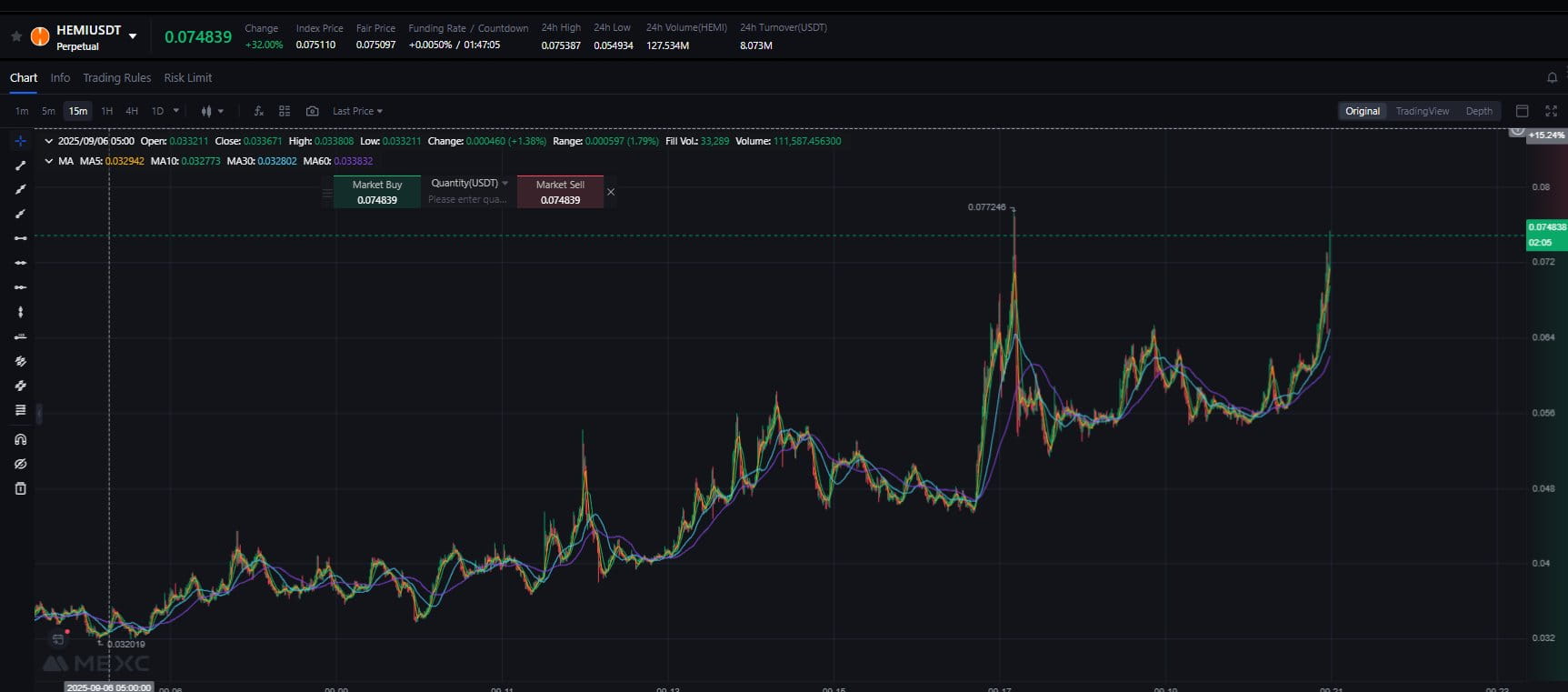
What qualities does Hemi possess that lead Binance and top VCs to view it as Bitcoin's 'orthodox' successor to bet on? Does that astonishing 64.9% surge indicate that the market is finally beginning to understand this grand story?
Eye of the Storm: A Carefully Laid Value Discovery
Exploring the trajectory of Hemi's price surge reveals that it is not due to a single sudden positive factor but an inevitable result of a series of accumulating positive factors. From the favorable wind of the overall market to the collective heating of the Bitcoin L2 track, and to Hemi's steady progress in technology and financing, these elements together form a solid foundation for this price explosion.
First of all, the macro market's trend is quietly changing. After a long period of consolidation, the market showed positive sentiment in September, and smart capital began to seek new narrative niches. As the valuation of the Ethereum Layer 2 ecosystem gradually saturates, the long-dormant topic of 'Bitcoin DeFi' has been reignited, and the capital rotation effect is beginning to show, with the entire Bitcoin L2 sector on the brink of an explosion.
It is under this favorable industry wind that Hemi's series of verifiable progress has become the direct catalyst for igniting market sentiment. On August 28, the confirmation of a $15 million financing led by YZi Labs and Republic Digital ignited the market's initial enthusiasm. Shortly thereafter, on September 5, the $HEMI token was simultaneously listed on Gate.io and KuCoin, bringing crucial liquidity improvement. What truly ignited expectations on the technical level was the key signal revealed in the official blog on September 11: the team clearly announced that its hBitVM implementation plan 'is about to go live on the mainnet' (incoming). This significant upgrade announcement regarding next-generation Bitcoin bridging and native programmability directly transformed future technical expectations into today's purchasing power, laying the most solid groundwork for subsequent market explosion.
Thus, the strong rise on September 22 can be seen as a concentrated 'value discovery' of the market regarding Hemi's long-accumulated technical strength and clear development path. It proves that in today's crypto world, the success or failure of a project ultimately comes down to its fundamentals—team, technology, and the solidity of the ecosystem.
Founding Gene: The 'Orthodoxy' Inheritance of Early Bitcoin Believers
In the mixed crypto world, a project's 'background' largely determines its potential upper limit. Hemi's greatest pride lies in its luxurious founding team, which can almost be regarded as the direct inheritance of Bitcoin's 'founding gene'.
The name of co-founder Jeff Garzik is enough to make any early Bitcoin participant stand in awe. As one of the few Bitcoin core developers who has worked with Satoshi Nakamoto himself, Garzik's involvement injects unparalleled 'orthodoxy' into Hemi. His deep understanding of the Bitcoin underlying protocol ensures that Hemi can maximize respect for and inheritance of its core security philosophy while expanding Bitcoin's functionality.

Another co-founder, Max Sanchez, is the hard-core guarantee of Hemi's technology. His invention of the 'Proof-of-Proof' (PoP) consensus mechanism is key to Hemi's ability to safely inherit the security of the Bitcoin mainnet. The involvement of well-known crypto investor and Bloq co-founder Matthew Roszak brings rich industry resources and strategic vision to the project.
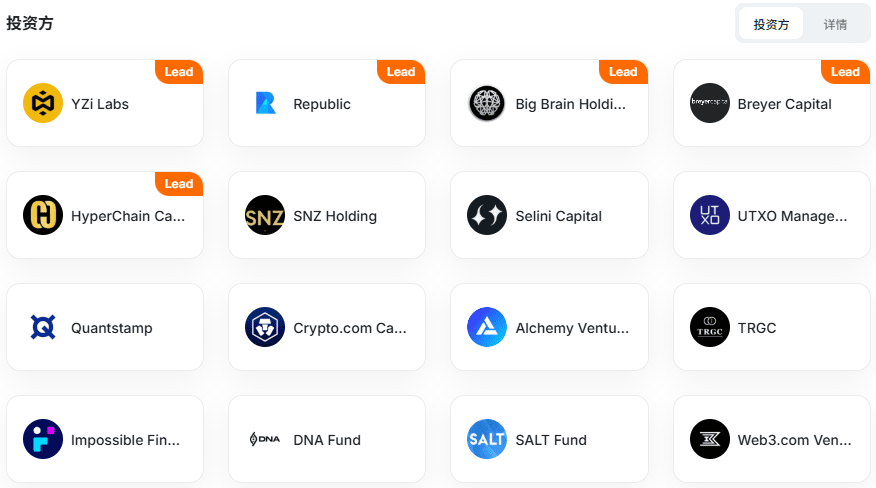
It is precisely this unparalleled founding gene and profound technical background that has attracted the attention of the world's most discerning capital. For investors, betting on Hemi is not just investing in a project but investing in a future led by industry founders with a high certainty of success. The existence of this 'dream team' not only attracts top technical talent but also wins the favor of capital. Hemi has completed a total financing of 30 million dollars, with prominent investors including YZi Labs (former Binance incubator), Republic Digital, HyperChain Capital, and Breyer Capital among the industry's top institutions. The strong team background and robust capital support together build a solid moat for Hemi, giving it a credibility and resource advantage that is hard for other projects to match at the start.
Technical Singularity: Enabling Smart Contracts to 'Natively' Access Bitcoin
If a strong team is the foundation of VCs' confidence in their bets, then Hemi's decisive technical solutions are the core chips that make them willing to bet heavily. Understanding Hemi's technical singularity is to understand the fundamental value of its investment.
Hemi's core innovation lies in fundamentally solving a problem that has plagued the industry for years: how to enable an independent smart contract platform to interact safely and trustlessly with the Bitcoin mainnet? Hemi's answer is the Hemi Virtual Machine (hVM).
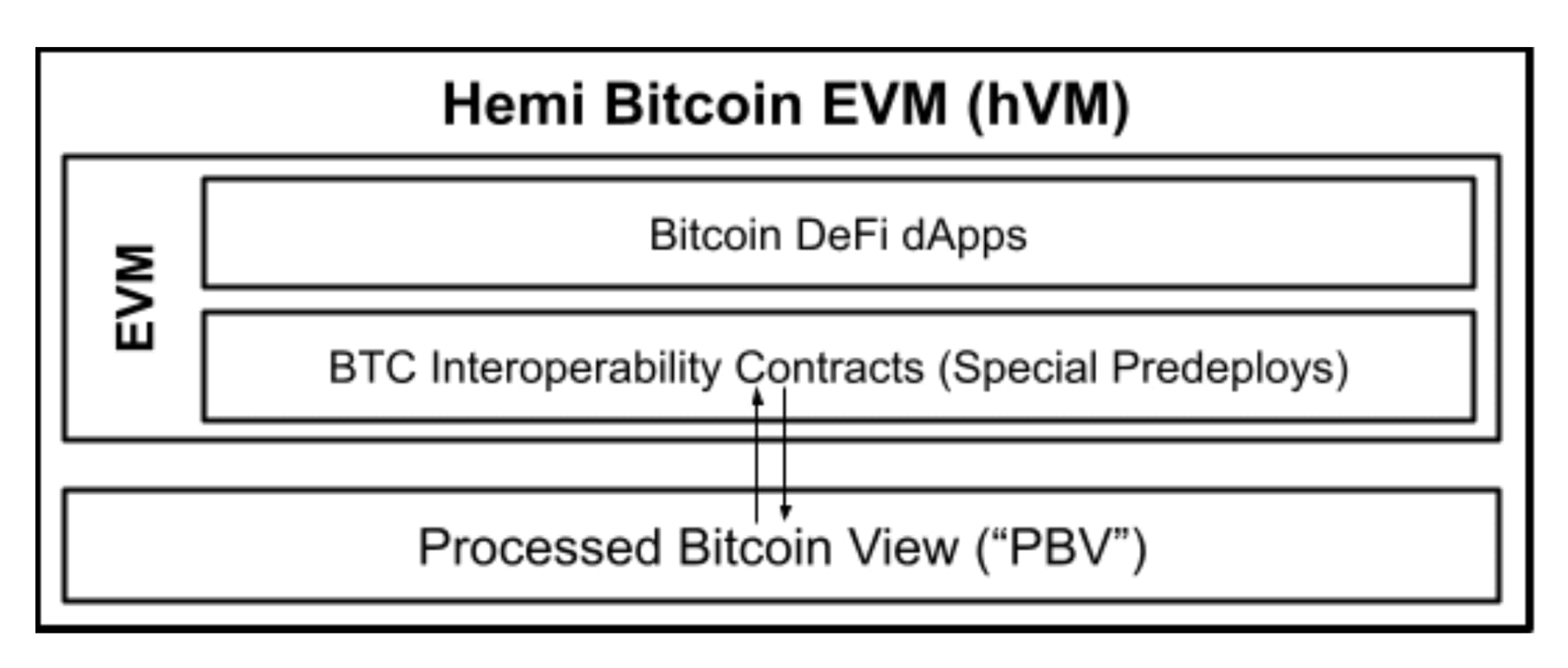
The revolutionary aspect of hVM lies in its not merely being compatible with EVM (Ethereum Virtual Machine) but in natively embedding a complete Bitcoin node within the EVM.
We can use a simple analogy to understand the brilliance of this design: imagine that traditional Bitcoin L2 solutions are like hiring a 'Bitcoin translator' (oracle or cross-chain bridge) for Ethereum (EVM). This translator can convey information, but it is itself a centralized link that needs to be trusted, which may go wrong or act maliciously. Hemi's hVM, on the other hand, directly installs Bitcoin's 'mother tongue system' (a complete BTC node) into Ethereum's brain.
In this way, smart contracts running on Hemi can directly 'think' and 'read' the complete state of the Bitcoin mainnet, such as querying the UTXO balance of any address. This reading process is driven by the L2 state of the Hemi protocol itself, ensuring that all nodes have a completely consistent and verifiable view of the BTC state when processing the same block, thereby completely eliminating the security risks and centralization issues brought by 'translators'.
On the foundation of hVM, Hemi's Proof-of-Proof (PoP) consensus mechanism further solidifies its security. It allows Hemi to lightweight and decentralized way to anchor a 'snapshot' of its network state on the Bitcoin mainnet. This allows Hemi's transactions to ultimately achieve Bitcoin-level proof of work (PoW) finality, which Hemi officially refers to as 'Bitcoin Superfinality'. This means that a transaction on Hemi that has undergone sufficient confirmation will have the same degree of irreversibility as the Bitcoin mainnet, which is crucial for L2s carrying large-scale financial applications.
Pattern Struggle: At the Crossroads of Bitcoin L2
The Bitcoin L2 track has never lacked participants, but the technical paths chosen by various parties are quite different, reflecting different trade-offs regarding scalability, security, and the “impossible triangle” of decentralization. Hemi's entry provides a brand new and highly competitive paradigm for this route dispute.
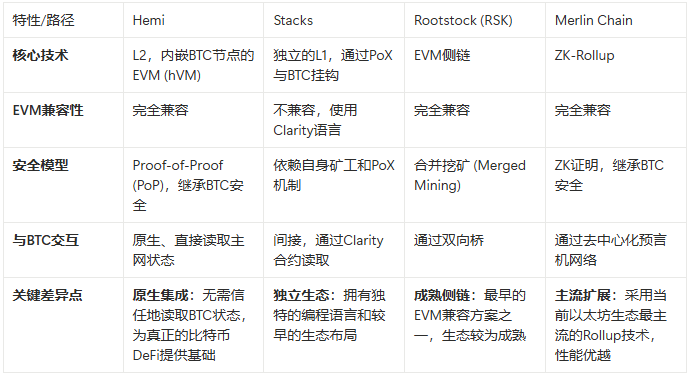
From the table above, it can be seen that Hemi's greatest differential advantage lies in its 'native integration' philosophy. Unlike Stacks' 'parallel chain' model, RSK's 'merged mining' model, and Merlin's 'rollup' model, Hemi seeks to deeply integrate the flexibility of EVM with the asset layer of Bitcoin at a core level. This design makes it possible to build complex DeFi protocols that genuinely rely on Bitcoin chain events (for example, the confirmation of a Bitcoin transaction) to trigger, which is difficult for other solutions to achieve.
For example, developers can build a decentralized Bitcoin options protocol on Hemi, where its execution and clearing logic can directly and automatically verify prices and trading states on the Bitcoin mainnet without relying on any external oracles. This opens up unprecedented imaginative space for 'Bitcoin-native DeFi'.
Ecological Landscape: Value Transmission from Protocol to Application
A successful public chain cannot do without a prosperous developer and application ecosystem. Hemi understands this well and has placed ecological construction at its strategic core since its launch. According to data from its official website, the Hemi ecosystem has attracted over 90 projects and partners, with a total locked value (TVL) exceeding 1.2 billion dollars.
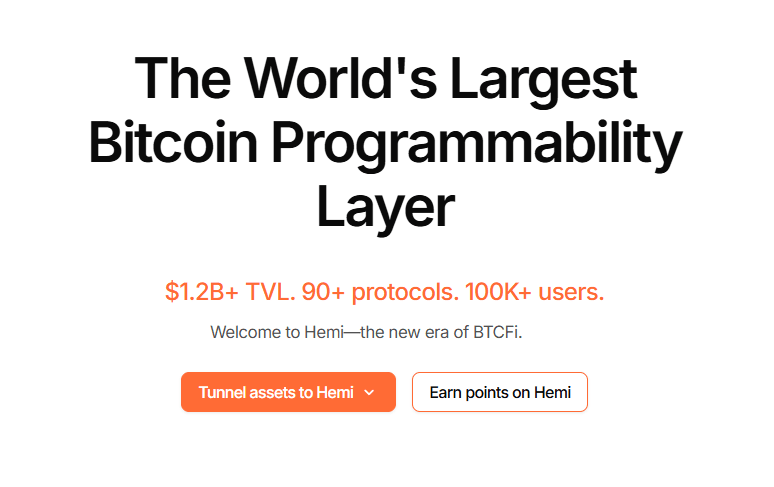
This initially scaleable ecosystem is not a castle in the air but demonstrates healthy diversity. In the DeFi field, there are native lending protocols like Satoshi Protocol; at the infrastructure level, Hemi has established deep cooperation with leading industry projects like LayerZero and Quantstamp; at the user entry level, it has gained support from mainstream wallets such as UniSat and RainbowKit. This comprehensive layout from the bottom layer to the application layer lays a solid foundation for its future explosive growth.
Driving this ecological flywheel to continue spinning is its carefully designed token economic model. The total supply of $HEMI tokens is 10 billion, of which the largest share (32%) is allocated to the community to incentivize early builders and participants in the ecosystem. As the native token of the network, HEMI will not only be used to pay gas fees but also serve as the core certificate for participating in protocol governance and staking for rewards. This design, which deeply binds the protocol’s value to the token, ensures that as the Hemi ecosystem thrives, its value can effectively be transmitted to HEMI holders.
Conclusion: Beyond the noise, a new chapter for Bitcoin is beginning.
In summary, the bets placed by Binance's incubator and top VCs on Hemi are not just a simple financial investment but a deep recognition of the technical route, the founding team, and even the future narrative of Bitcoin. Its revolutionary hVM architecture is the 'orthodox' key that unlocks Bitcoin's trillion-dollar liquidity. That astonishing 64.9% surge may just be the beginning of the market starting to understand this 'successor' story. The noise will eventually fade, but a new DeFi era driven by Bitcoin is slowly unfolding.