

Today, Bitcoin rose to 74000 USD and then fell back to around 70000 USD. From a monthly perspective, since it started to decline in October 2025, until February 2026, Bitcoin has been in a state of decline for 5 consecutive months.
However, some people think that since the pancake has fallen for 5 months in a row, it should rise at least once in March or in the following months, right? In fact, this kind of thinking is simply a misunderstanding, as they do not understand market rules or probabilities.
Currently, global stock markets are at very high positions, and if the war in the Middle East does not end in a short time as Trump envisioned, the market turbulence and impact it brings could be particularly significant.
Currently, major stock markets in various countries are experiencing high-level declines, and gold and silver have also dropped significantly, while the U.S. dollar index has risen again. These signs indicate that the money available for investment in the global market is starting to decrease, leading to reduced liquidity.
If this war can end in a short time, then we don't have to worry too much, but if it doesn't end, the market will likely experience significant fluctuations, as some have observed.
A reminder: everyone must remain calm now, avoid acting impulsively, and during this market turmoil, never leverage or operate recklessly, as it can easily lead to losses.
Tonight at 21:30, two data points will be released that will affect the short-term Bitcoin trend.
1. U.S. unemployment rate, currently expected at 4.3
If tonight's figures exceed expectations, and the economy cools down, the Federal Reserve may lower interest rates, which would be positive for Bitcoin.
2. Non-farm payroll employment is expected to be 5.9
If tonight's figures are below expectations, and the economy cools down, the probability of interest rate cuts will increase, which is favorable for Bitcoin.
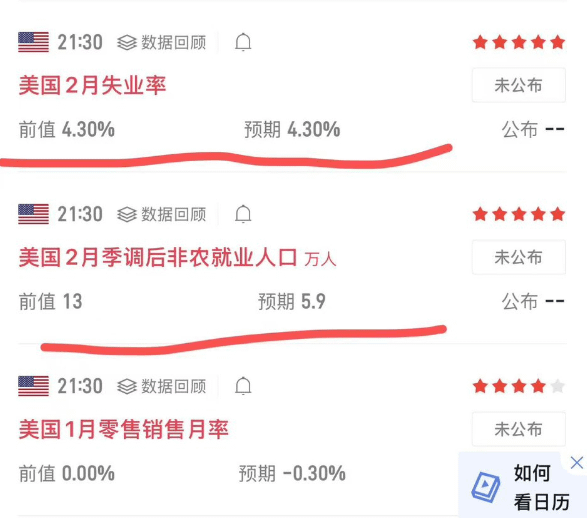
Overall: the higher the unemployment rate, the lower the employment numbers, making it possible for future interest rate cuts, which is beneficial for Bitcoin.
Non-farm payroll data is generally a significant indicator of short-term volatility in the bear market for Bitcoin.
Last night, OKB surged 50% due to the parent company of the New York Stock Exchange valuing OKX at $25 billion and investing in it. This will bring about many changes, both for the NYSE parent company itself and the entire cryptocurrency industry, with three very obvious industry signals that are easy to understand.
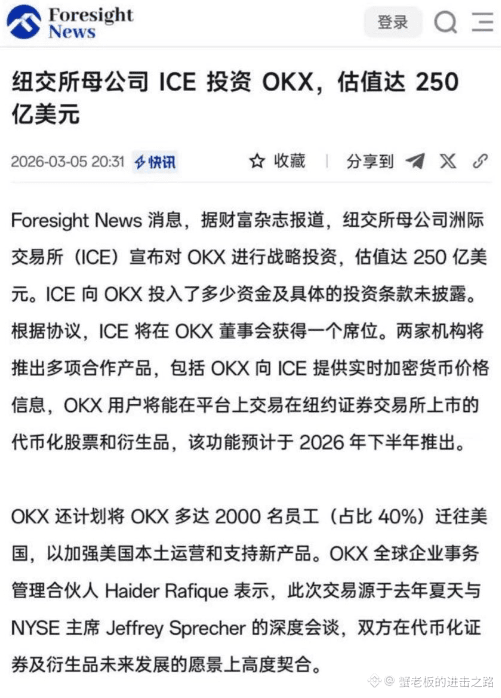
Three clear signals
1. Old money has fully entered the market
Traditional financial institutions have started to directly hold shares in the leading cryptocurrency platform OKX, which means that the gap between cryptocurrencies and the traditional finance we usually encounter is being completely bridged, and in the future, the two will be more closely connected.
2. The target is the U.S. market, focusing on compliance
OKX is looking to develop and expand into the U.S. market, backed by the parent company of the New York Stock Exchange, a top traditional financial giant, which will help OKX obtain compliance qualifications more smoothly in the U.S. and make it easier to connect with institutional clients, avoiding many detours.
3. Tokenized securities are going to be on fire
The announcement of this investment clearly states the intention to create tokenized securities, which simply means turning traditional assets like stocks and bonds into tokens in cryptocurrency form for easier trading. In the future, these traditional assets will be able to directly reach global investors through digital platforms; it's only a matter of time and an inevitable trend.
Another key point: the largest growth potential for the U.S. cryptocurrency market is actually not in the U.S. itself, but in other countries and regions, such as Europe, where cryptocurrency platforms like RobinHood and Kraken already exist. One of the largest markets for cryptocurrencies is Asia, which happens to be OKX's advantage, allowing it to cover Asian users and markets.
To summarize: in the next phase, the core of the cryptocurrency industry revolves around three things, clearly stated without suspense—first is compliance, second is institutional entry, and third is RWA, which refers to the conversion of traditional assets into token trading.