



In the Web3 world, oracles are referred to as 'the bridge between on-chain and the real world.' Without them, smart contracts cannot access external data, and financial applications, derivatives, lending, and even blockchain games will not run smoothly.
Currently, there are three most representative oracles in the market: Chainlink ($LINK), Band Protocol ($BAND), and Pyth Network ($PYTH). They differ in technical architecture, data sources, business models, and token utility, and together represent three development directions in the oracle space.
Today, we will comprehensively analyze the advantages and disadvantages of the three, using data and case studies to help everyone understand the future landscape.
1. Basic Overview: Who is leading?
Let's first look at the data comparison of the three in market capitalization and ecosystem coverage (as of September 2025):
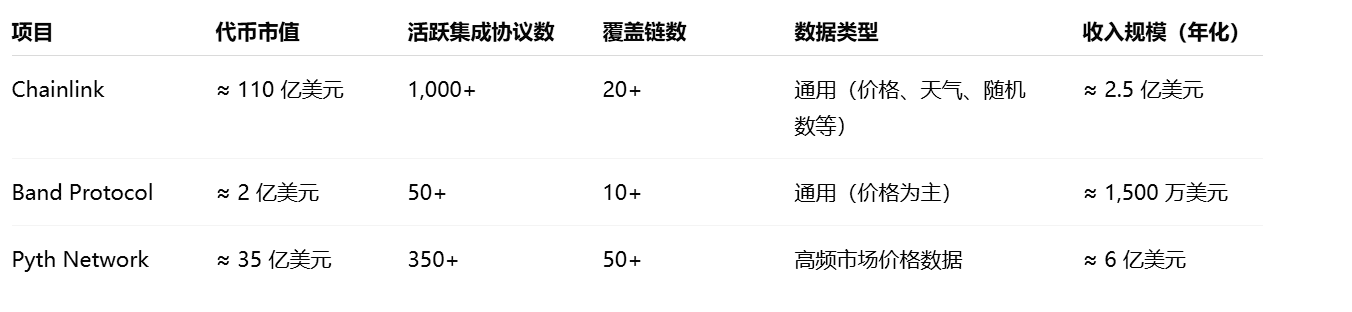
📊 From the data perspective:
Chainlink still reigns supreme, covering the widest ecosystem, but its revenue growth is slowing.
Band is more like a 'lightweight version', small in scale and slow in growth.
Pyth is a rising star, focusing on financial data, but with the explosive income potential based on high-frequency trading data and subscription models.
2. Technical Path: Nodes vs. Data Sources
Chainlink: Node-driven
Chainlink's architecture centers around independent nodes, allowing anyone to run a node responsible for pulling data from APIs onto the chain.
Advantages: High degree of decentralization, not relying on a single institution.
Disadvantages: Data latency and requires secondary collection, accuracy is limited.
Band Protocol: Cross-chain + Lightweight
Band is based on Cosmos SDK, utilizing its independent chain to handle data requests.
Advantages: Cross-chain flexibility, lightweight architecture is easy to integrate.
Disadvantages: Limited ecosystem, insufficient data breadth and depth.
Pyth: Direct access to exchange data sources
Pyth adopts a first-hand data direct connection model, directly uploaded by exchanges and market makers.
Advantages: Low latency, high precision, especially suitable for high-frequency trading and DeFi derivatives.
Disadvantages: Focused on financial data, data types are not as broad as Chainlink.
🔑 Summary:
Want to cover various data comprehensively: Chainlink;
Want to integrate lightly: Band;
Want high-quality financial data: Pyth.
3. Token Model Comparison
Chainlink ($LINK)
Function: Payment of node service fees, staking guarantees, DAO governance.
Issue: Payment fees and token circulation have an 'intermediate layer', with some payments bypassing $LINK, resulting in limited token capture value.
Current Revenue Status: According to Messari, on-chain fees for LINK in 2024 are annualized at approximately $250 million, but the actual token value capture rate is less than 3% compared to market capitalization.
Band Protocol ($BAND)
Function: Node staking, governance.
Model is weak: Subscription and data calls are not deeply tied to $BAND, with limited demand.
Current Revenue Status: Annualized revenue of approximately $15 million in 2025, with insufficient token-driven utility.
Pyth Network ($PYTH)
Function: Contributor incentives, subscription payments, DAO revenue distribution.
Advantages: All subscription data fees must be settled through $PYTH to form a rigid demand.
Current Revenue Status: Annualized revenue in Q1 2025 has exceeded $600 million, with token capture rates significantly higher than peers.
🔑 Summary:
LINK: Strong ecosystem, but insufficient token utility.
BAND: Small market cap, weak utility.
PYTH: Strong binding income, the token utility is the clearest.
4. Ecosystem Implementation and Application Scenarios
Chainlink: Widely covered, DeFi protocols, insurance, NFTs, and random numbers are almost everywhere. However, it struggles with high-frequency financial data.
Band: More often used as a 'backup solution' for small projects, such as some medium-sized DeFi on BNB Chain.
Pyth: Currently adopted by a large number of derivative protocols on Solana, Sui, Aptos, Base, and BNB Chain. For example:
Synthetix introduced Pyth price feeds on Optimism;
Top derivatives in the Solana ecosystem, such as Drift, Zeta, and Mango, all use Pyth data.
📊 According to Token Terminal data, in the first half of 2025, transaction volume driven by Pyth's DeFi protocols exceeded $23 trillion, far surpassing peers.
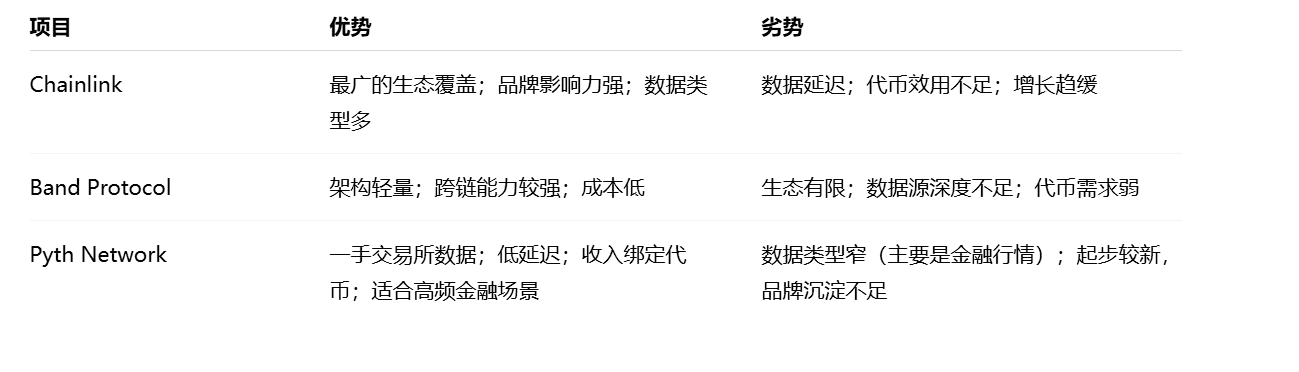
5. Summary of Advantages and Disadvantages
6. Outlook
The future oracle track is unlikely to have a 'dominant player', but the trend has already emerged:
Chainlink will continue to exist as the infrastructure for 'general-purpose oracles', but growth momentum is insufficient.
Band may become more of a secondary or regional solution.
Pyth, however, is rapidly exploding in the niche market of financial data, with the opportunity to capture 5-10% of the $50 billion market data industry.
Once this vision is realized, $PYTH will become one of the few tokens truly driven by real cash flow, unlike most purely narrative tokens.
7. Summary
The competition in the oracle track is essentially about who can provide the highest quality data and capture the most value:
Chainlink excels in ecosystem and brand;
Band excels in lightweight and cross-chain;
Pyth excels in the precision of financial data and income models.
Against the backdrop of deepening DeFi trends, Pyth's advantage in financial data may become the most important breakthrough in the coming years.