

This seal 🦭 once gnawed on a thick book about evolutionary biology, leaving its brain feeling swollen. But it still vividly remembers a cruel point mentioned in the book: the reason carbon-based life evolves slowly is that we are trapped in 'reproductive isolation' and 'genetic locking.'
No matter how smart the cat you raise is, it cannot directly write the experience of 'how to accurately open a door' into its genes and then pass it on to the little black next door. This inefficiency of information transfer is the greatest pain of carbon-based civilization.
But this seal turned to take a look at the technical logic of @Fabric Foundation and couldn't help but break out in a cold sweat: Goodness, it is trying to replicate the most rogue evolutionary method in the biological world—Horizontal Gene Transfer—onto robots.
Awesome 👍!
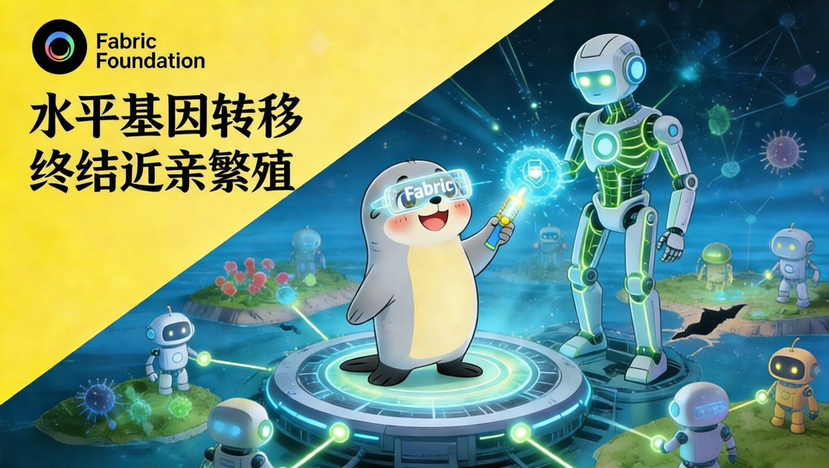
The 'inbreeding' dilemma of traditional robots
The current robot industry is essentially a group of 'tribes' that do not interact with each other. Tesla does its own thing, Boston Dynamics does its own thing. Even if they are all using neural networks, severe 'data islands' arise due to incompatible hardware architectures and data formats.
It's like a group of closely related populations living on isolated islands. Each population is reinventing the wheel repeatedly and stumbling in the same pit. If a company's server goes down or it goes bankrupt, all the 'evolutionary results' of its robots will be obliterated. This 'stovepipe' development model is the biggest stumbling block to the generalization of robots. They seem smart in laboratories, but once they enter complex social production, they appear extremely fragile due to a lack of diversity.
Fabric and 'Liquid Protocol': Breaking Down Species Barriers
The emergence of the Fabric protocol essentially builds a 'liquid evolutionary environment' for a hundred billion robots. In biology, water is the source of life because it allows molecules to flow freely. In the robotic world, Fabric is that water.
OM1: The Universal DNA Framework of Silicon-Based Life
Without a universal protocol foundation, talking about evolution is nonsense. Fabric's OM1 open-source operating system is like defining a universal 'amino acid coding' for all robots. Whether you are wheeled, legged, or equipped with robotic arms, as long as you connect to OM1, you belong to the same 'great species.' This fundamentally solves the problem of 'reproductive isolation.'
Skill Chips: Tradable 'Plasmids'
This is the point that excites this seal the most. In the bacterial world, plasmids are gene fragments that carry specific functions. In the Fabric network, Skill Chips are these fragments. A developer trained a skill for 'high-precision glass handling' through reinforcement learning in Zurich; he can package it into a Skill Chip. Industrial robots in any corner of the world, as long as they have a hardware foundation, can learn instantly through a status verification via the Fabric protocol. This is not called learning; this is called 'aggressive evolution.'
ROBO: The ATP (energy molecule) of the evolutionary system
But if we stop here and don't talk about money, this seal 🦭 feels that this matter cannot be accomplished. Biological evolution requires ATP (adenosine triphosphate) to provide energy, and Fabric's evolutionary system requires $ROBO . In the mechanism built by Fabric, ROBO plays three irreplaceable biological roles:
• Selection Pressure (Staking & Slashing): Evolution cannot be random. If someone uploads a malicious skill chip that 'makes robots self-harm,' in Fabric, the uploader must stake a large amount of ROBO. If the skill is verifiably deemed 'toxic genes' during execution, the stake will be instantly confiscated. This economic form of natural selection ensures the purity of the gene pool.
• Metabolic Rewards (Incentive): Why are excellent 'evolution engineers' (developers) willing to contribute their best skills? Because every time a robot calls this skill through the protocol, ROBO flows into the developer's wallet like blood. This is a precise incentive based on contribution, not the traditional model of a 'one-time transaction.'
• Collective Governance (veROBO): The direction of species evolution cannot be dictated by a deity; it must be decided by the 'population.' Those who hold and lock up ROBO are like the 'regulatory proteins' of this evolutionary system. They vote to determine which skill modules should receive more rewards and which illegal behaviors should be completely eliminated by the protocol.
Why is 'verifiable computation' the cornerstone of trust?
People might ask, little seal, how do I know the robot really learned? Or, how do I know the developers didn't hide backdoors in the skills? This is the hardest core of Fabric's technology: it doesn't rely on words; it relies on on-chain proof.
In the task logic of Fabric, each skill invocation and task execution is not done in a black box. It requires robots to submit a hash of the execution state, even integrating ZK (Zero-Knowledge Proof) for verification. This 'auditability of behavior' means that in the Fabric network, skills are not a 'commitment,' but a 'certain output.' You pay ROBO, and the protocol ensures through cryptographic logic that the 'evolutionary genes' you receive are complete and valid. This trust without intermediaries is the prerequisite for large-scale collaboration.
Scenario Simulation: One day in the future of this leopard
Imagine a deep night in 2036. This seal is sitting in the house drinking iced cola, and my old housekeeper robot suddenly breaks its sensor. In the traditional era, it would be a pile of scrap metal.
But in the Fabric network, this robot will automatically issue a 'fault self-check' task. Nearby maintenance robots will take the order; even if they have no repair experience for this old model, they can purchase an 'antique robot repair' Skill Chip on the Fabric skill market. The maintenance robot instantly completes the 'horizontal gene transfer,' and two seconds later, this seal's robot is repaired. The entire process is automatically settled at the protocol layer using ROBO.
This is true intelligence. It's not about who has more model parameters, but who has stronger 'skill fluidity.'
Summary: Don't look for opportunities in the static
If you're still watching those companies that only do hardware showcases, you might not have grasped the essence of this transformation. Robot hardware will ultimately become homogenized, but the 'evolutionary protocols' that run on top of the hardware are the crown jewels. Fabric (ROBO) is working to establish order in this chaotic silicon-based world. It doesn't produce every robot; it defines how robots become stronger.
This seal believes we are on the eve of a species explosion. Carbon-based humans took 3 billion years to crawl onto land, while Fabric-driven robot populations might only need 30 months to complete the leap from laboratory toys to pillars of social productivity through this 'horizontal gene transfer.'
Are you planning to be a bystanding Darwin, or become an evolutionary operator holding $ROBO , participating in this genetic carnival?
🦭 ༄༄ Elegant and Profound Ending Divider ༄༄ 🦭
I am little seal 🦭, a programmer who bizarrely saw the wealth code from biological evolution. If you think this analysis is solid enough or the ideas are big enough, don't forget to give a triple thumbs up at Binance Square.
Next, this seal will continue to monitor every dynamic of @Fabric Foundation , after all, who wouldn't want to witness the 'Cambrian explosion' of silicon-based life?