

On Wednesday (September 17), during the Asian trading session, Bitcoin hovered above $116,000, fluctuating in a narrow range of 2.3% since last Friday, as the market awaits today's Federal Reserve interest rate decision, with widespread predictions that the central bank will cut rates by 25 basis points.
The trading price of Bitcoin is above $116,500, and the market remains optimistic about potential U.S. interest rate cuts. Technical factors such as futures gap filling have also increased upward pressure, but some cautious sentiment has warmed ahead of the Federal Reserve meeting.
Ethereum maintains a moderate rise supported by the overall market momentum dominated by BTC, but investors are facing certain resistance while weighing macro risks and awaiting clearer policies.
Polymarket and CME FedWatch agree: The Fed's easing cycle will begin tomorrow. Both have locked in a 25 basis point rate cut for the next FOMC meeting, and expectations for three rate cuts before the end of the year are accumulating.
Polymarket traders believe there is more room for aggressive easing, while CME assigns a more robust probability to a 25 basis point gradual rate cut. Regardless, the market generally views a cumulative 75 basis point rate cut by 2025 as the baseline scenario.
Market confidence in the Fed's pivot is already reflected in on-chain data. Bitcoin is trading at $116,762, up 1.3% for the day and 4.7% for the week; Ethereum is reported at $4,502, up 4.3% for the week, as traders digest the expectations of rate cuts.
Some traders are opting to wait for the market's actual reaction following the Fed's announcement of rate cuts.
CryptoQuant's latest report shows that the number of Bitcoins flowing into exchanges has dropped to a 7-day average of 25,000 BTC, the lowest level in a year and a half, previously seen in mid-July when Bitcoin first broke through $120,000. Meanwhile, the average single BTC deposit amount has also halved to 0.57 BTC, indicating that large holders are in a wait-and-see mode rather than eager to sell.
Ethereum is no different: The number of ETH flowing into exchanges has dropped to a two-month low of 783,000 ETH, well below August's 1.8 million. The average single ETH deposit has fallen from 40–45 earlier in the summer to 30, showing reduced selling activity from large holders.
Unlike BTC and ETH being "stockpiled," stablecoins are flowing in significantly. A report from CryptoQuant indicates that USDT inflows to exchanges surged to $379 million at the end of August, the highest this year, and remain at a high level of $200 million. Since July, the daily average USDT deposit has doubled, providing ample "ammunition" for exchanges to support a potential rebound after the Fed's decision.
However, the flow of different cryptocurrencies is not consistent. The exchange activity of altcoins is rebounding, with total deposits over the past 7 days climbing to 55,000 transactions, higher than the range of 20,000–30,000 transactions earlier this year. This discrepancy suggests that even if BTC and ETH supply is tight, some high-risk tokens may still see profit-taking.
Gracie Lin, CEO of OKX Singapore, wrote in a report to CoinDesk: "September will see a total of $4.5 billion in token unlocks, which could put pressure on liquidity and test the market's absorption capacity."
She further pointed out that the real opportunity lies beyond short-term fluctuations. "The supply of stablecoins is approaching $300 billion, token unlocks are testing market depth, and Nasdaq is pushing for significant infrastructure upgrades like tokenization of securities, all indicating that cryptocurrencies are becoming part of the global financial system rather than outsiders."
The information is clear: The Fed's pivot has almost been priced in by the market. The key now is whether the liquidity buffers in the crypto market—stablecoins, exchange inflows, and token unlocks—can absorb the shocks and guide capital into the next phase of Bitcoin's upward trend.
Bitcoin may break through $120,000
Although the direct impact of rate cuts on Bitcoin remains uncertain, there are three independent factors supporting BTC's further rise.
Exchange-held coin amounts have sharply decreased, tightening short-term liquidity
Glassnode estimates that in September, Bitcoin saw a net outflow of 44,000 BTC from exchange addresses, reversing the trend of significant coin deposits in July. As the number of circulating coins decreases, short-term liquidity tightens, with limited selling pressure around the current price level of about $116,000, which is beneficial for price support.
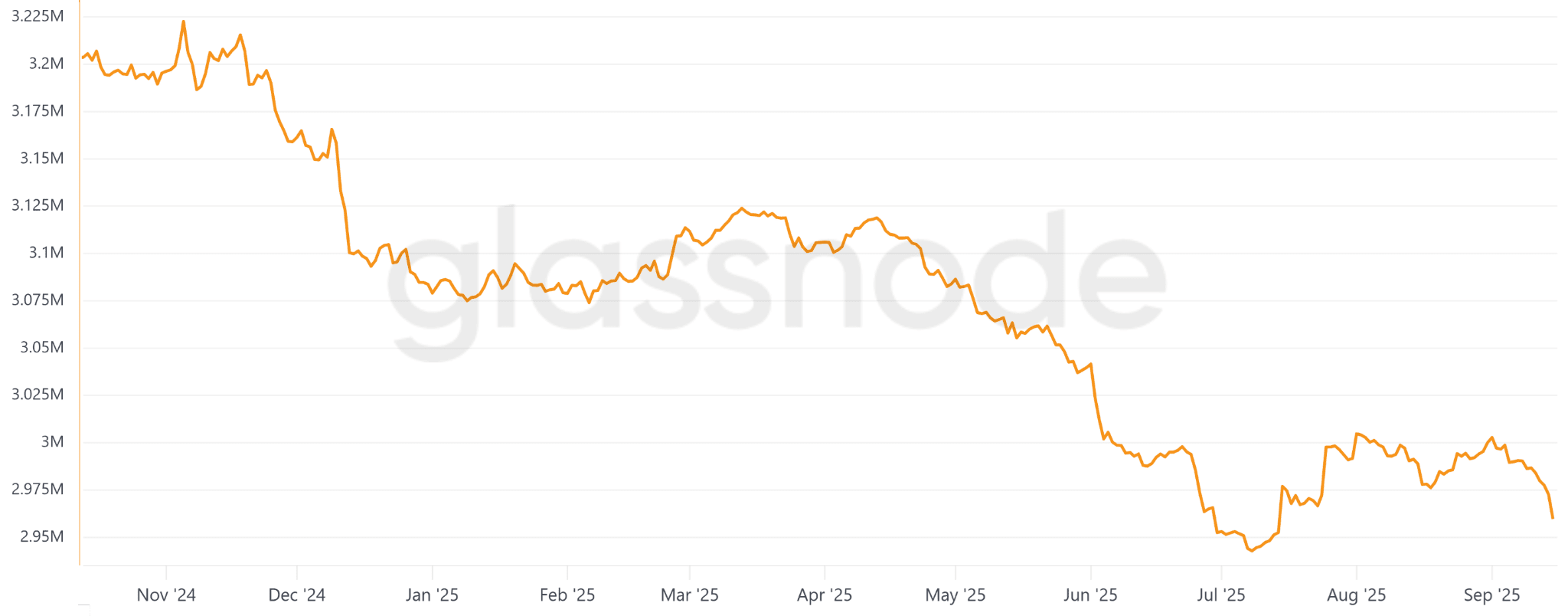
Some believe that the 2.96 million Bitcoins held by exchanges are enough to absorb buying pressure. However, this view overlooks the fact that a large amount of Bitcoin stored on exchanges is not on the order books. Some investors, concerned about self-custody, or seeking to enjoy yield opportunities and reduce fees, keep their Bitcoin on exchanges.
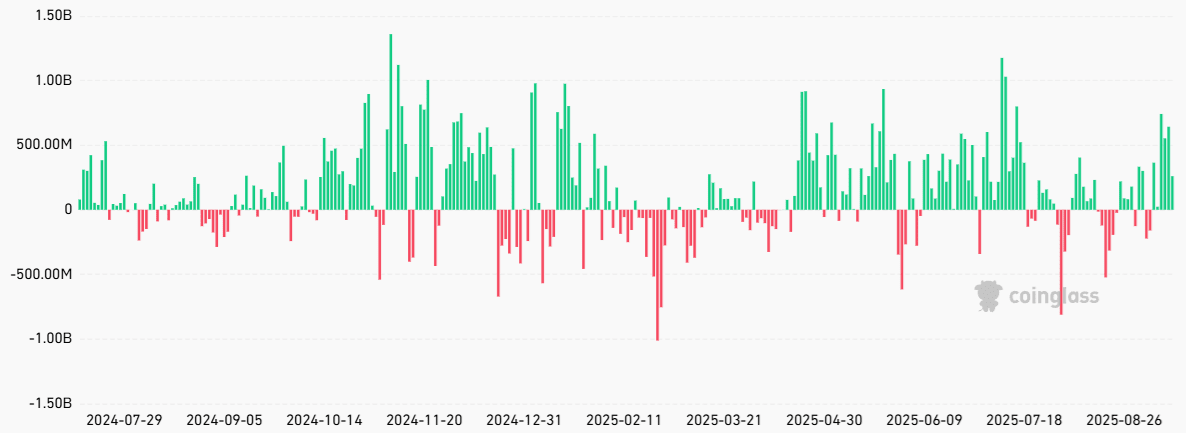
The continuous buying power of spot Bitcoin ETFs at the $115,000 level provides additional support. From last Wednesday to this Monday, Bitcoin ETFs listed in the U.S. recorded a net inflow of $2.2 billion, with average daily buying pressure exceeding 10 times the daily new mining output. This trend has helped restore investor confidence, as gold has risen 11% since August, outperforming Bitcoin.
Trump's son supports Bitcoin
Eric Trump, the son of former President Donald Trump, referred to Bitcoin as "the greatest asset of our time" in an interview with CNBC on Tuesday, likening it to modern gold, an effective hedge against the weak real estate market. He is also a co-founder of American Bitcoin (ABTC), a Bitcoin mining and financial management company.
Bitcoin may have limited reaction to the Fed's interest rate cuts
The bond market expects the Fed to lower rates from 4.5% to 4.25% this week, with a probability as high as 96%. This means Bitcoin may only have a mild reaction to Wednesday's announcement. Chairman Powell's remarks during the press conference will be more decisive—if inflation remains a significant risk, Bitcoin's push to $120,000 may face obstacles.
New signs of tension are emerging in the funding market
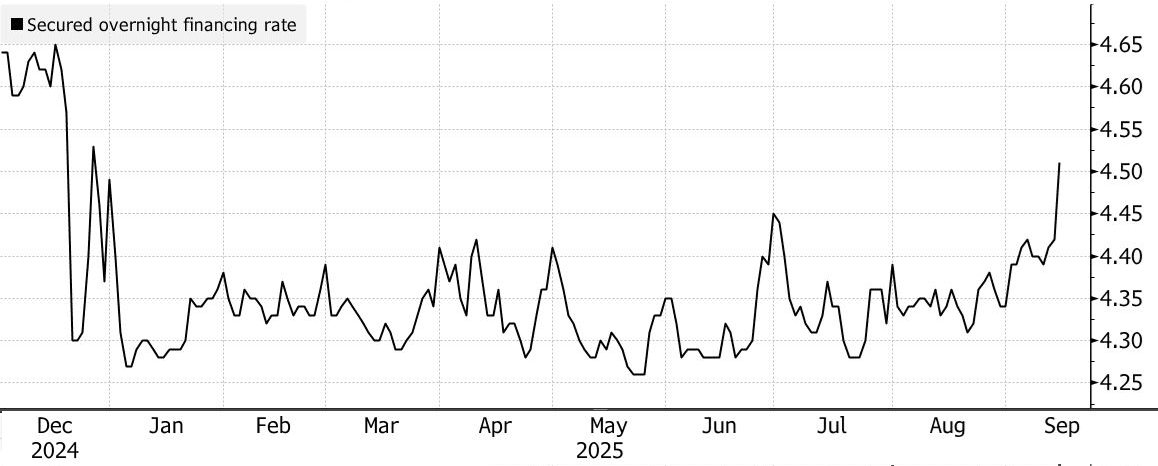
A new financial signal this week indicates increasing market pressure. On Monday, Bank of America borrowed $1.5 billion from the Fed's Standing Repo Facility (SRF), reflecting "tightness in meeting financing needs," according to Reuters. Overnight borrowing rates rose to 4.42% on Friday, the highest level in two months.
This uncertainty has driven up gold prices, reaching an all-time high on Tuesday. Regardless of the specific rate cut magnitude by the Fed, Bitcoin could break through $120,000, driven by spot ETFs, corporate reserve strategies, and its role as an independent hedge asset. This advantage has also been further reinforced by Eric Trump's statement.