

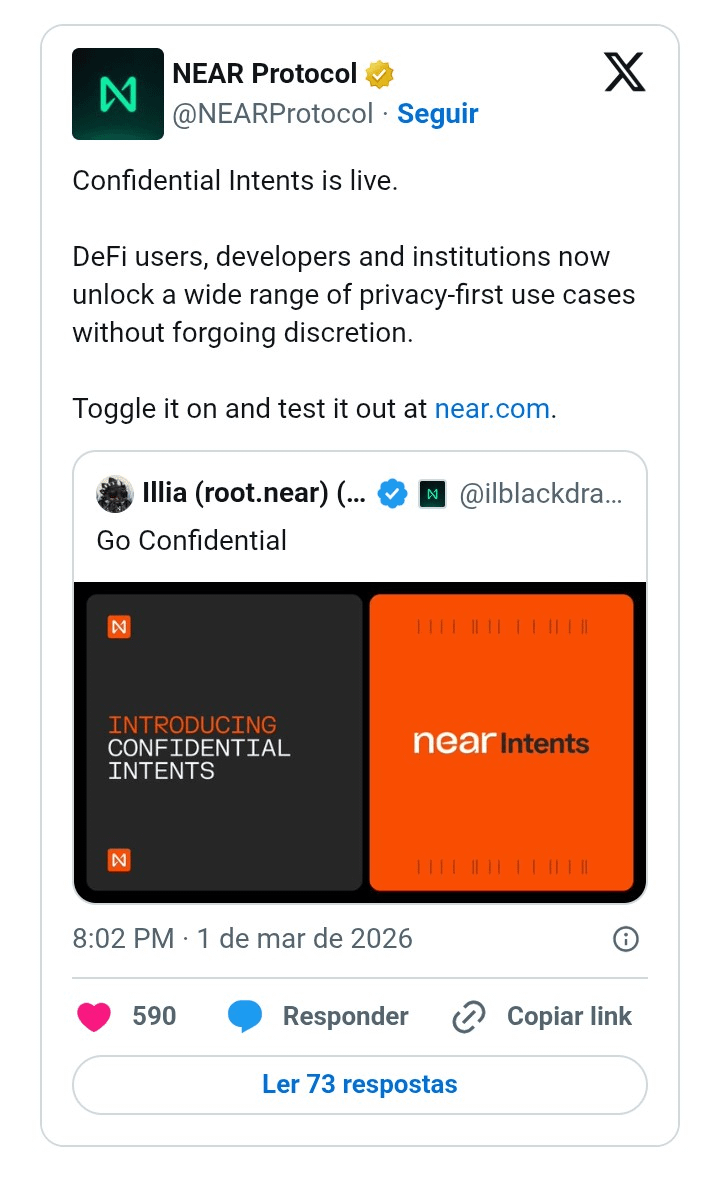
The token $NEAR surged by up to 17% after they launched the so-called 'Confidential Intents', a layer of privacy to protect trading orders from being exposed on the blockchain.
But hey, even with this surge, the little guy lost some strength and around 10 AM it was worth about $1.34, still up 10.5% in the last 24 hours. In the weekly balance, NEAR is already up 38.5%, outpacing the privacy token crowd.
This new feature was showcased last week at NEARCON, over in San Francisco, and officially went live on Tuesday (3). According to the folks from the technical team, transactions now go through a private 'shard' linked to the main network, allowing the user to use a confidential account when making a transaction.
The main idea behind this thing is to reduce the risk of traps that occur in open blockchains, such as front-running and “sandwich” attacks. In these public networks, the transaction appears before being confirmed, showing the size and direction of the order. Then the bots take advantage and jump ahead, leveraging the traders. This phenomenon is known as MEV (maximal extractable value), which people often refer to as an “invisible fee” in operations.
But unlike currencies such as Monero($XMR ) and Zcash($ZEC ), which are born with privacy as a standard, NEAR decided to do things differently: it offers the option to keep certain things more hidden, but only at the time of trading. The proposal is not to show everything in the public mempool, like specific transfers or positions across various chains, but without losing the possibility of auditing when needed for legal or investigative purposes.
The NEAR team says they designed this system to appeal to financial institutions, which typically do not like open blockchains because they do not want to reveal real-time trading strategies. Therefore, by offering selective privacy within a framework that respects compliance, the network aims to be a bridge between the traditional market and on-chain settlement.
Even with the token price reacting strongly, data from DeFiLlama shows that the fees generated by NEAR's base layer are still small compared to the market capitalization, which is around $1.8 billion. This indicates that the movement is more about the expectation of attracting institutional flow in the future than an immediate increase in revenue for the protocol.